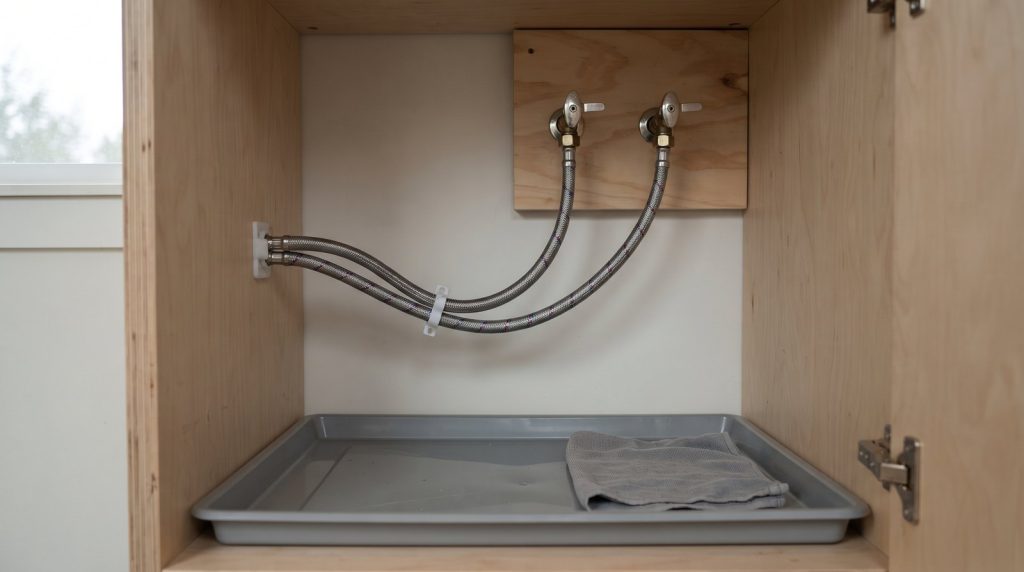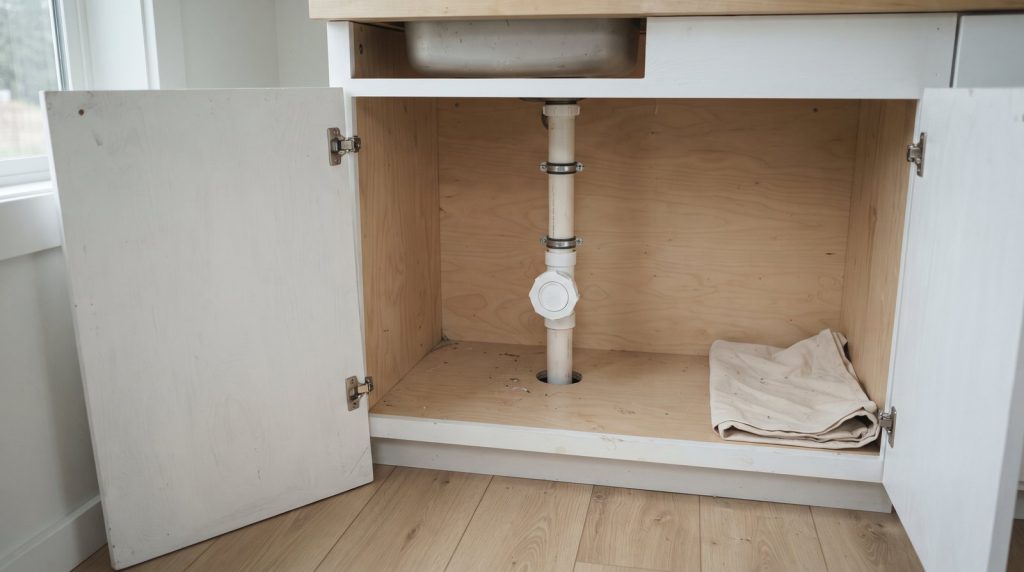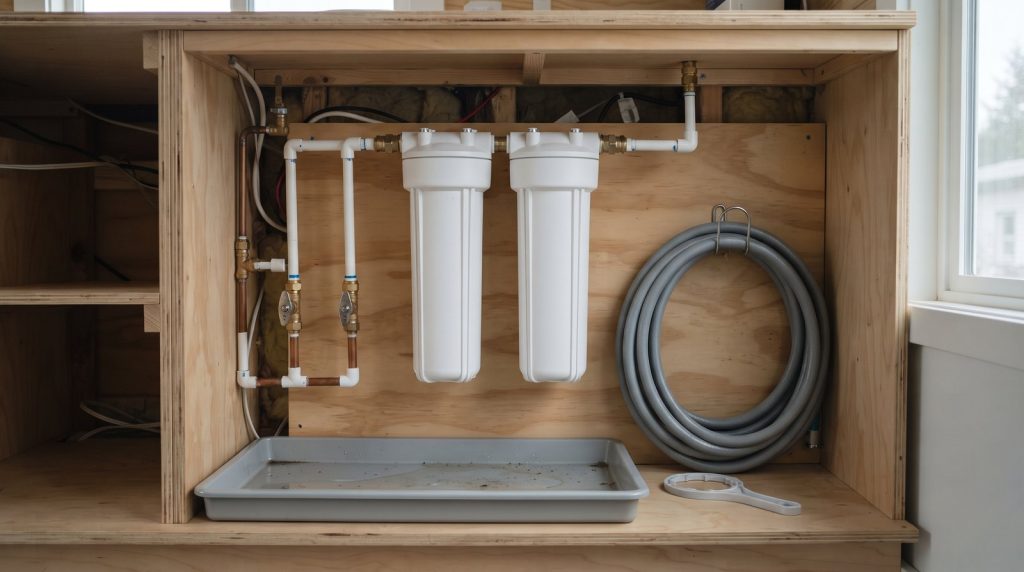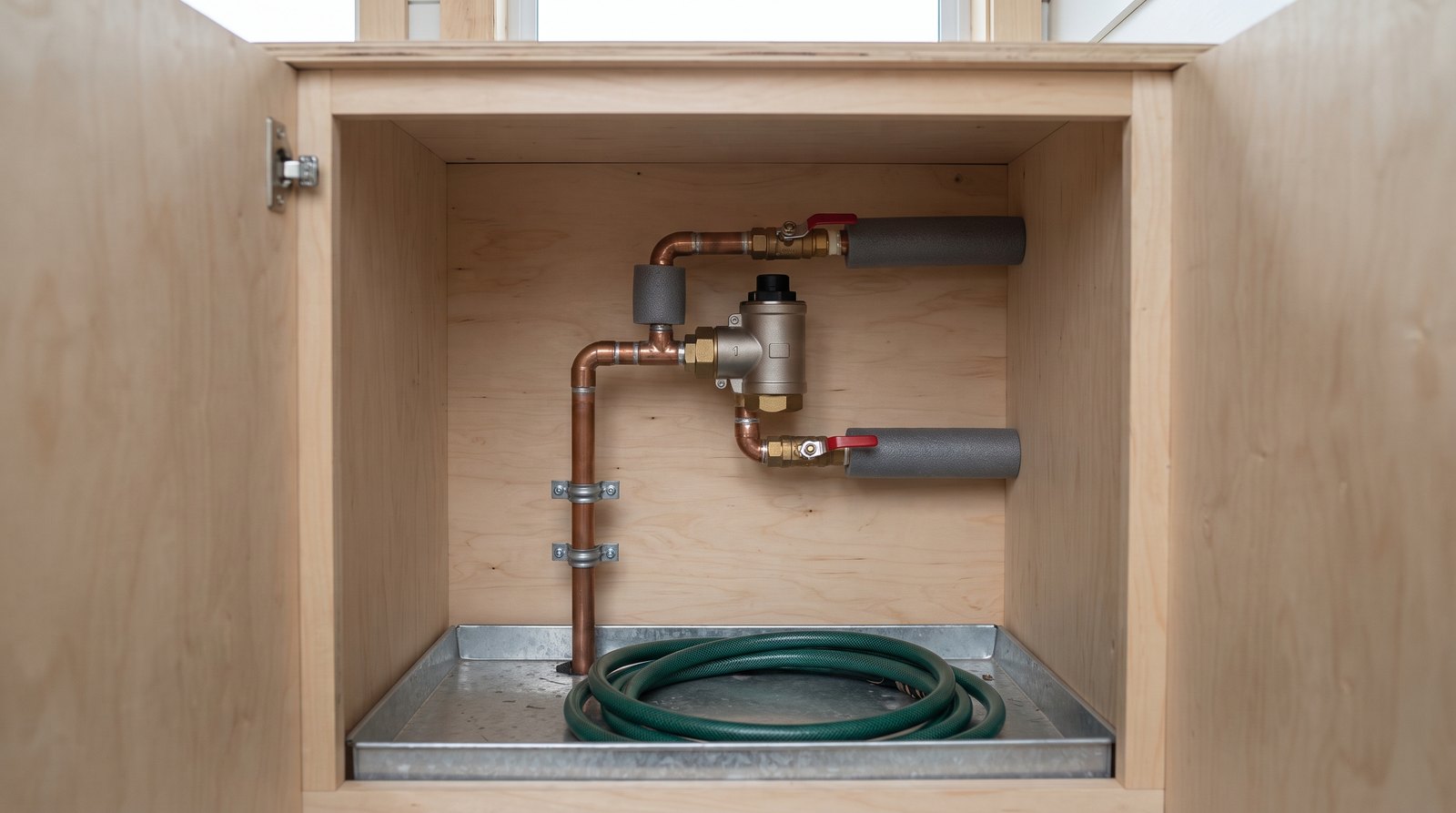
A tiny house needs backflow protection anywhere potable water could contact a hose, tank, drain, chemical, or uncertain water source. Use a true air gap when practical, a listed device matched to the hazard when it is not, and local utility or plumbing requirements as the final authority. A plain check valve is not a universal substitute.
Table of Contents
What Backflow Means in a Tiny House
Backflow is unwanted reverse flow into drinking-water piping. It can happen through backsiphonage when supply pressure falls, or through backpressure when a pump, elevated hose, heated system, or other source pushes harder than the potable supply. Protection must match both the possible contaminant and the direction of pressure.
A cross-connection is the path that makes this reversal possible. Common tiny house examples include a hose end sitting in a tank, a campground hose connected without outlet protection, a winterizing tube immersed in antifreeze, a well and municipal line tied together, or a drain line connected directly to a potable fill.
The small size of the house does not reduce the health risk. A compact system often combines a city inlet, tank, pump, filter, water heater, outdoor faucet, and winterizing valves inside one tight cabinet. That makes clear separation, correct flow arrows, service access, and labeling especially important.
Quick Answer by Situation
The right device depends on the water source and the hazard, not on the house being movable or small. Begin with physical separation where possible. For a mechanical device, use one listed for the exact application, pressure condition, temperature, pipe size, and installation orientation required by its instructions.
- Open tank or potable fill: keep the fill outlet above the receiving opening with the required air gap. Never leave a hose end submerged.
- Campground or municipal hose connection: use the site-required service protection and a listed hose-connection device where required. Disconnect before travel.
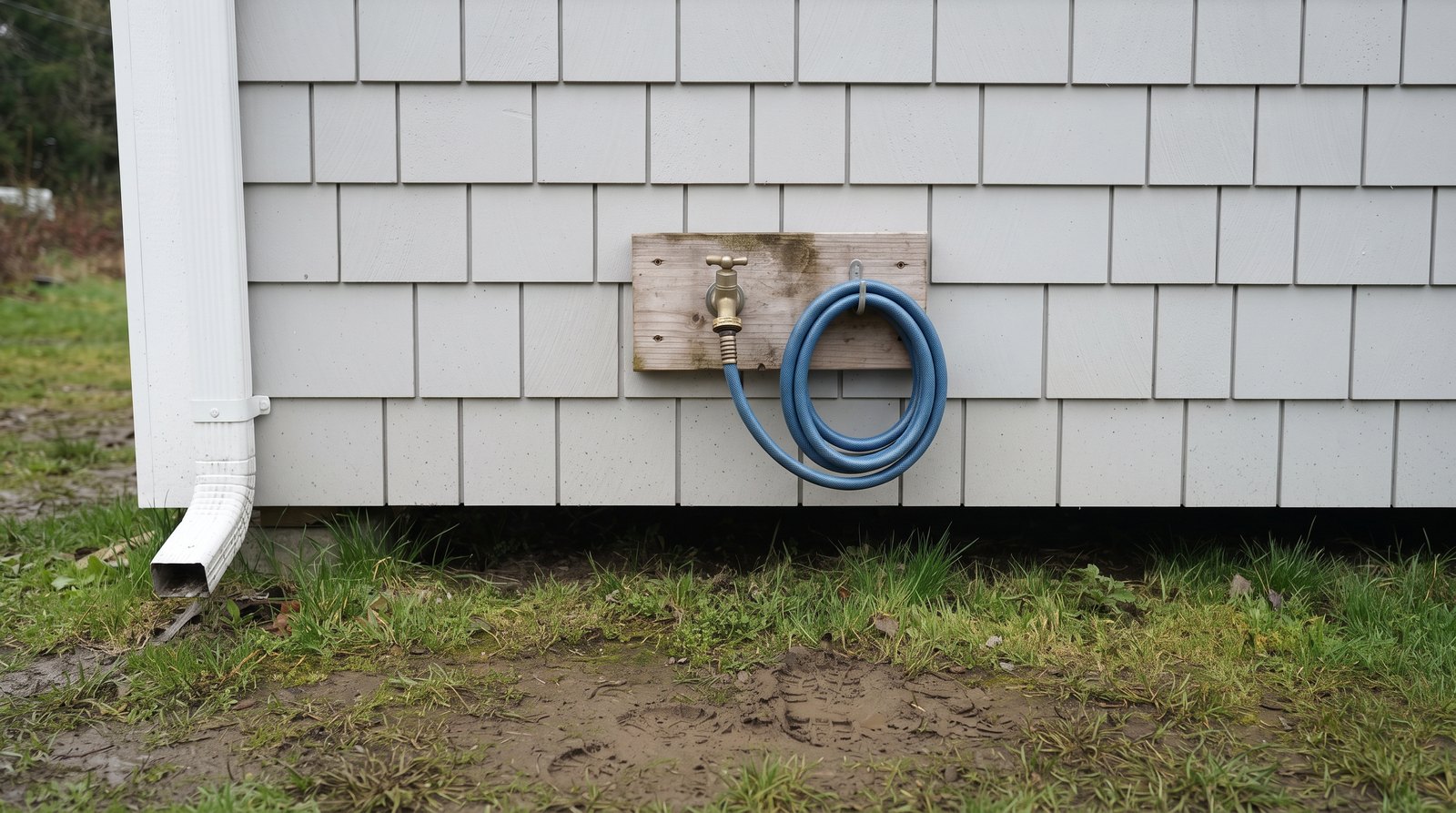
- Outdoor hose bib: use a listed hose-bib vacuum breaker or protected wall hydrant that matches local rules and freezing conditions.
- Private well with no public connection: protect the household system from tanks, treatment equipment, irrigation, chemical feeders, and other cross-connections.
- Well plus public water: do not interconnect the sources unless the water supplier and local authority approve a specific protected design.
- Onboard pump and tank: follow the pump and tank maker’s layout. A pump check valve controls flow, but it may not provide the required health-hazard protection.
- Water heater in a closed system: plan for thermal expansion when a backflow preventer, regulator, or check valve blocks expanded water from returning upstream.
Air Gaps, Vacuum Breakers, and Check Valves
An air gap is usually the simplest and most dependable separation because there is no mechanical seal to stick. Vacuum breakers protect against specific siphoning conditions. Dual checks, double-check assemblies, and reduced-pressure assemblies address different hazards and pressure conditions. These products are not interchangeable merely because their fittings match.
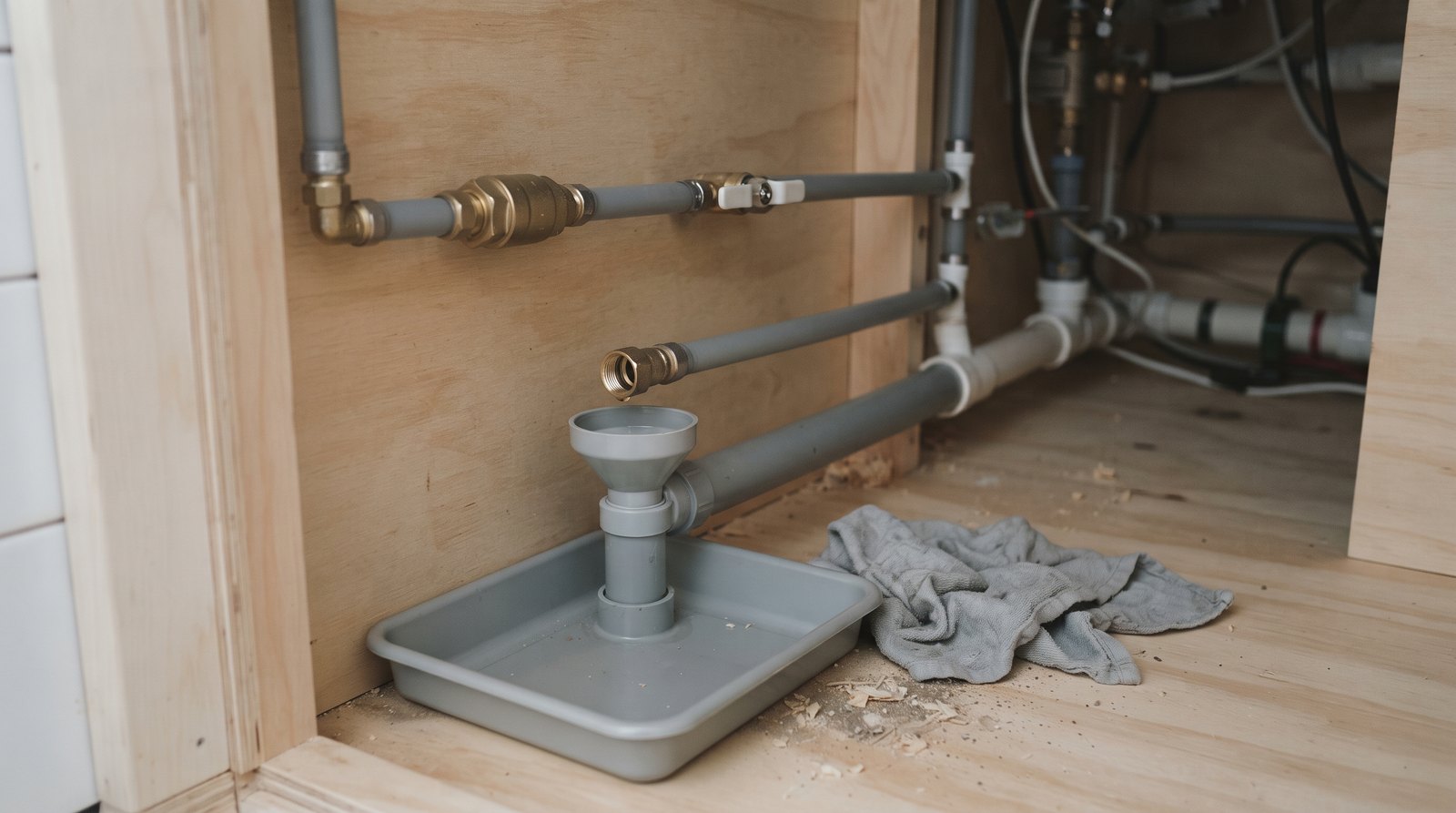
An air gap is the vertical open distance between a potable outlet and the flood-level rim of the receiving fixture or tank. The EPA manual gives a general benchmark of twice the effective outlet diameter and never less than one inch, but the adopted code and local authority determine the required measurement. Splash guards must not bridge the gap.
A hose-connection vacuum breaker mounts at a hose-threaded outlet and helps prevent contaminated hose water from being siphoned back. Current ASSE product scopes distinguish ordinary hose vacuum breakers from field-testable hose backflow preventers. Some devices allow only limited low-head backpressure, while an atmospheric vacuum breaker protects against backsiphonage only and cannot serve every continuously pressurized layout.
A residential dual check or a double-check assembly can be appropriate for low-hazard conditions when approved. A reduced-pressure principle assembly is used for more demanding backpressure or backsiphonage conditions, including some high-hazard applications. It can discharge water during operation, so it needs approved placement, drainage, freeze protection, access, and testing.
A single spring check at a pump or tank keeps ordinary flow moving in one direction and helps the pump hold pressure. It does not automatically protect a public supply from contaminants. Never select a device from its appearance alone. Match its listing and published application to the actual cross-connection.
Municipal and Campground Hookups
A municipal or campground connection should be treated as a complete chain from the source outlet to the tiny house plumbing. Confirm that the water is potable, use the protection required by the supplier, keep the hose clean, and avoid any bypass that could connect the public system to a tank, pump discharge, or chemical source.
Before connecting at a campground, ask whether the supply is approved for drinking. The Centers for Disease Control and Prevention advises RV users to confirm potability with the park manager. Use a hose and fittings intended for potable water, cap clean ends during storage, and keep them away from sewer equipment and ground contamination.
The pedestal may already include a protected hydrant, but that does not prove the tiny house arrangement meets local rules. A hose-bib vacuum breaker at an outlet is inexpensive protection for a hose hazard, not permission to create a direct link between the city service and an onboard tank system. Some utilities require containment protection at the service entrance as well as fixture-level protection.
Install pressure regulators, filters, shutoffs, and backflow devices in the order approved for the system. Follow every flow arrow. Provide unions or other service connections when allowed, support the assembly independently, and leave room to remove strainers, check modules, cartridges, and test caps without dismantling the cabinet.
Wells, Onboard Tanks, Pumps, and Fill Ports
Private wells and onboard tanks need cross-connection control even when no city main is involved. Protect the drinking system from untreated sources, irrigation, winterizing chemicals, drain piping, and stagnant hoses. If public water is also available, keep the sources physically separate unless an approved design specifically permits their connection.
For a gravity fill, terminate the potable outlet above the tank opening with the required air gap. A sealed threaded connection from an uncertain source to the tank can defeat that protection. For a pressure fill, use the tank and inlet manufacturer’s approved parts and ask the authority whether a listed device, an air-gap fill box, or another arrangement is required.
Place the pump check valve where its instructions specify, and secure it against vibration. The strainer, pump, accumulator, relief provisions, and check valve must be compatible. If a winterizing valve draws from a container, do not leave the tube connected or submerged after service. Cap it, isolate it, and follow the system maker’s sanitation and flushing procedure before drinking use resumes.
CDC guidance for recreational water systems recommends filling tanks from a safe source and following the maker’s schedule for draining, disinfecting, and flushing. It notes that many manufacturers call for this at least yearly or after several months of nonuse. That maintenance complements backflow prevention. It does not replace it.
Water Heaters, Closed Systems, and Expansion
Adding a check valve, regulator, or backflow preventer can turn the tiny house plumbing into a closed system. Heated water then has less room to expand upstream, which can raise pressure. Use the water-heater instructions and local requirements to size and place an approved potable-water expansion tank or other accepted control.
Warning signs can include a relief valve that drips only after heating, pressure that climbs during a no-flow period, faucet surges, or repeated connector leaks. Do not plug or cap a temperature and pressure relief valve. Test static and heated pressure with suitable equipment, then have a plumber diagnose the cause.
This issue is easy to miss in a tiny house because the heater, regulator, pump, and backflow device may be added at different times. Review the whole system whenever one-way protection changes. Our guide to tiny house water pressure regulators explains how regulators, pumps, gauges, and expansion control interact.
Freeze Protection and Travel Vibration
Backflow devices need protection from freezing, impact, and road vibration without being hidden from inspection. Drain and winterize only as the manufacturer directs. Insulation alone does not remove trapped water, and heat tape is not appropriate unless both the cable and installation are approved for that exact location and material.
Hose-bib devices and testable assemblies often contain small chambers that hold water. A frozen body can crack or distort internal checks even when the outside looks normal. Some wall hydrants or assemblies are specifically listed as freeze resistant, but they still require correct pitch, drainage, and installation. Remove detachable parts only when their instructions and local rules allow it.
For a THOW, mount valves and piping to solid structure with compatible supports. Leave flexible connections only where they are approved, and do not let a heavy assembly hang from PEX. After a trip, look for rotated fittings, loose supports, rubbed tubing, bent test cocks, seepage, and debris near any relief or vent opening.
Winterizing fluid must never have an unprotected path into a public supply. Shut off and disconnect the external connection before using a suction tube or pump bypass. In spring, restore valve positions deliberately, inspect every device, sanitize and flush the potable system, and verify that flow arrows and service caps are correct.
Travel and seasonal work can affect insurance records and inspection history. Keep photos, device model information, receipts, test reports, and maintenance dates with the house file. For broader documentation questions, see our tiny house insurance cost guide.
Installation, Testing, Maintenance, and Cost
Plan for access, drainage, support, testing, and replacement before buying a device. A low-cost hose vacuum breaker may be a simple outlet upgrade, while a testable service assembly can require permits, a certified tester, freeze protection, and major plumbing work. The installed price depends more on the approved design than house size.
Current retail examples put basic threaded hose-bib vacuum breakers at roughly $6 to $30. Residential dual-check devices can start around $40, while common three-quarter-inch pressure vacuum breaker assemblies often list near $90 to $350. Three-quarter-inch double-check or reduced-pressure assemblies can range from about $225 to more than $1,000 before installation.
Those figures are part-only snapshots, not quotes. Labor rises when the plumber must add shutoffs, unions, supports, a drain receptor, an insulated enclosure, heat protection, a pressure gauge, or pipe changes. Permit, utility review, and certified test fees may also apply. Get a written scope that identifies the exact listed model and who performs the initial test.
Testable assemblies commonly require periodic field testing under local programs, often at installation, after repair, and on a recurring schedule set by the water supplier. A small non-testable device still needs inspection and replacement when it leaks continuously, sticks, corrodes, freezes, or fails its maker’s service checks.
The Bottom Line
Good tiny house backflow prevention starts by removing cross-connections, then uses listed protection matched to the remaining hazard. Preserve air gaps, protect hose outlets, keep public and private sources separate, account for thermal expansion, and make every device serviceable. Local utility rules, adopted plumbing requirements, product listings, and manufacturer instructions decide the final design.
Frequently Asked Questions
These short answers cover the decisions tiny house owners ask about most often. They are a starting point, not a substitute for a site-specific cross-connection review. Water source, hazard level, pressure conditions, device listing, adopted code, utility policy, and manufacturer instructions can change which protection is acceptable.
Does every tiny house need a backflow preventer?
Every tiny house needs protection at actual or potential cross-connections, but that protection may be an air gap rather than one whole-house valve. A municipal supplier may also require a service assembly. Have the water source, hoses, tank fill, pump, outdoor outlets, treatment equipment, and winterizing layout reviewed together.
Is a check valve enough for tiny house backflow prevention?
Not automatically. A pump check valve can maintain one-way flow and system pressure, but it may lack the listing, redundancy, venting, relief function, or test ports required for a particular hazard. Use only the protection approved for the exact application, and never replace an air gap or required assembly with a generic check valve.
Do I need a vacuum breaker on a campground water hose?
A hose-threaded outlet commonly needs listed backsiphonage protection, but requirements differ by campground, utility, and adopted code. The pedestal may have a protected hydrant, and the tiny house may need additional inlet protection. Confirm the site’s drinking-water status, keep the potable hose clean, and never submerge its free end.
Can I connect city water and an onboard tank?
You can design a system that uses either source, but a direct unapproved cross-connection can endanger both the house and public supply. Common safe designs isolate sources with an approved fill method or controlled valving and listed protection. Have the utility or plumbing authority approve the layout before joining any piping.
How often should a backflow device be tested or replaced?
Follow the local water supplier’s schedule and the device instructions. Testable assemblies may need certification at installation, after repair, and periodically. Small outlet devices are often inspected rather than field tested and replaced when damaged or unreliable. Freezing, contamination, pressure events, plumbing changes, and THOW travel justify an extra inspection.