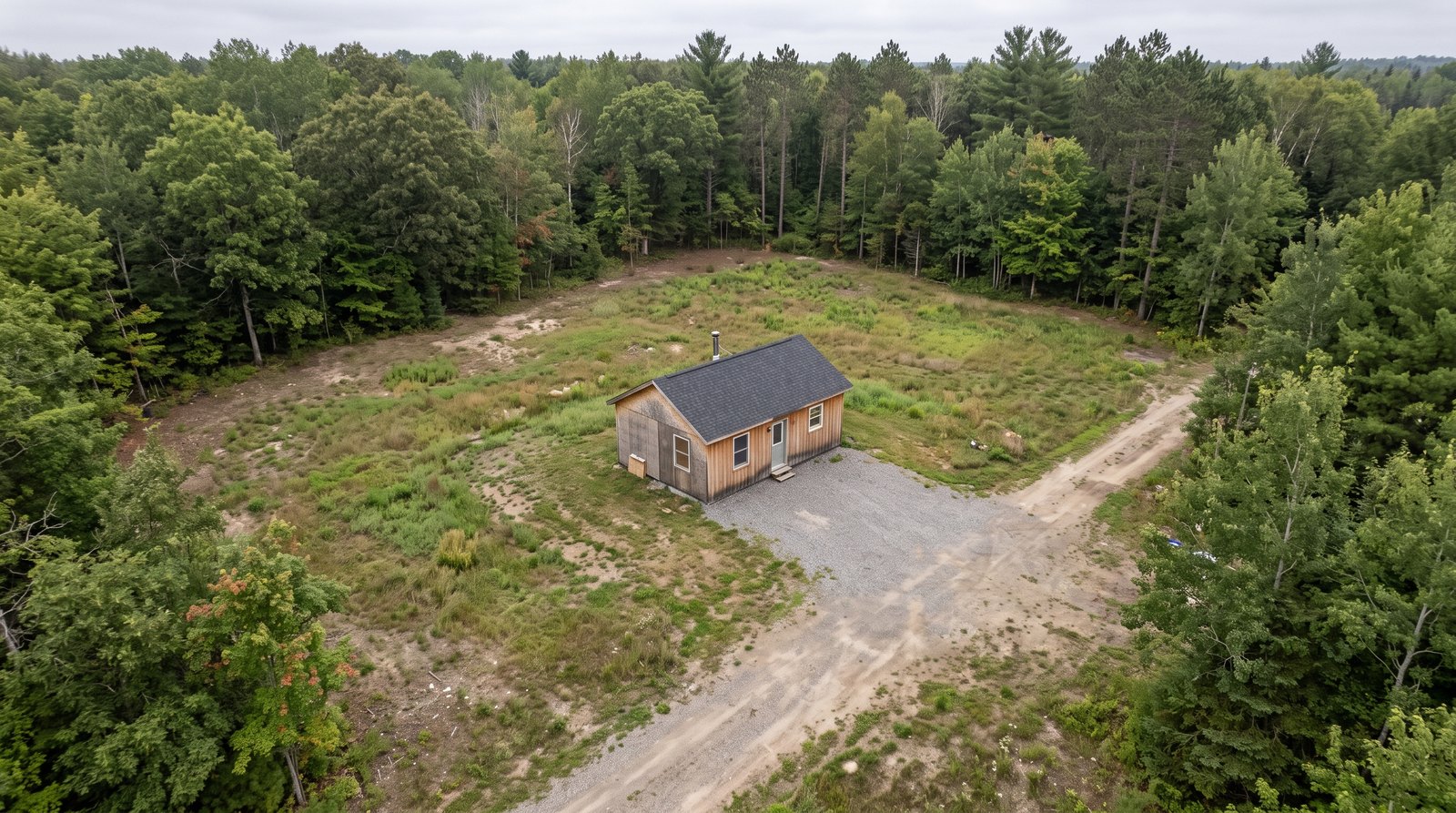
Most tiny houses need somewhere between a quarter acre and one acre. A quarter acre is often enough when the lot already has city water and sewer at the street. One acre becomes the practical floor when the property needs its own well and septic system, because separation distances, not house size, drive the number.
Table of Contents
Why the Size of the House Is Not the Number That Matters
A 300 square foot tiny house occupies less than one percent of a quarter acre lot. The house is never the constraint. What consumes land is everything the house has to sit away from: property lines, wells, drain fields, wetlands, easements and the turning space a truck needs to deliver it.
Think of a parcel as three layers. The first layer is the raw acreage on the deed. The second is the buildable envelope left after setbacks, easements and unusable ground are subtracted. The third is the part of that envelope where soil will actually pass a septic percolation test. Buyers shop for the first number and get stopped by the third.
This is why two one acre parcels on the same road can behave completely differently. One has a dry, sandy south corner that perks on the first try. The other is clay with a seasonal high water table, and the health department wants a mound system that eats twice the footprint. Same acreage, very different outcome.
Minimum Lot Size: What Zoning Actually Requires
There is no national minimum. Lot size rules are written by cities and counties, and they range from no minimum at all for an accessory dwelling unit up to two acres in some rural districts. The number that governs your project sits in the local land development code, not in any state or federal standard.
A few patterns are worth knowing. In states with strong accessory dwelling unit preemption, such as California, local agencies are barred from imposing a minimum lot size on an ADU at all, which means a small infill lot can legally host a second small dwelling. In Washington, by contrast, a foundation built tiny home in an urban residential zone commonly lands on a lot of roughly 5,000 to 10,000 square feet, which is between one eighth and one quarter of an acre.
Rural districts run the other direction. Where a parcel has to carry its own water and waste treatment, counties frequently set minimums of one, one and a half, or two acres. Montgomery County in Texas, for one example, advises lots of at least one and a half acres when a septic system and a private well are both needed. Porter County in Indiana requires at least one acre of usable, buildable ground before it will issue a septic permit.
Tiny houses on wheels add a second question on top of lot size, which is whether the jurisdiction recognizes a movable dwelling as housing at all. Some counties now do. Fresno County updated its code to allow tiny homes on wheels as permanent residences on residential lots under a standard building permit, and Los Angeles, San Luis Obispo, Nevada County and Santa Cruz County have their own movable tiny home pathways. Most places still have no such category, which is a separate problem from acreage and is worth settling before you shop for land. If you are still weighing the wheels question, our comparison of a tiny house versus an RV for full time living covers how the two get classified.
Septic and Wells Set the Real Floor
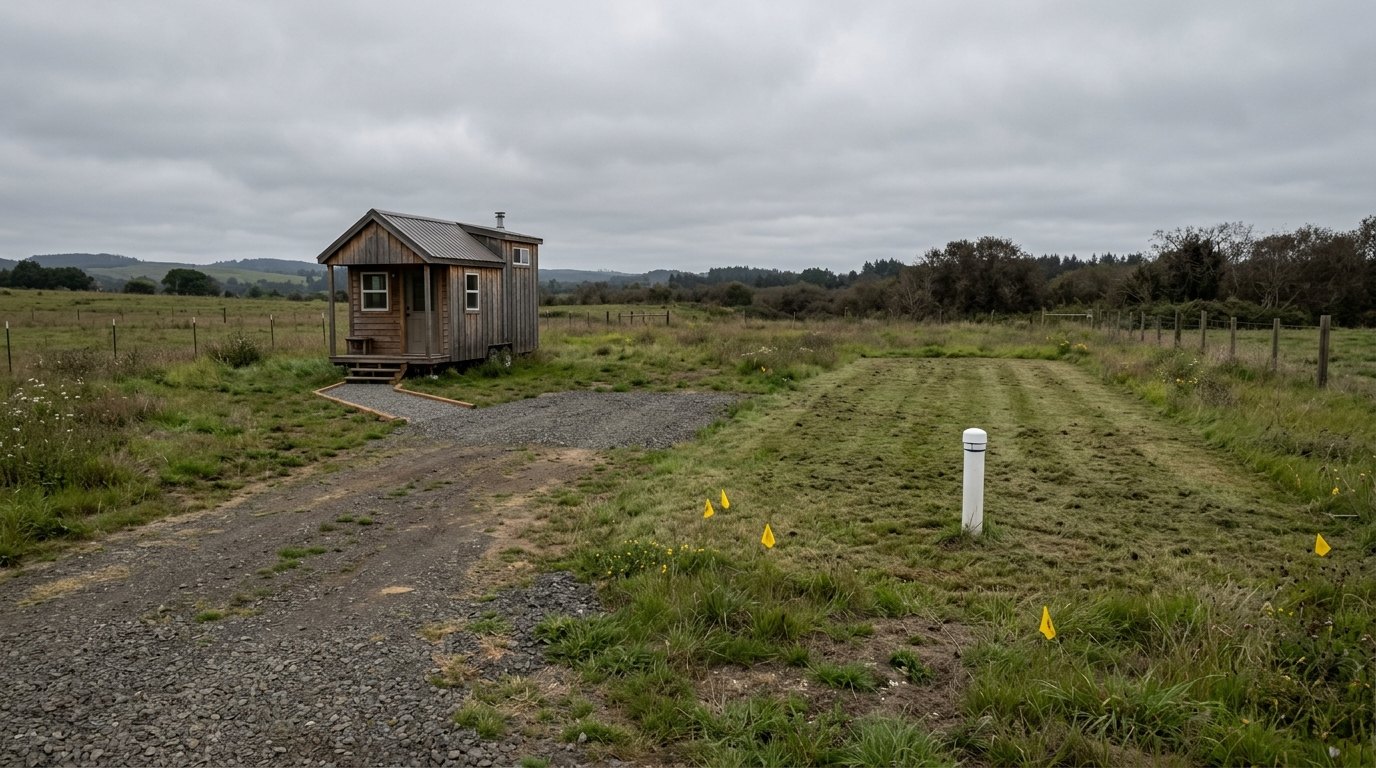
On an unsewered parcel, the septic system and the well decide how much land you need. Both carry mandatory separation distances from each other, from the house, from the property line and from surface water. Stack those circles on a small lot and they overlap, which is the moment a half acre stops working.
The headline number is the distance between a drain field and a drinking water well. One hundred feet is the common requirement, though jurisdictions run anywhere from fifty feet to one hundred fifty feet or more depending on soil permeability and how vulnerable the aquifer is. Texas, for instance, requires one hundred feet between a water well and a drain field or spray area when minimum well construction specifications are met.
Then come the smaller setbacks that quietly add up. Septic tanks and drain fields typically sit five to ten feet off a property line. Wells commonly need ten feet from a property line, fifteen feet from a road or dedicated right of way, and thirty feet from any structure. A reserve area for a future replacement drain field is also required in many counties, which means you must leave a second patch of good soil untouched.
Run that math on a rectangular half acre and the usable middle can disappear. Run it on a full acre with reasonable soil and it usually works with room left over. This is the clearest single reason the practical answer to the land question roughly doubles the moment a parcel loses access to a sewer main.
Setbacks Shrink the Buildable Area Before You Start
Setbacks are the minimum distances a structure must sit from each property line. They apply to a tiny house exactly as they apply to a full sized one, and on a small lot they can remove more area than the house itself occupies. Check all four sides before assuming a corner will work.
Front setbacks are usually the largest. In Florida, for a common example, a residential structure often has to sit twenty five feet back from the front property line and seven and a half feet off the sides. Accessory dwelling units are typically treated more gently, with side and rear setbacks around five feet in many codes, which is what makes backyard placement viable at all.
Corner lots get two front setbacks instead of one. Lots on a private road may measure from the easement edge rather than the deed line. Flag lots measure from the wide part, not from the driveway strip. None of this is obvious from a listing photograph, and all of it is answerable in one phone call to the planning counter with a parcel number in hand.
Driveway Width, Turning Radius and Delivery Access
If the house arrives on wheels, the driveway is part of the land requirement. A tiny house on a trailer generally needs about sixteen feet of vertical clearance and a wide, gentle turning radius. A narrow entrance, a sharp corner at the road, low branches or a steep grade will stop a delivery that the lot itself could otherwise accommodate.
Plan the pad as well as the path. A gravel pad built for a house roughly eight and a half by twenty four feet is commonly spread at something like twenty by forty feet, which leaves room for a water cistern, for leveling equipment, for hookups and for walking around the exterior later with a ladder. Six inches of compacted road base at the thinnest point is a typical specification.
Walk the route before you commit. Trimming branches, moving a fence panel, widening an entrance or arranging a different approach are all cheap in advance and expensive on delivery day with a driver waiting. Our breakdown of what it costs to move a tiny house shows how quickly access problems turn into transport charges.
Easements, Wetlands and the Parts You Cannot Use
Acreage on a deed includes ground you are not allowed to build on. Utility easements, drainage easements, shared driveway easements, wetland buffers, floodplain, steep slope overlays and right of way dedications all subtract from the buildable envelope while still counting toward the total you paid for.
A power line easement thirty feet wide across the middle of a one acre lot can split it into two unusable halves. A wetland buffer of fifty or one hundred feet from a seasonal creek can push the building envelope into the one corner where the soil will not perk. Neither shows up on a tax card. Both show up on a survey and on the county mapping portal.
Ask for the recorded plat and read the exceptions listed on the title commitment. If the parcel has never been surveyed, budget for one. A survey is the cheapest way to learn that the acreage you are buying and the acreage you can use are two different numbers.
Quick Answer by Situation
- Backyard ADU on city water and sewer: no additional land needed. The question is whether your jurisdiction allows the unit and whether the setbacks leave a legal spot.
- Infill lot with sewer at the street: a quarter acre is comfortable, and an eighth of an acre often works where the code permits it.
- Rural lot with septic but public or shared water: a half acre to one acre, driven by drain field size and the required reserve area.
- Rural lot with both a private well and septic: one acre is the practical floor, and one and a half to two acres is safer in clay soils.
- Tiny house on wheels in an RV park or tiny house community: no land purchase at all, typically a rented pad of roughly thirty by fifty feet.
- Off grid with solar, a cistern and a composting toilet: one to five acres, driven less by regulation and more by solar exposure and privacy.
How Much Land Feels Right Versus How Much You Need
The regulatory minimum and the comfortable amount are different numbers. Most people who move onto a small parcel report that the house feels fine and the outdoor space feels tight. A tiny house pushes daily life outward onto a deck, a shed, a workshop or a garden, and that spillover needs somewhere to go.
A useful rule is to add whatever your outdoor program requires on top of the regulatory floor. A shed and a small deck need very little. A workshop, a garden, a woodpile, parking for two vehicles and a guest space add up to roughly a quarter acre of open ground on their own. Privacy adds more, because a screen of trees costs land that a fence does not.
There is also a maintenance ceiling worth respecting. Five acres of field is five acres to mow, brush hog or otherwise keep from swallowing the driveway. Plenty of tiny house owners downsize the house and then quietly regret upsizing the land.
What to Check Before You Buy the Land
Verify five things before money changes hands, and verify them with the agencies that enforce them rather than with the seller. Zoning district and permitted dwelling types, minimum lot size, setbacks, septic feasibility and legal access are the five that kill deals, and every one of them is answerable in advance.
Call the planning department with the parcel identification number and ask plainly whether the dwelling you intend to place is allowed in that district. Call the health department and ask what a septic permit requires, whether a percolation test has ever been run on the parcel and whether a reserve area is mandated. Pull the plat. Confirm that access is a recorded easement or public frontage, not a handshake with a neighbor.
Make the purchase contingent on those answers where the seller will allow it. Financing land is its own exercise, and lenders treat raw parcels differently from improved ones, which our guide to tiny house mortgages and financing options walks through. Local rules change, so confirm every figure above with your own city or county before you rely on it.
Frequently Asked Questions
Can you put a tiny house on a quarter acre?
Yes, in most cases, provided the lot has public water and sewer and the local code allows the dwelling type. A quarter acre leaves ample room after typical setbacks. The answer changes if the parcel needs its own septic system, because drain field and reserve area requirements usually push the practical floor higher.
How much land do you need for a tiny house with a septic system?
Plan on one acre when the parcel also needs a private well, and a half acre to one acre when water comes from a public or shared source. The drain field, the mandated reserve area and the one hundred foot well separation are what set that number, not the size of the house.
Do you need a full acre for a tiny house on wheels?
Not necessarily. On a serviced lot the acreage question is minor, and the real obstacle is whether the jurisdiction recognizes a movable dwelling as housing. Some counties now permit tiny homes on wheels as permanent residences on ordinary residential lots. Most still do not, so confirm the classification before the acreage.
Can you put a tiny house on land you already own?
Only if the zoning district permits that dwelling type and the parcel can meet setback, access and wastewater requirements. Owning the land settles none of those questions. Start with the planning department and the health department, using your parcel identification number, before you order a house or spread a pad.
How close to the property line can a tiny house sit?
It depends entirely on the local code. Accessory dwelling units commonly sit about five feet from side and rear lines, while primary structures in rural districts are often held to twenty feet or more, and front setbacks of twenty five feet are common. Corner lots usually face two front setbacks instead of one.