For most grid-connected tiny houses, the best water heater is a 20 to 30 gallon electric tank with a moderate recovery rate. It is simple, predictable, and much easier on a small electrical service than whole-house electric tankless. Propane tankless is the stronger choice when space is extremely tight or electricity is limited.
Table of Contents
What is the best water heater for a tiny house?
A compact electric storage tank is the best all-around choice for most stationary tiny houses. It can serve a low-flow shower and sink without demanding an enormous electrical circuit, and nearly any plumber can service it. The trade-off is cabinet or floor space plus a limited supply of stored hot water.
That recommendation assumes the house has dependable shore power, one bathroom, one or two occupants, and normal short showers. A 20 gallon tank is often workable for one careful user. A 30 gallon unit gives two people more breathing room, especially in winter, when colder inlet water increases the work required to reach the same outlet temperature.
Do not choose by square footage alone. The heater does not care whether the house is 240 or 400 square feet. It must handle the number of fixtures used together, their flow rates, the cold-water inlet temperature, available fuel, electrical capacity, and the space needed for safe installation and future service.
Quick answer by situation
The right technology becomes clearer once you identify the house’s hardest constraint. Start with the existing utility service and winter inlet temperature, then consider space. A wall-mounted unit may save a cabinet, but that is not a bargain if it forces a panel upgrade, larger gas line, complicated vent, or freeze-prone exterior installation.
- Typical grid-connected tiny house: Choose a 20 to 30 gallon electric tank.
- 30 amp tiny house on wheels: Favor a modest 120 volt or carefully load-managed storage tank.
- 50 amp service with limited interior space: Consider electric tankless only after an electrician completes a load calculation.
- Off-grid or power-limited home with propane already installed: Consider a properly vented propane tankless heater.
- Permanent home with a garage or large utility room: A heat pump water heater can cut electricity use, but it rarely fits comfortably inside the tiny house itself.
- Seasonal cabin in freezing weather: Choose equipment that can be drained easily and protect every exposed pipe.
Size the heater from flow and temperature rise
Tankless heaters are sized by peak gallons per minute and required temperature rise, while tanks are sized by usable stored volume and recovery. In both cases, winter matters. Raising 40 degree inlet water to a 105 degree shower requires much more output than heating 65 degree inlet water to the same temperature.
List the fixtures that could operate together. A water-saving showerhead may use about 1.5 to 2 gallons per minute, while a lavatory faucet may add roughly 0.5 to 1 gallon per minute. Confirm the actual fixture ratings rather than relying on averages. If simultaneous use is avoidable, design for one major draw at a time.
The U.S. Department of Energy’s tankless sizing guidance says to use both maximum demand and maximum temperature rise. That rule exposes a common mistake: a compact electric tankless unit that performs acceptably at a sink may deliver disappointing shower flow during a cold winter.
For a storage heater, check the first-hour rating when available, not only nominal gallons. Recovery depends on element wattage and incoming water temperature. A small tank can support a comfortable short shower when paired with a low-flow fixture, but consecutive long showers may require a recovery break.
Compact electric tanks are simple and dependable
A compact electric tank wins on installation simplicity, moderate peak demand, quiet operation, and easy service. Models in the 20 to 30 gallon range take more room than tankless equipment, but their heating elements usually impose a far smaller instantaneous load. Stored hot water also smooths demand when a shower and faucet briefly overlap.
Standby loss is the main efficiency drawback. The tank leaks some heat into its surroundings even when nobody uses water. In an interior utility cabinet during winter, part of that heat remains in the house. In summer, it adds an unwanted cooling load. Good factory insulation and short, insulated hot-water runs reduce the penalty.
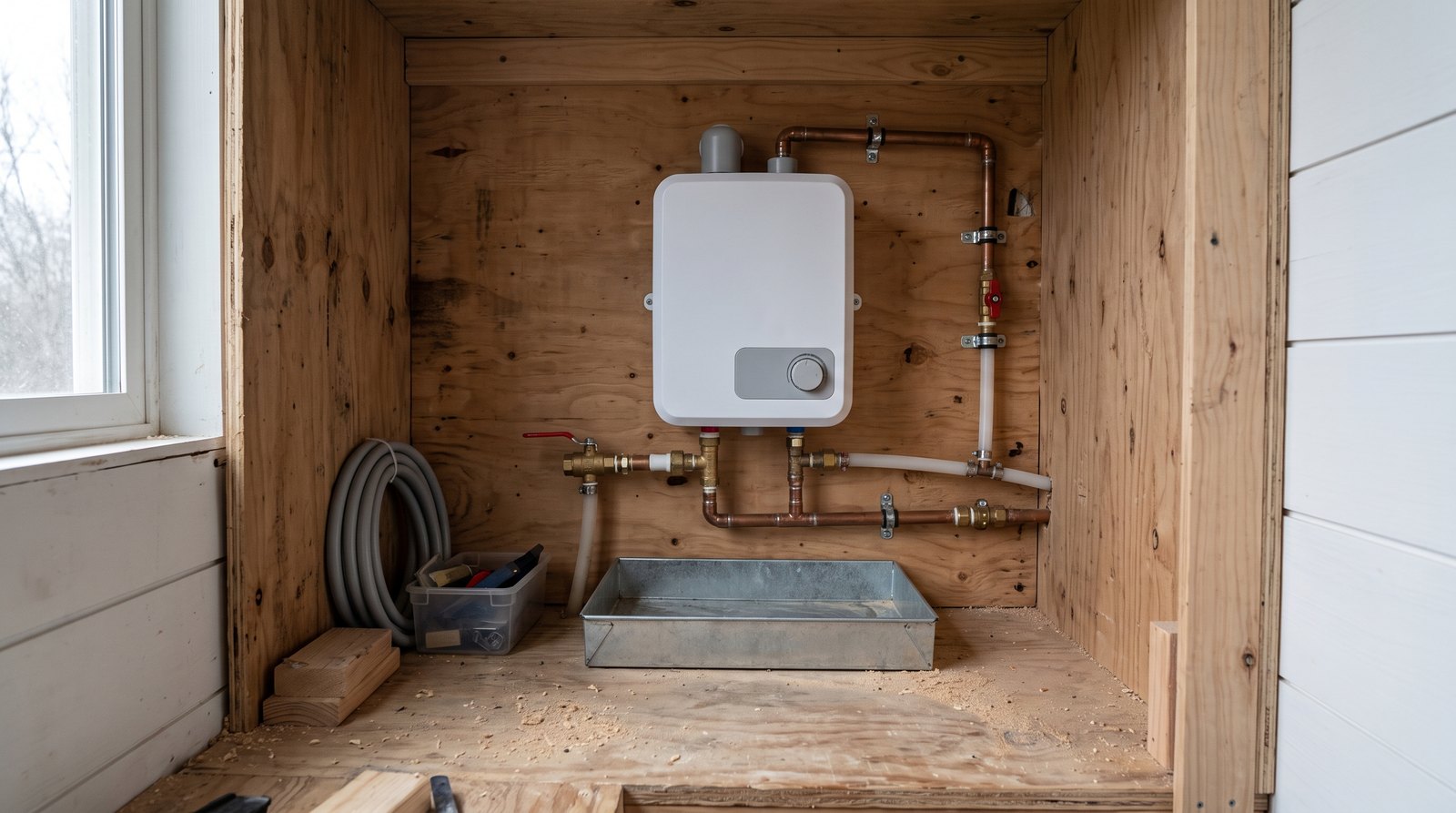
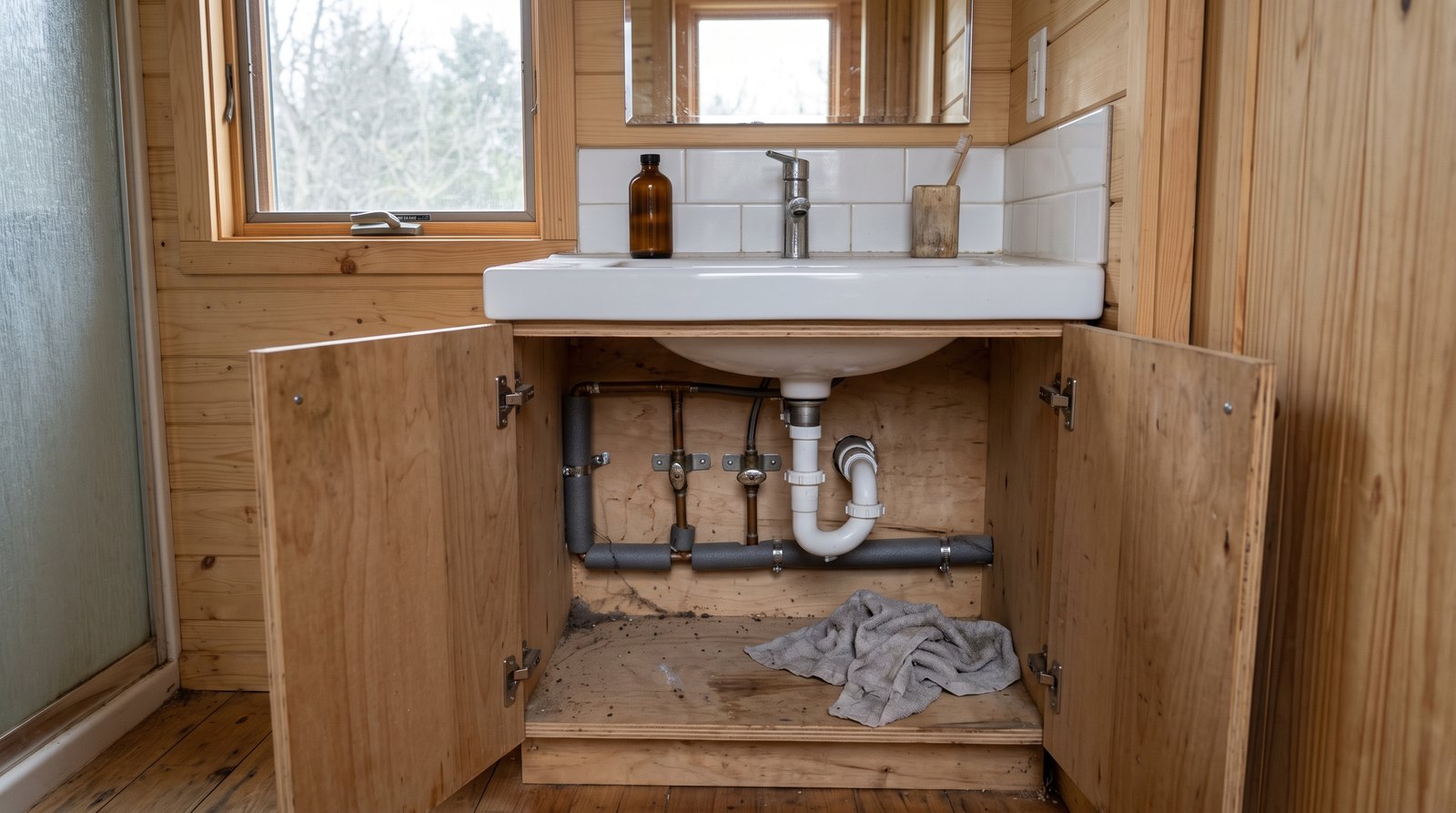
Plan for a drain pan where leakage could damage the structure, a pressure relief discharge route, accessible shutoffs, and enough clearance to replace an element or the entire tank. Never bury the heater behind built-in furniture. A cheap installation becomes expensive if the kitchen must be dismantled for service.
Electric tankless can overwhelm a small service
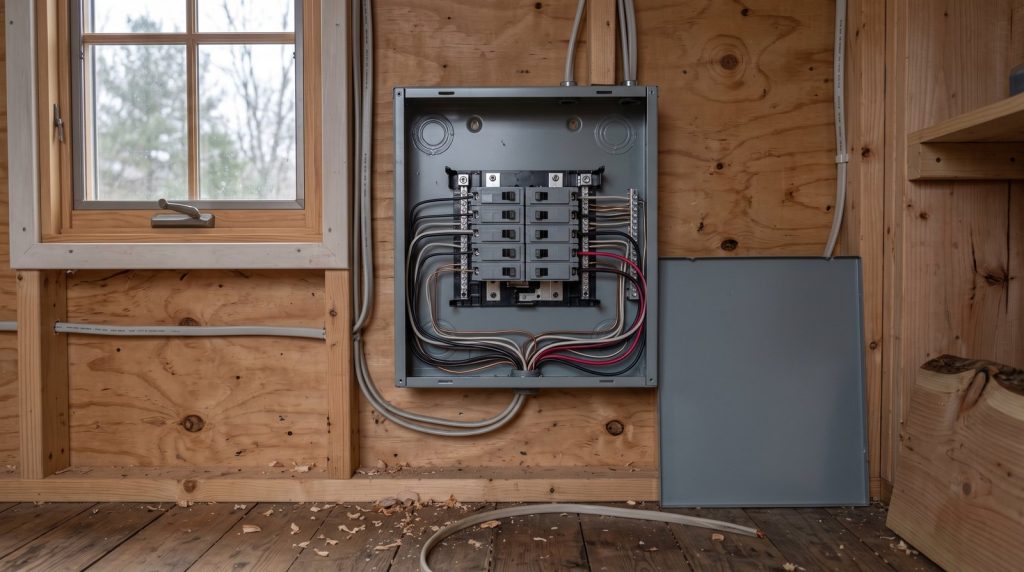
Whole-house electric tankless looks ideal because it is small and has no storage loss, but its electrical demand is often the deal breaker. A genuine shower-capable unit may need several large 240 volt circuits. That can conflict with induction cooking, a mini split, and other loads even on a 50 amp tiny-house connection.
For scale, one current whole-house model rated at 19.2 kW draws 80 amps at 240 volts and uses two 40 amp double-pole breakers. Larger units demand still more. That example does not mean every tankless heater needs 80 amps, but it shows why a small wall box is not automatically a small electrical load.
A low-power point-of-use unit can work well for a hand sink. It generally cannot heat enough cold water for a satisfying winter shower. Check the manufacturer’s temperature-rise chart at your required flow, the minimum flow needed to activate the heater, wire size, breaker count, and total calculated load before buying.
If electrical upgrades are required, compare the complete project cost against a storage tank. Review our guide to tiny-house financing options before rolling a costly panel or utility upgrade into the build budget.
Propane tankless suits power-limited tiny houses
Propane tankless is often the best space-saving option when electrical capacity is scarce. Gas can supply a large heat input without consuming most of a small shore-power connection. The installation is more involved, however, because it needs correct fuel pressure and pipe sizing, combustion air, an approved venting arrangement, and safe clearances.
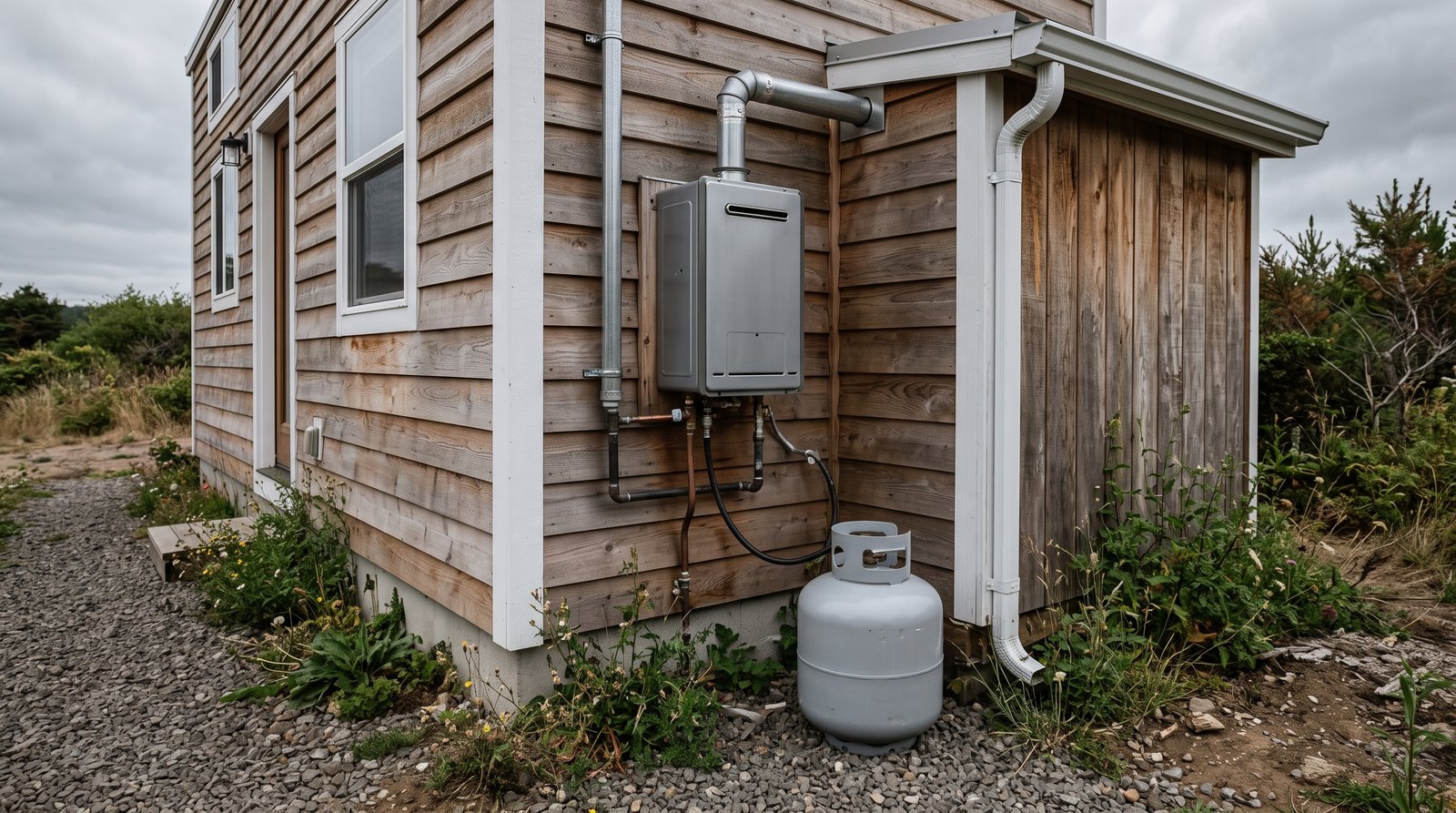
Buy a listed residential unit intended for the proposed location. Portable outdoor camping heaters are not substitutes for a permanently installed indoor appliance. An indoor unit must use the vent system and termination allowed by its manufacturer. An outdoor model avoids an indoor flue but remains exposed to weather and freezing.
Built-in freeze protection usually depends on continuous electrical power and does not automatically protect the external pipes. Rinnai advises maintaining power and keeping vent and condensate paths clear, while its manuals call for draining equipment during certain freezing power outages. Follow the exact manual for your unit, not a generic internet checklist.
Heat pump water heaters need more room than expected
A heat pump water heater can be the most efficient electric option, but an all-in-one model is usually a poor fit inside a tiny home’s living envelope. It needs a relatively large tank, adequate surrounding air, condensate drainage, service clearance, and tolerance for fan noise and cool exhaust air.
ENERGY STAR installation guidance says manufacturers commonly call for 450 or 700 cubic feet of available air, depending on the model, with some consumer guidance using still larger volumes. That requirement can exceed an entire tiny utility closet. Ducting may help on approved models, but it adds penetrations, space, and design work.
Heat pump units also produce condensate that must reach a drain or pump, and their fans commonly create sound comparable to a dishwasher. They can cool the room around them. Those traits are manageable in a garage, mechanical shed, or generous utility room, but intrusive beside a tiny-house bed or work area.
Installation details matter more in a house on wheels
A tiny house on wheels adds vibration, weight, flexible utility connections, and periods without heat or power. Secure the heater and piping for travel, keep heavy components near the planned axle load zone, and use connection methods approved for the appliance and local code. Drain water before moving whenever the design requires it.
Outdoor tankless installations need special attention to exposed water lines. Insulate them, protect them from wind, and provide a practical drain-down procedure. If the heater relies on electric freeze protection, understand what happens during storage or an outage. A small low point that traps water can split even when the main unit drains.
Combustion appliances require professional fuel and vent design. Electric units require an electrical load calculation, proper overcurrent protection, grounding, and wiring sized for the nameplate. Plumbing rules, permits, and inspection requirements vary by city and county, so confirm them before ordering equipment or cutting wall openings.
What should you budget in 2026?
For planning, a straightforward compact electric tank installation often lands near $800 to $1,800, while tankless projects commonly reach roughly $1,200 to $3,500. Difficult electrical, gas, vent, or permit work can push costs higher. Heat pump installations often fall around $2,500 to $4,500 before local incentives.
These are broad U.S. planning ranges, not quotes. A $400 retail tank can become a four-figure project once the estimate includes a pan, drain, expansion control where required, shutoffs, new wiring, disposal, labor, and permits. Tankless costs climb quickly when service conductors, a panel, gas piping, or venting must change.
Maintenance and operating habits affect the result
No heater stays efficient without basic care. Inspect for leaks, test or service safety components as directed, keep vents clear, and flush scale where the manufacturer calls for it. Heat pump models add an air filter and condensate line. Tank units need periodic inspection of the anode rod when their design permits replacement.
Keep the set temperature conservative to reduce scalding and standby loss, while following health and manufacturer guidance. A mixing valve may be appropriate in some systems, but it must be selected and installed correctly. Insulate accessible hot-water lines and place the heater near the main fixtures to reduce wait time and wasted water.
Durability depends on water chemistry, workmanship, freeze events, and maintenance as much as heater type. See how long tiny houses last for a broader look at the systems and building details that determine service life.
The bottom line
Choose a compact electric tank when you want the least complicated dependable solution. Choose propane tankless when electrical capacity or interior space is the dominant constraint and professional fuel, vent, and freeze-safe installation is practical. Treat whole-house electric tankless and heat pump systems as specialized choices that need careful site and utility checks.
Before buying, record winter inlet temperature, desired shower flow, simultaneous fixtures, electrical service, propane availability, installation volume, and freeze exposure. Give those facts to the plumber and electrician. The best water heater for a tiny house is the one the entire utility system can support on its hardest day.
Frequently asked questions
These answers cover the practical questions that most tiny-house owners face before selecting a heater. Final sizing still belongs to the equipment manufacturer’s published chart and qualified local trades, because climate, water temperature, elevation, fuel supply, wiring, and code requirements can materially change what will work.
Is a 20 gallon water heater enough for a tiny house?
A 20 gallon electric tank can be enough for one person who uses a low-flow showerhead and avoids back-to-back long showers. Two occupants may prefer 30 gallons or a deliberate recovery break. Check first-hour rating, element wattage, winter inlet temperature, and actual shower flow before deciding.
Can a 30 amp tiny house use an electric tankless heater?
A small point-of-use electric tankless heater may fit within a managed 30 amp system, but a whole-house shower unit usually will not. Its instantaneous draw can consume or exceed the available service. Have an electrician calculate all simultaneous loads, including heating, cooking, and water heating, before purchasing one.
Is propane tankless safe inside a tiny house?
It can be safe when the model is listed for indoor use and installed exactly as required, including combustion air, venting, fuel pressure, clearances, and carbon monoxide alarms. Do not install an outdoor or portable camping heater indoors. Use a qualified gas installer and obtain required local permits and inspections.
Will a tankless water heater freeze?
Yes. Built-in protection has limits, often requires uninterrupted power, and may not protect external piping. Insulate exposed lines, follow the manufacturer’s cold-weather instructions, and create a complete drain-down plan for outages, seasonal storage, or travel. Never assume an outdoor unit is freezeproof because its controls include a heater.
Is a heat pump water heater worth it in a tiny house?
Usually not inside the living space, because the tank, required air volume, fan noise, cool exhaust, and condensate drain are awkward in a very small home. It can be worthwhile for a permanent tiny house with a garage, mechanical shed, or suitable utility room, especially where electricity is expensive.