Most tiny houses need far less heating and cooling capacity than the smallest mini split on the shelf provides. A well insulated 200 to 400 square foot house is usually served by a 6,000 to 9,000 BTU single zone unit, and 9,000 BTU is oversized more often than it is undersized. Installed cost typically runs $2,500 to $4,200.
Table of Contents
What Size Mini Split a Tiny House Actually Needs
Size the unit to the heat loss of the building, not to the square footage. A tiny house built to modern insulation standards has very little envelope to lose heat through, so the load is small even in a cold climate. The practical problem is that the market floor is around 6,000 BTU, and many brands start at 9,000.
Rules of thumb from full size housing do not transfer. The common 20 BTU per square foot figure would suggest 6,000 BTU for a 300 square foot house, which sounds right, but that number was built around leaky construction and eight foot ceilings. A tight tiny house with good windows often lands well under it. A house with a large glass wall, a poorly insulated floor over a trailer, or single pane windows lands well over.
What actually moves the number is insulation quality, window area, air tightness, and your climate zone. If you want a real answer rather than an estimate, ask the installer for a Manual J load calculation on the finished house. On a build this small the calculation is quick, and it is the only way to know whether you are at 4,000 BTU of load or 12,000.
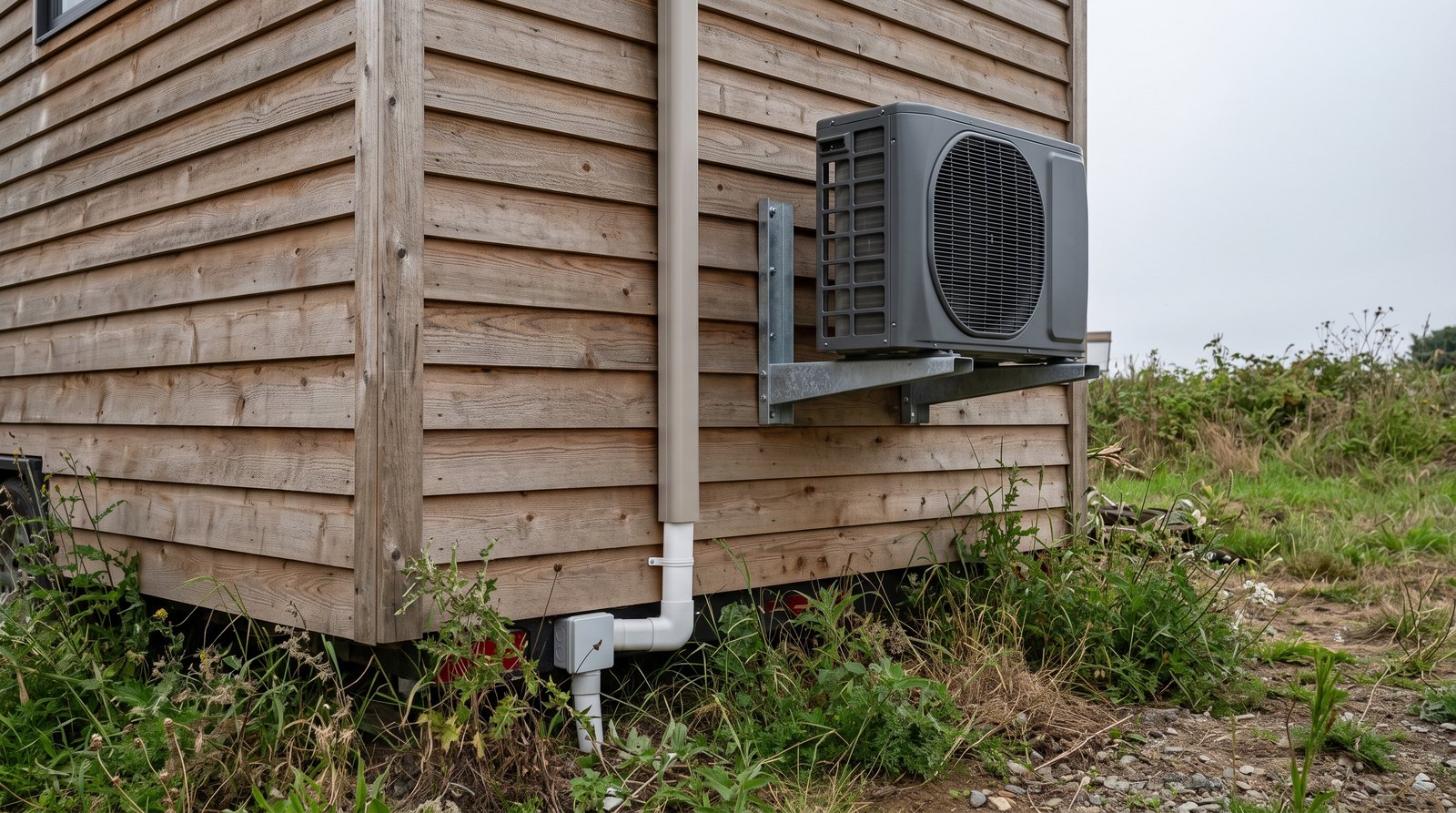
One more constraint applies to a house on wheels. The condenser has to sit on a bracket or a small pad that survives being towed, and it adds weight outside the wall. Plan its location during framing so the bracket lands on structure rather than on sheathing alone.
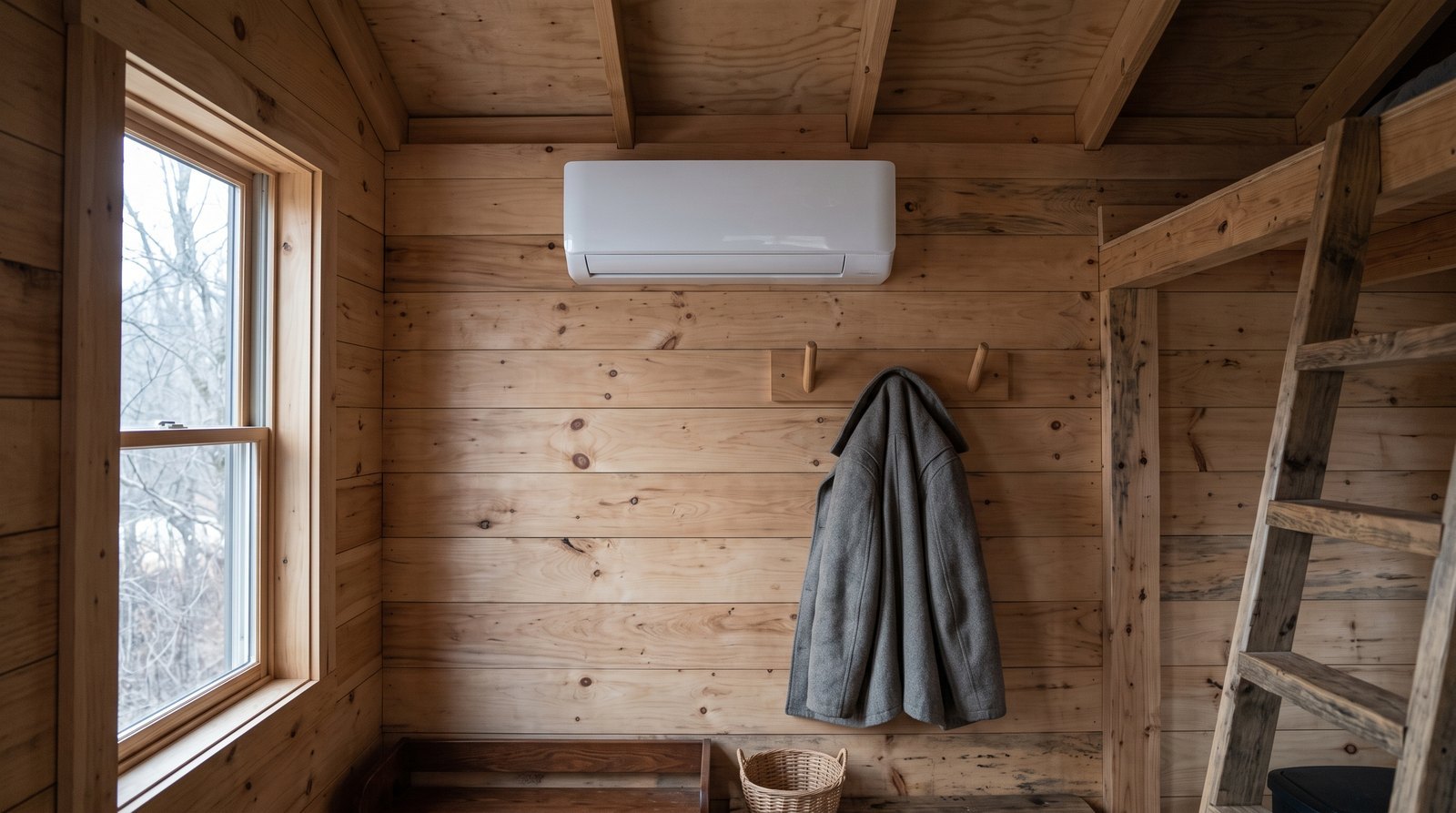
Why an Oversized Unit Short Cycles and Ruins Humidity Control
An oversized mini split reaches the set temperature quickly, shuts down, and repeats. That is short cycling, and it costs you three things at once: efficiency, equipment life, and humidity control. In a tiny house the effect is worse than in a large house because the volume of air is so small that the room hits temperature in minutes.
Humidity is the part people underestimate. A mini split removes moisture only while the coil is running. A unit that runs in short bursts never runs long enough to pull water out of the air, so the house ends up cool and clammy in summer. In a small, tightly built house with a shower and a stove in the same room, that moisture has nowhere else to go, and it shows up as condensation on windows and eventually as mildew in corners.
Two things help. First, choose the smallest capacity that covers your calculated load rather than adding a safety margin on top. Second, choose an inverter unit, which is now standard on most quality models. An inverter compressor modulates its output rather than switching fully on and off, so it can run at low speed for long stretches. That long, slow run is what dries the air.
If your load calculation comes back at 4,000 BTU and the smallest unit available is 6,000, that is acceptable as long as it is a true inverter model with a wide turndown range. Ask what the minimum output is, not just the maximum. A unit that modulates down to 1,600 BTU behaves very differently in a tiny house than one that bottoms out at 5,000.
Cold Climate Models and Their Real Low Temperature Output
Standard heat pumps lose capacity as the outdoor temperature drops, and the number on the box is measured at 47 degrees Fahrenheit. If you plan to heat through a real winter, you need the capacity rating at your design temperature, not the headline figure. This is the single most common sizing mistake in cold climates.
Cold climate models are built for this. To carry the ENERGY STAR cold climate designation, a unit has to deliver at least 70 percent of its 47 degree heating capacity at 5 degrees Fahrenheit, verified by independent testing. Better hyper heat models hold most of their capacity down to minus 13 degrees and continue operating lower still, with some manufacturers rating operation to minus 22 degrees.
The practical rule is simple. Find your winter design temperature, then look up the manufacturer capacity table at that temperature and size from that row. A 9,000 BTU unit that produces 9,000 BTU at 47 degrees may produce far less at 5 degrees, and if that number falls below your heat loss, the house gets cold on exactly the nights you needed it not to.
Plan for a backup as well. Even a good cold climate unit goes into defrost periodically, and a power cut takes it out entirely. A small electric heater covers the first case. If you are living somewhere genuinely cold, read our guide to living in a tiny house in winter before you commit to a single heat source.
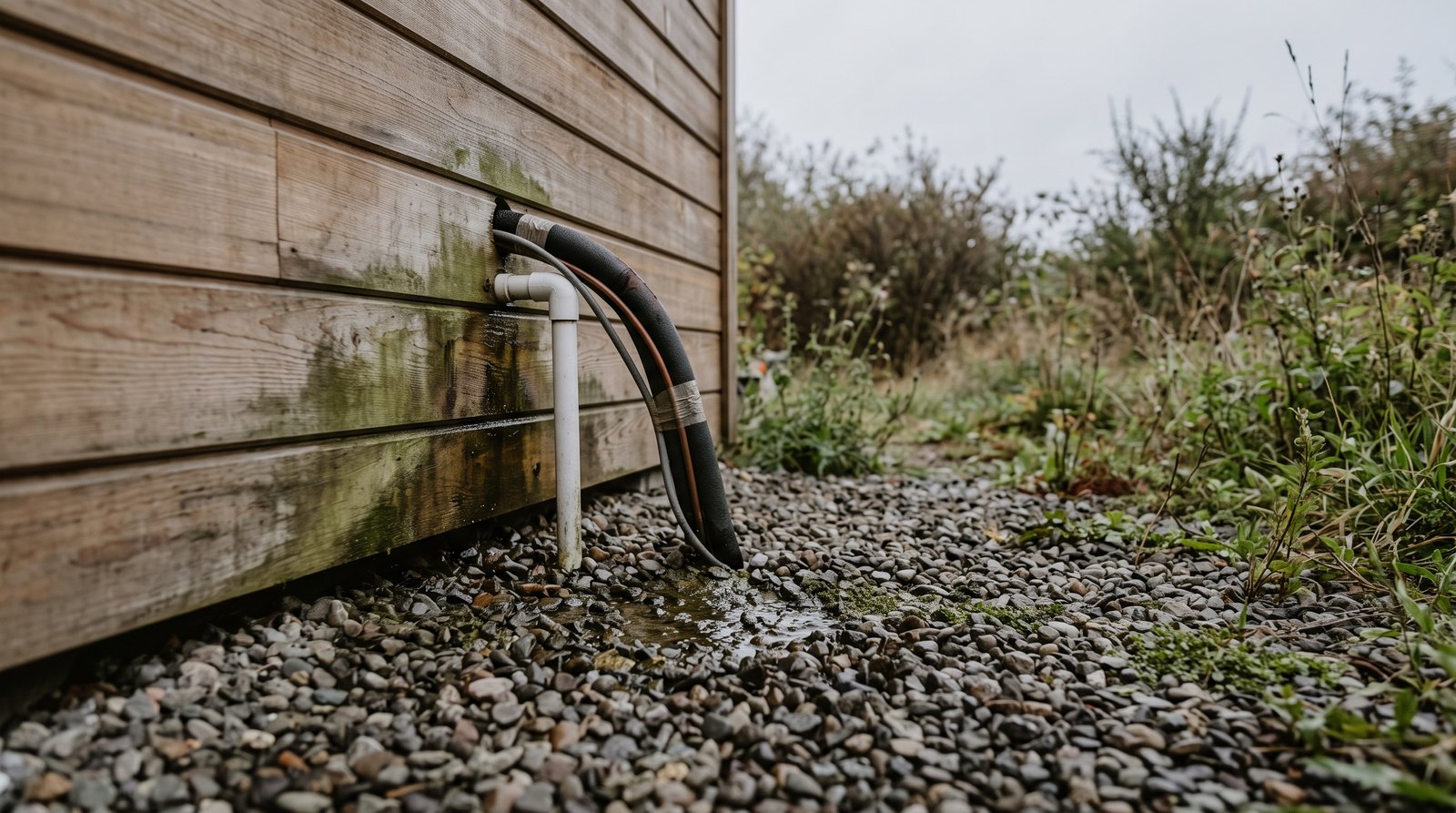
Line Set and Condensate Routing on a House That Moves
A mini split is two boxes joined by a refrigerant line set, a control cable, and a condensate drain. On a fixed house that connection is routine. On a house that gets towed, it is the part most likely to fail, because copper does not like being flexed and vibrated.
Give the line set a service loop rather than a taut run, protect it in a line set cover, and secure it at short intervals so it cannot whip on the road. Every wall penetration needs a sleeve, a downward slope to the outside, and proper sealing, since this is a hole through your air barrier and your insulation. Water finding its way in through a badly sealed line set penetration is a slow and expensive kind of damage.
Condensate needs a route with continuous fall to daylight. A gravity drain that discharges into gravel below the house is the simplest arrangement and the one to aim for. Where the head is mounted low or the run is long, a small condensate pump is the fallback, but a pump is one more thing to fail and one more thing to hear. If you tow the house, drain the line before you move it so nothing sits in the trap.
Two details save trouble later. Discharge the condensate away from the trailer frame, because water dripping onto steel for years leaves rust. And plan the penetration where you can reach it, since a line set leak found early is a recharge and a line set leak found late is a compressor. Ongoing checks of these penetrations belong in your annual tiny house maintenance routine.
Electrical Load and What It Means for Solar
Mini splits in the 6,000 to 12,000 BTU range are modest electrical loads by house standards, but they are large loads by off grid standards. Most units in this size want a dedicated circuit, commonly 15 or 20 amps. Many small models run on 208 to 240 volts, and a growing number of 9,000 and 12,000 BTU units are available in 120 volt versions, which matters a great deal if you are on a 30 amp shore power connection.
Check the minimum circuit ampacity and the maximum overcurrent protection on the data plate on the unit before you size the wire or the breaker. These two numbers, not the BTU rating, decide your circuit.
Off grid is where the honest conversation happens. A mini split can be run on solar, but heating in winter is the hard case, because that is when output from the array is lowest and the heat pump runs longest. Cooling in summer is much easier, since the load peaks when the sun is strongest. If you are planning an off grid system around a heat pump, size the array and the battery against winter production rather than annual average, and read our guide on what size solar system a tiny house needs before you buy panels.
Quick Answer by Situation
- Mild climate, grid connected, 200 to 400 square feet. A 6,000 to 9,000 BTU single zone inverter unit is almost certainly right. Do not go larger.
- Cold climate winter living. Buy a cold climate or hyper heat model and size from the capacity table at your design temperature, not the 47 degree rating. Keep a small backup heater.
- Off grid on solar. A mini split for summer cooling is realistic. A mini split as your only winter heat is a large battery and array commitment, and propane or wood is often the cheaper answer.
- The house gets towed regularly. Insist on a service loop, a line set cover, secure fastening, and a drained condensate line before every move.
- You are on 30 amp shore power. Look specifically for a 120 volt model and check the minimum circuit ampacity before you assume it fits.
- Budget is the binding constraint. A quality electric heater plus good insulation costs a fraction of a mini split. Fix the envelope first, because it lowers every heating bill you will ever pay.
Honest Installed Costs Against Propane and a Wood Stove
A single zone mini split in the 6,000 to 9,000 BTU range typically runs $2,500 to $4,200 installed in 2026, with equipment usually a little under half of that and labor, line set, electrical work and permits making up the rest. Simple installs where the head and the condenser are on opposite sides of the same wall sit at the low end. Long line runs, a difficult mounting position, or a new circuit back to a full panel push it up.
Propane is the usual comparison. A direct vent propane heater costs less to install, often in the $1,200 to $2,500 range, and it keeps working in a power cut, which is a genuine advantage. Against that, it delivers no cooling, no dehumidification, and it commits you to buying and hauling fuel. In much of the country propane heat also costs more per delivered unit of heat than a heat pump, because a heat pump moves heat rather than making it.
A wood stove is the third option and the most divisive. A small stove suited to a tiny house plus hearth, chimney and clearances often lands in the same range as a mini split once installed properly, and it is not cheaper than people expect. It provides excellent heat and independence from the grid. It also demands space you barely have, needs the clearances the manufacturer specifies rather than the ones that fit, requires tending, and gives you no cooling at all. Many insurers ask questions about wood stoves, so check your policy before you buy one.
For most people the practical answer is a mini split as the primary system, chosen for the cooling and dehumidification as much as the heat, with a small secondary heater for power cuts and deep cold. That combination costs more up front than a single fuel burning appliance and less to run in most climates.
Frequently Asked Questions
What size mini split do I need for a 300 square foot tiny house?
Usually 6,000 to 9,000 BTU, and often the smaller of the two if the house is well insulated. Square footage alone is a weak guide, because insulation, window area and air tightness change the load substantially. Ask your installer for a Manual J calculation on the finished house before you buy equipment.
Can a mini split heat a tiny house through a cold winter?
Yes, if you buy a cold climate or hyper heat model and size it from the capacity rating at your design temperature rather than at 47 degrees. ENERGY STAR cold climate units hold at least 70 percent of their rated capacity at 5 degrees Fahrenheit. Keep a small backup heater for power cuts and defrost cycles.
Will a mini split run on a tiny house solar system?
For summer cooling, yes, because the load peaks when solar production peaks. For winter heating it is much harder, since the heat pump runs longest when the array produces least. Size the system against winter production, and expect a substantially larger array and battery bank than a summer only setup.
Is a 9,000 BTU mini split too big for a tiny house?
Frequently, yes. In a tight house under about 300 square feet, 9,000 BTU can exceed the actual load, which leads to short cycling and poor humidity control. If 9,000 is the smallest unit available in the model you want, choose a true inverter with a low minimum output so it can run gently for long periods.
Can I install a mini split myself in a tiny house?
Precharged do it yourself kits exist and are legal for an owner to install in many places, though the electrical work often still requires a licensed electrician and a permit. A professional install gets you a proper vacuum on the lines, a verified charge, and a manufacturer warranty that usually depends on both. Check your local rules before deciding.