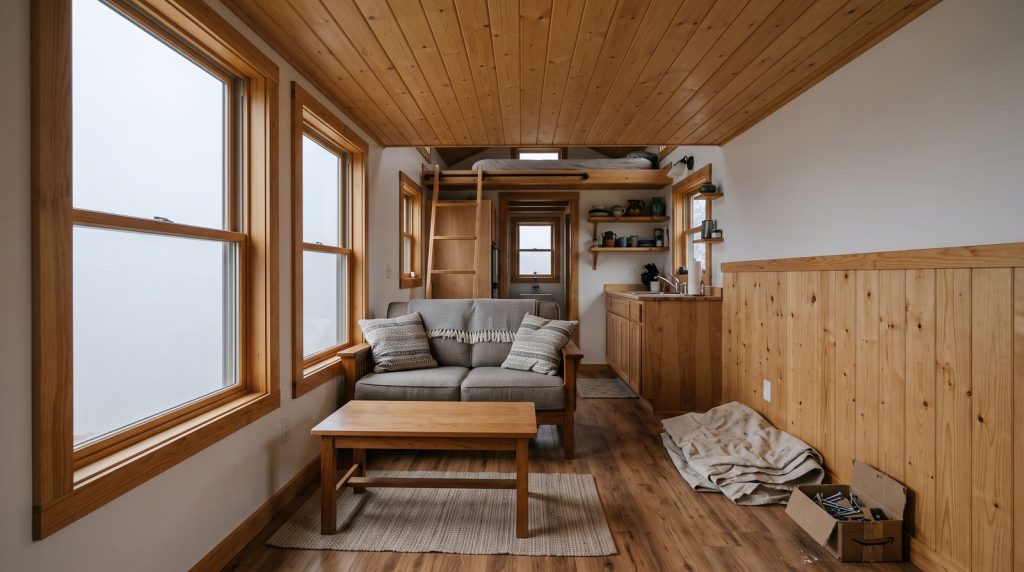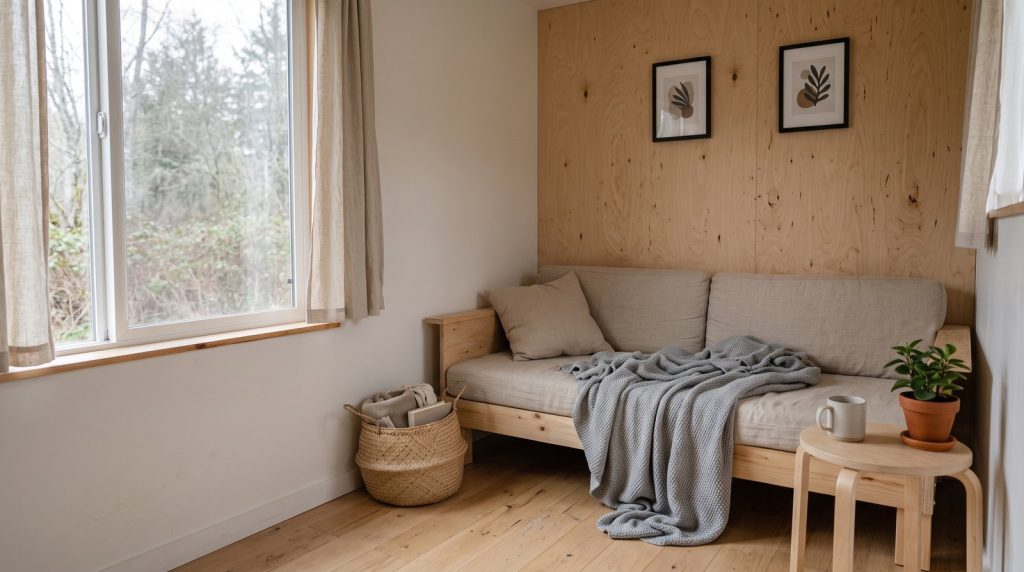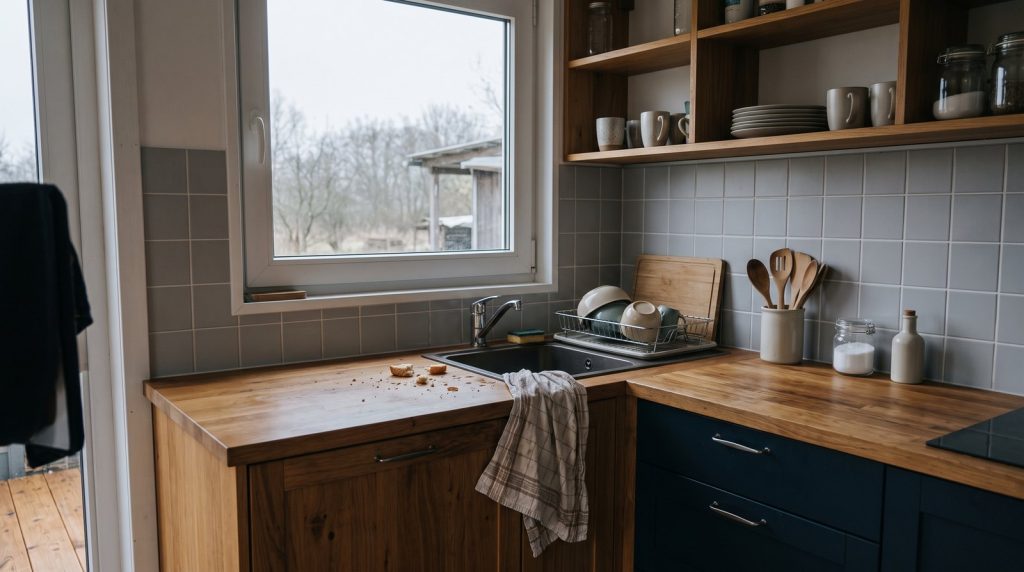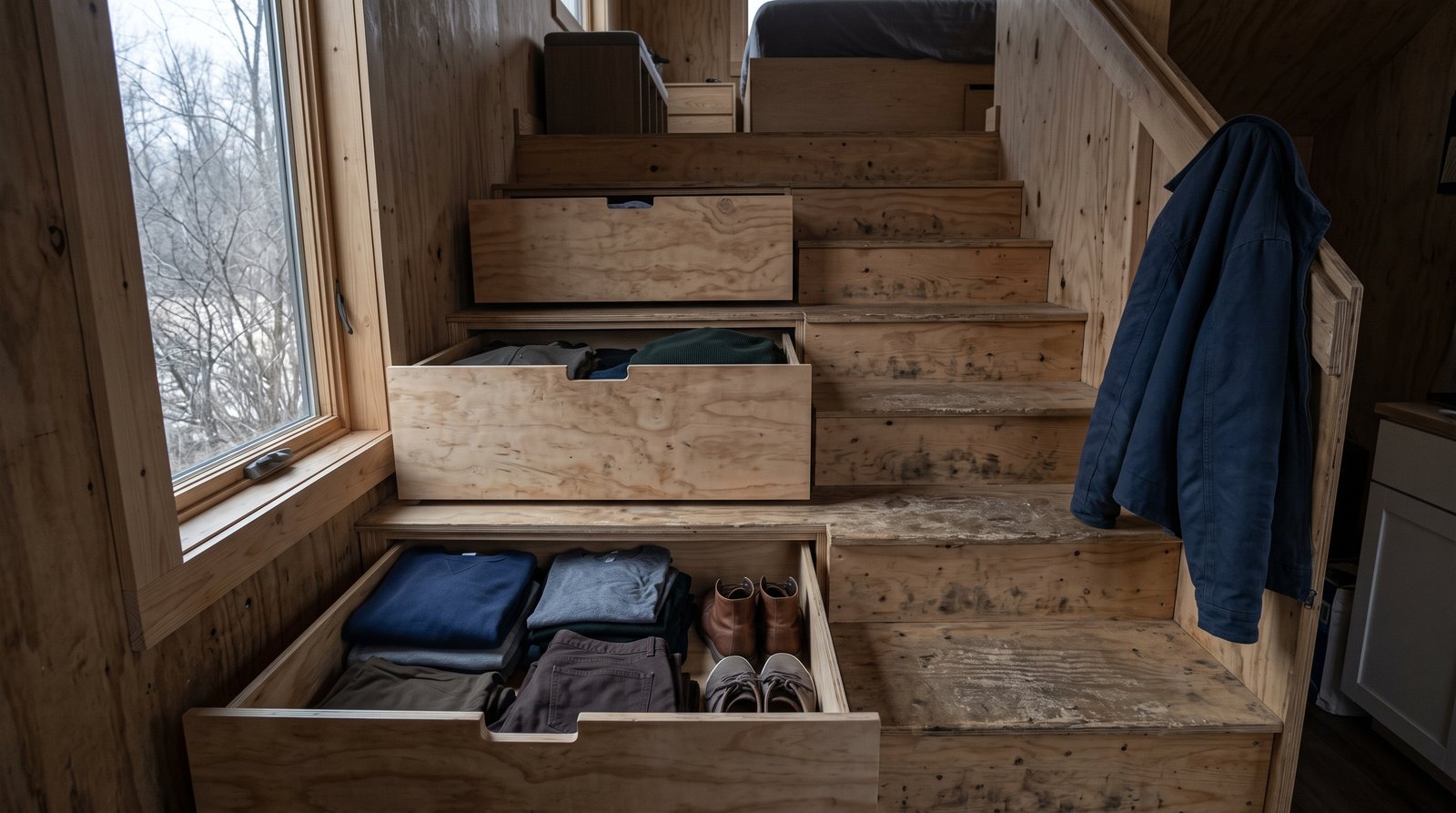
Tiny house storage works long term when it is built into the structure instead of added on later. Stair drawers, toe kick bays, and bench seating carry most of the load, weight stays low and near the axles, and the rest of your belongings get edited down before move in day. Open shelving and stacked bins fail first.
Table of Contents
How much storage does a tiny house actually need?
There is no single cubic foot target, because a tiny house budgets storage by weight and position as much as by volume. The trailer carries the house first, and whatever capacity is left has to cover your belongings, your water, and your gear. Storage that sits low and near the axles is storage you can safely fill.
Weight is the part most people underestimate. Tongue weight on a towable tiny house should land between 9 and 15 percent of the total loaded weight, so a 10,000 pound house needs roughly 900 to 1,500 pounds on the hitch. Loading heavy storage into the far rear pulls that percentage down and invites trailer sway. Piling it over the tongue pushes it up and lightens the front wheels of the tow vehicle. Neither problem is fixable with better bins.
Water alone is a useful reality check. Fresh water weighs a little over eight pounds per gallon, so a 30 gallon tank adds more than 250 pounds before you have stored a single book. The real design question is where the volume sits, not how much of it there is.
Quick answer by situation
- Towable tiny house, full time: build storage into stairs, benches, and base cabinets, and keep the heaviest items low and within a few feet of the axles.
- Foundation tiny house or park model: ignore the weight limits and optimize for reach, which means deep drawers rather than deep shelves.
- Two people sharing one loft: give each person a dedicated enclosed drawer bank instead of splitting one shared closet.
- Cold climate: keep all clothing and bedding storage inside the insulated envelope and skip under floor bays entirely.
- Frequent mover: no open shelving anywhere, a positive catch on every door, and a deck box you can empty in ten minutes.
- Buying prebuilt: ask the builder for cubic feet of enclosed storage, because listing photos flatten how small the cabinets really are.
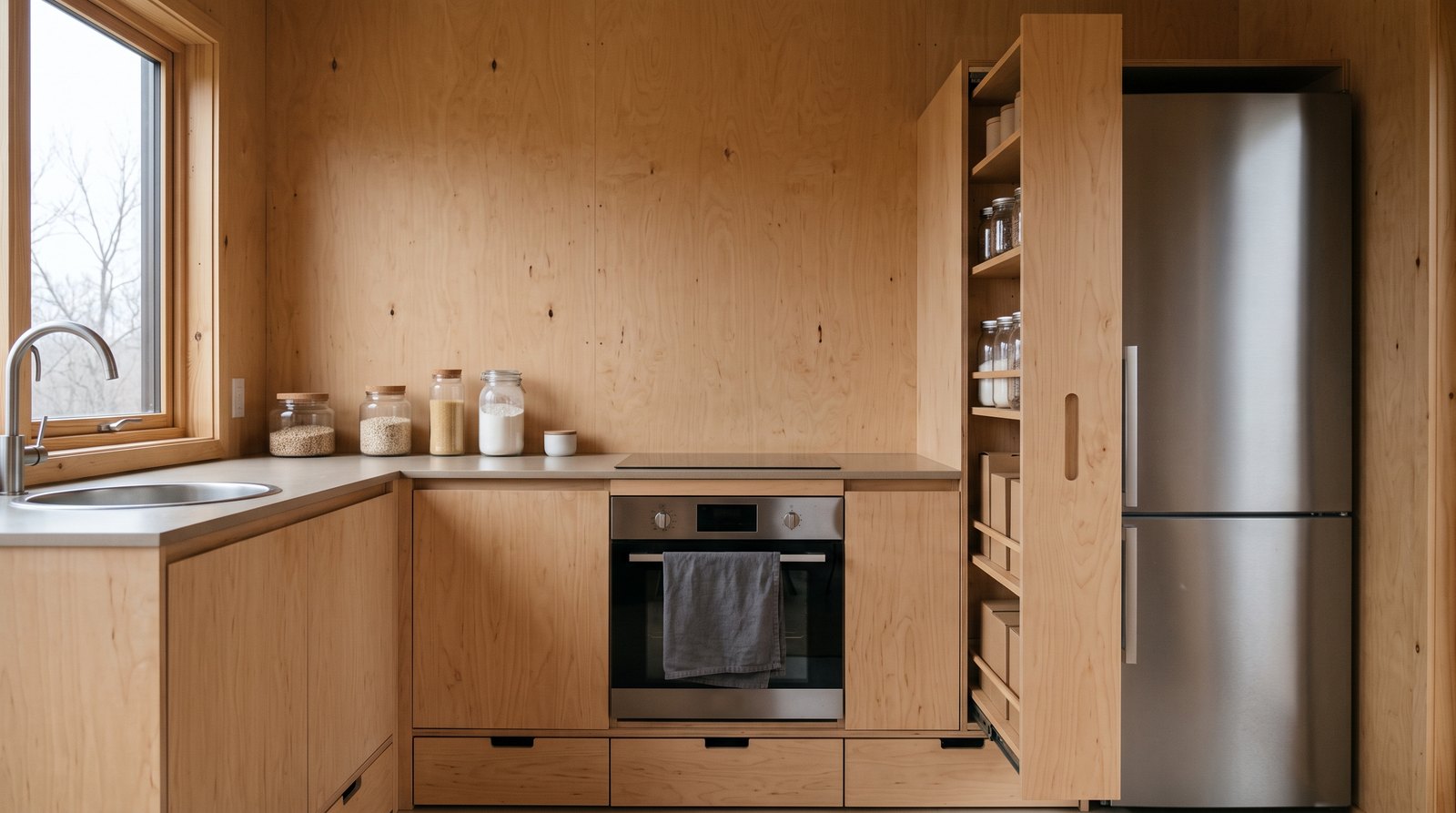
Stair drawers and toe kick drawers are the best storage you can build
Storage stairs and toe kick drawers turn space you have already paid for into enclosed storage without adding footprint or raising the center of gravity. Stairs serving a loft have to satisfy dimensional rules in most places that adopt Appendix Q of the International Residential Code, so build the stair correctly first and fit the drawers into what remains.
Appendix Q sets the envelope you are working inside. Risers for stairs serving a loft must be at least 7 inches and no more than 12 inches. Tread depth is tied to riser height by formula: tread depth equals 20 inches minus four thirds of the riser height. Headroom must be at least 6 feet 2 inches, measured from a sloped line connecting the tread nosings. Clear width must be at least 17 inches above the handrail and 20 inches below it. A landing platform at the top must be 18 to 22 inches deep and 16 to 18 inches high measured up to the loft floor. Adoption varies by state and by city, so confirm the details with your local building department before you cut anything.
Inside that envelope, every step gives you a box roughly 10 inches deep and 10 inches tall once the drawer box and slides are accounted for. Three steps of drawers will hold a full wardrobe for one person, and they come to you at waist height instead of forcing you onto the floor.
Use full extension ball bearing slides rather than roller slides, so the back of the drawer clears the stringer. Cabinet grade slides are commonly rated around 100 pounds per pair, and heavy duty versions run to 500 pounds or more. Design for no more than 70 to 80 percent of the rated capacity, which leaves headroom for a drawer slamming shut while the house is towed.
Toe kick drawers are the cheapest storage upgrade in the house. The space under a base cabinet is usually 3 to 4 inches tall and otherwise completely wasted, and that height happens to fit baking sheets, cutting boards, placemats, shallow tool trays, and flat shoes. You will not store bulky items there, but you will free a whole cabinet of the flat things that never stack well.
Under floor storage bays and the moisture risk you have to plan for
Under floor bays look like free volume and behave like a maintenance problem. Anything below the floor deck sits either outside the insulated envelope or punched through it, which means condensation, road spray, and rodents. Build one only if you can seal and drain it properly, and never store clothing or paper down there.
The physics is straightforward. Warm humid indoor air meets a cold surface and gives up its water. A bay hung under the floor is cold on every side in winter, so if indoor air reaches it, moisture collects where nobody can see it. Over a few seasons that is how you rot a floor system that would otherwise have lasted decades. Our guide to how long tiny houses last goes deeper on the moisture failures that shorten the life of a build.
If you want under floor storage anyway, treat the bay as exterior space. Keep the insulation and air barrier continuous across the floor deck above it, give the bay its own weather resistant lid with a gasket, slope the bay floor so water drains out instead of pooling, and screen every opening against rodents. Store only things that tolerate weather: leveling blocks, hoses, chocks, straps, and spare hardware. Remember that anything hanging below the frame also costs you ground clearance, and it is the first thing to catch on a steep driveway apron.
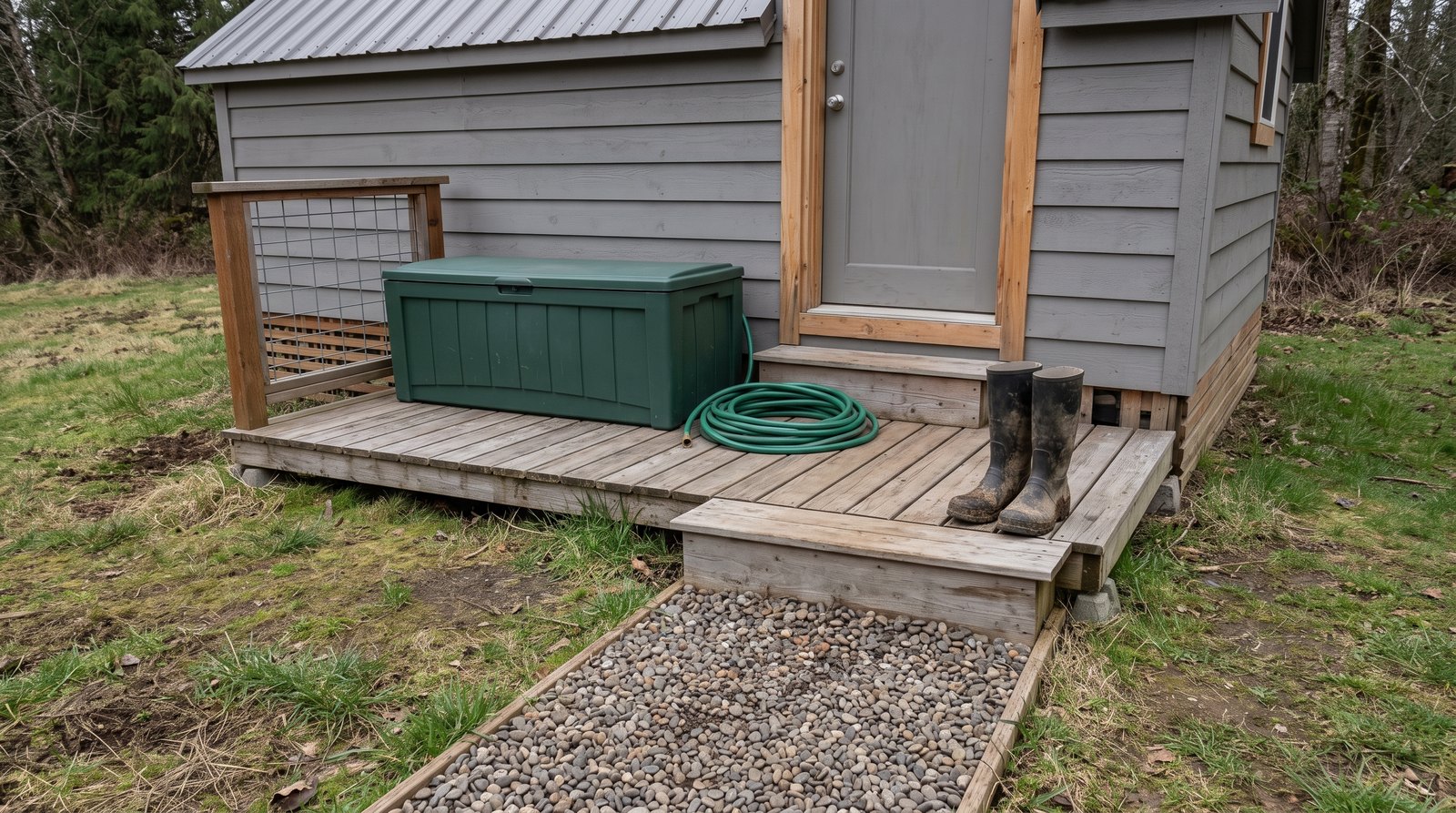
What belongs outside in a deck box
A weatherproof deck box moves the dirtiest and bulkiest category of belongings out of a house that cannot spare the volume. Hoses, hookup gear, chocks, hand tools, muddy boots, and outdoor cushions all live better outside. It is the highest value storage per dollar in a tiny house, and it costs no interior square footage at all.
Good candidates are items that are already dirty, already wet, or already rated for outdoor use: water and sewer hoses, leveling blocks, wheel chocks, tie down straps, a small tool kit, and boots. Keeping hookup gear outside also keeps it away from anything you eat off of.
Some things should not go in a deck box. Batteries of any chemistry lose capacity in freezing temperatures, and paint, caulk, and construction adhesives are usually rated to stay above freezing. Anything with fabric or paper in it will take on moisture even inside a sealed box, because the air in there cycles with the temperature. Propane cylinders belong on an open rack or in a ventilated exterior compartment, never in a sealed box.
If your house moves, the deck box either bolts to the deck framing or gets emptied before you tow. A loaded plastic box on a small porch is a projectile. Our breakdown of what it costs to move a tiny house covers the rest of the pre tow checklist.
Loft edge shelving and storing things overhead
Shelving along the knee wall of a loft is real storage, but it is the worst place in the house to put weight. Everything stored up there raises the center of gravity, which matters both for towing stability and for how the house feels in a strong crosswind. Keep it light and keep it contained.
The practical rule is that loft storage holds soft, light, and infrequently used things: off season clothing, spare bedding, sleeping bags, and towels. Books, tools, and canned food belong in the stairs or the base cabinets instead. Build the shelf with a lip or a rail at the front, at least an inch and a half proud of the surface, so nothing slides off when the house is moving or when you bump it climbing into bed.
Watch the headroom you are giving up. A shelf that projects eight inches into a loft that is already 40 inches tall at the peak turns a usable sleeping space into a place where you crack your head every morning. Measure the space you actually use before you build anything above the mattress.
Why open shelving fails on a house that moves
Open shelving photographs beautifully and fails in practice. On a house on wheels, every unsecured item becomes a projectile the moment you tow. Even parked, open shelves put your entire inventory on display in a room where visual noise registers far more strongly than it would in a full sized home.
The towing problem is the concrete one. A tiny house on a trailer pitches, flexes, and takes potholes with very little suspension travel between the road and your dishes. Doors with positive mechanical catches, not magnetic catches, are the only reliable answer. Magnetic catches release under sustained vibration, and you will discover that the expensive way.
The visual problem is quieter but it drives more people out of tiny houses than towing damage does. In 200 square feet you see almost every surface from almost every position in the house, so twelve visible objects read as clutter in a way the same twelve would not in a 1,500 square foot home. Doors are about being able to look at a wall and see nothing.
If you want the look, compromise: one short open shelf for the few things you use daily, and closed storage everywhere else. Our comparison of tiny houses and RVs for full time living covers how differently the two approach storage and movement.
A realistic decluttering plan before you move in
Storage design fails when it has to absorb a full sized household. Give yourself eight to twelve weeks before move in and work category by category rather than room by room. The goal is not minimalism for its own sake. The goal is that every single thing you own has an assigned enclosed place to live.
Weeks one through three cover paperwork, media, and duplicates. Scan what you need to keep, recycle the rest, and pull the second and third versions of every tool and kitchen item. It is the least emotional category and it builds momentum.
Weeks four through eight cover clothing and gear. Pack everything you are unsure about into boxes, seal them, and write the date on the lid. Anything you do not open in the following month leaves. The test works because it measures behavior instead of intention.
Weeks nine through twelve cover furniture, sentimental items, and the hard calls. Photograph what you cannot keep, and choose a fixed number of physical keepsakes rather than deciding one item at a time. A single labeled box that fits inside a stair drawer is a decision you make once instead of every week.
Then measure the actual openings in your house, including the swing of the door and the travel of the drawer slide, before you buy a single bin. Buying containers before the house exists is the most common way people end up with storage that does not fit their storage.
Frequently asked questions
How much storage does a typical tiny house have?
It varies widely, because storage in a tiny house is designed rather than standard. A well planned 24 foot build usually has three to five drawer banks in the stairs, a full run of base cabinets with toe kick drawers, bench seating with lids, and a loft shelf. Ask any builder for cubic feet rather than photos.
Are storage stairs safe and code compliant?
Storage stairs are compliant when the stair itself meets the dimensional rules, and adding drawers does not change that. Under Appendix Q of the IRC that means risers of 7 to 12 inches, tread depth set by formula, at least 6 feet 2 inches of headroom, and 17 inches of clear width above the handrail. Confirm local adoption first.
Is under floor storage on a tiny house a bad idea?
It is a risk you take on deliberately. A bay below the floor deck sits outside the warm envelope, so it collects condensation, road spray, and rodents unless it is sealed, gasketed, drained, and screened. It also cuts ground clearance. Use it for weather tolerant gear only, never for clothing, paper, or food.
How do I keep things from falling out while I tow?
Fit every cabinet and drawer with a positive mechanical catch rather than a magnet, because magnets release under vibration. Empty or bolt down anything sitting on the porch, secure loft bins behind a rail, and walk the house once with a checklist before you pull out. Ten minutes here prevents most towing damage.
What is the single best storage upgrade in a tiny house?
Stair drawers, by a wide margin. They use volume you have already built and paid for, they keep weight low and close to the axles, and they open at waist height instead of demanding that you kneel on the floor. Toe kick drawers are the cheapest runner up and take an afternoon to add.