Most tiny houses need roughly 1,200 to 3,000 watts of solar panels and 5 to 15 kWh of battery storage. The number that decides it is your daily kilowatt hour use. A propane heavy tiny house can run on 2 kWh a day. An all electric one with a mini split and an induction cooktop can pull 12 kWh or more.
Almost every bad solar quote starts the same way, with a panel count instead of a load number. Panels are the cheap part. Batteries and the inverter are where the money goes, and both of those are sized from what you actually run in a day. This guide walks the numbers in the order a good installer walks them, so you can check any quote you get.
Table of Contents
Start With Your Daily kWh, Not With Panels
Add up the watts each appliance draws, multiply by the hours you run it, and divide by 1,000. That gives kilowatt hours per day. Do this before you price a single panel. Efficient tiny houses commonly land between 3 and 8 kWh a day, and that one figure sets the size of everything downstream.
Here is what the big loads really cost you in a tiny house:
- Mini split heat pump (9,000 BTU): roughly 0.35 to 0.6 kWh per hour cooling, and 0.75 to 1.1 kWh per hour heating. This is almost always your largest single load. Eight hours of shoulder season cooling is about 4 kWh.
- Induction cooktop: 1,200 to 1,800 watts on a burner, but only in short bursts. Real cooking use is usually 0.5 to 1.5 kWh a day for two people.
- Efficient compressor fridge: 0.5 to 1 kWh a day. A full size household fridge is closer to 1.5 kWh.
- Laptop, phones, router, lights: 0.3 to 0.8 kWh a day combined if the lighting is LED.
- Electric water heater: 2 to 4 kWh a day for two people. This is the load most likely to break an off grid budget, and the reason propane on demand water heating stays popular.
- Well pump: small on average, but its surge draw drives inverter sizing.
Two categories separate cheap systems from expensive ones. Heat and hot water. Move both to propane or wood and a tiny house sits near 3 kWh a day. Put both on electricity in a cold climate and you can pass 15 kWh a day in January, which is a different and much pricier system.
How Many Solar Panels You Actually Need
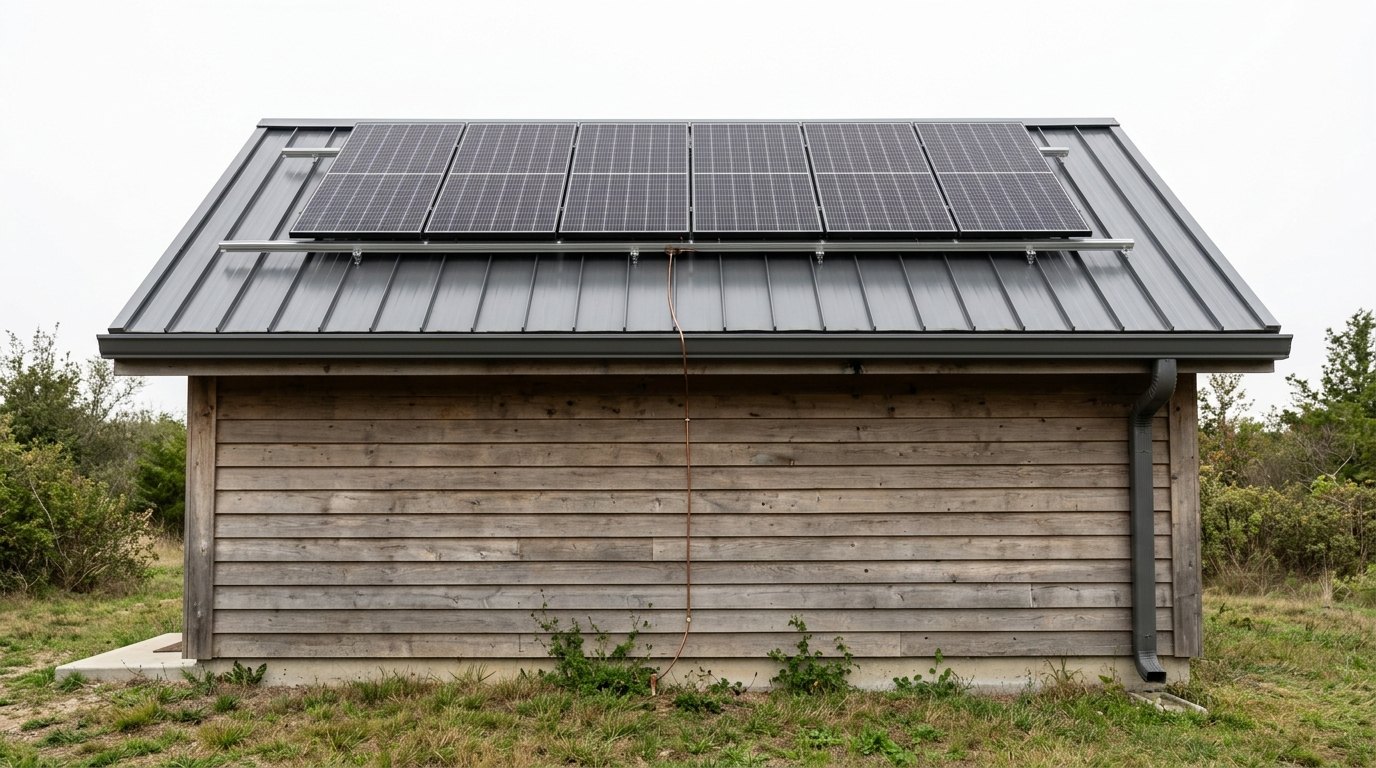
Take your daily kWh, divide by your local sun hours, then add about 30 percent for wiring loss, heat, dust, and charging inefficiency. In most of the United States, plan on 4 sun hours in winter and 5 to 6 in summer. A 5 kWh per day house therefore needs roughly 1,600 watts of panel to hold its own in winter.
Run the arithmetic once and it stops feeling mysterious. Five kWh divided by four winter sun hours is 1.25 kW. Add the 30 percent real world derate and you are at about 1,625 watts, which is four 400 watt panels. Size for your worst month, not your average month, or you will be running a generator every December.
Roof space is the constraint nobody plans for. A 400 watt panel is about 3.5 by 6.5 feet. Four of them need roughly 90 square feet of clear roof, and a tiny house roof is already carrying a vent, a skylight, a chimney, or a mini split line set. Measure the actual clear rectangle before you commit to a roof mount.
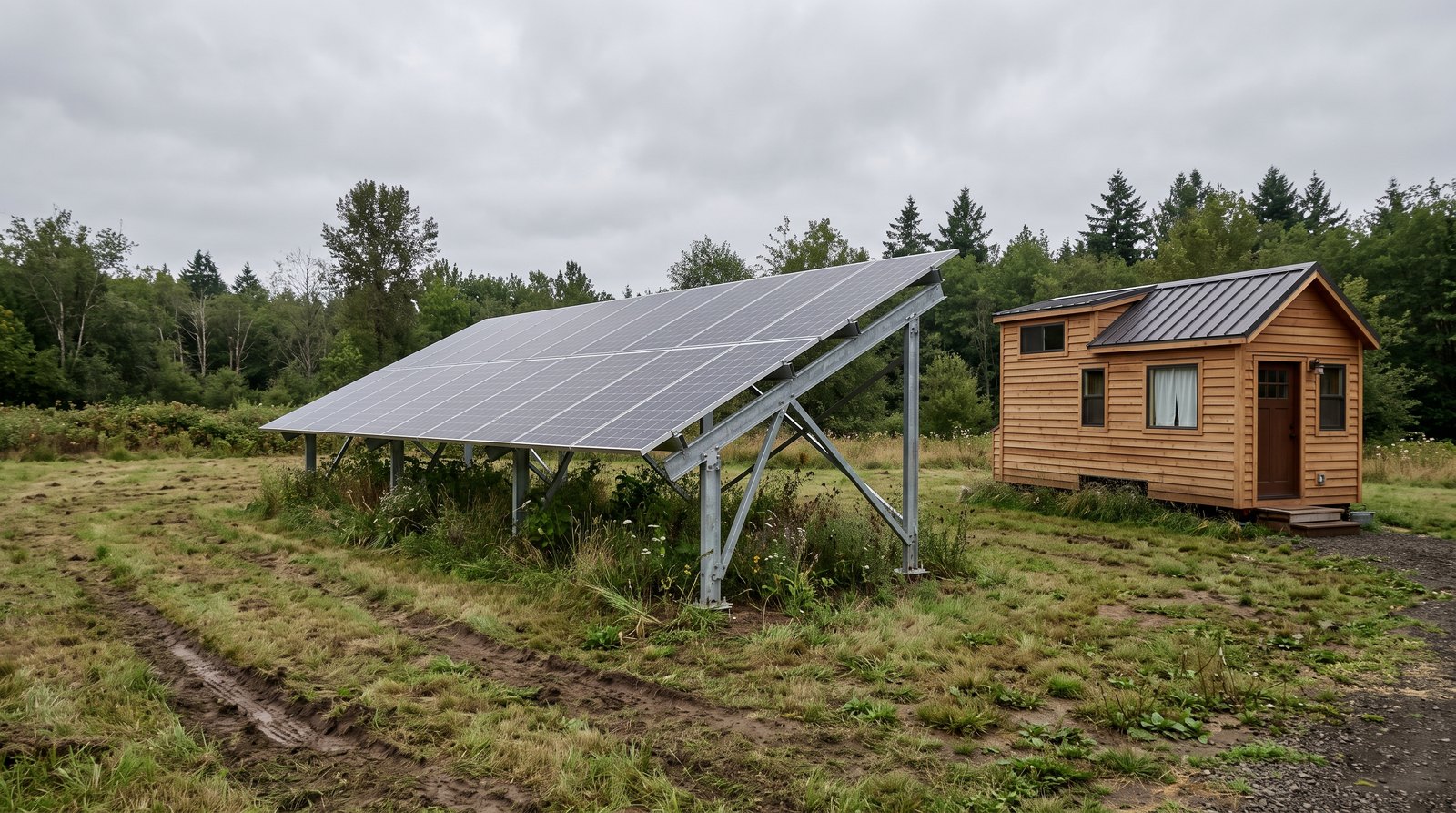
That is why a ground mount is worth considering if you own the land. A ground array can be aimed at a steeper winter angle, it stays cooler and therefore more efficient, you can sweep snow off it in thirty seconds, and it does not force you onto the roof with a caulk gun every spring. The tradeoff is a trench, a frame, and a footprint you cannot tow away.
Sizing the Battery Bank
Battery capacity is set by how many days you want to run without sun. Multiply daily kWh by your desired days of autonomy, then divide by usable depth of discharge. Lithium iron phosphate gives you about 80 to 90 percent usable. Old lead acid gives you 50 percent, which means you buy twice the nameplate capacity.
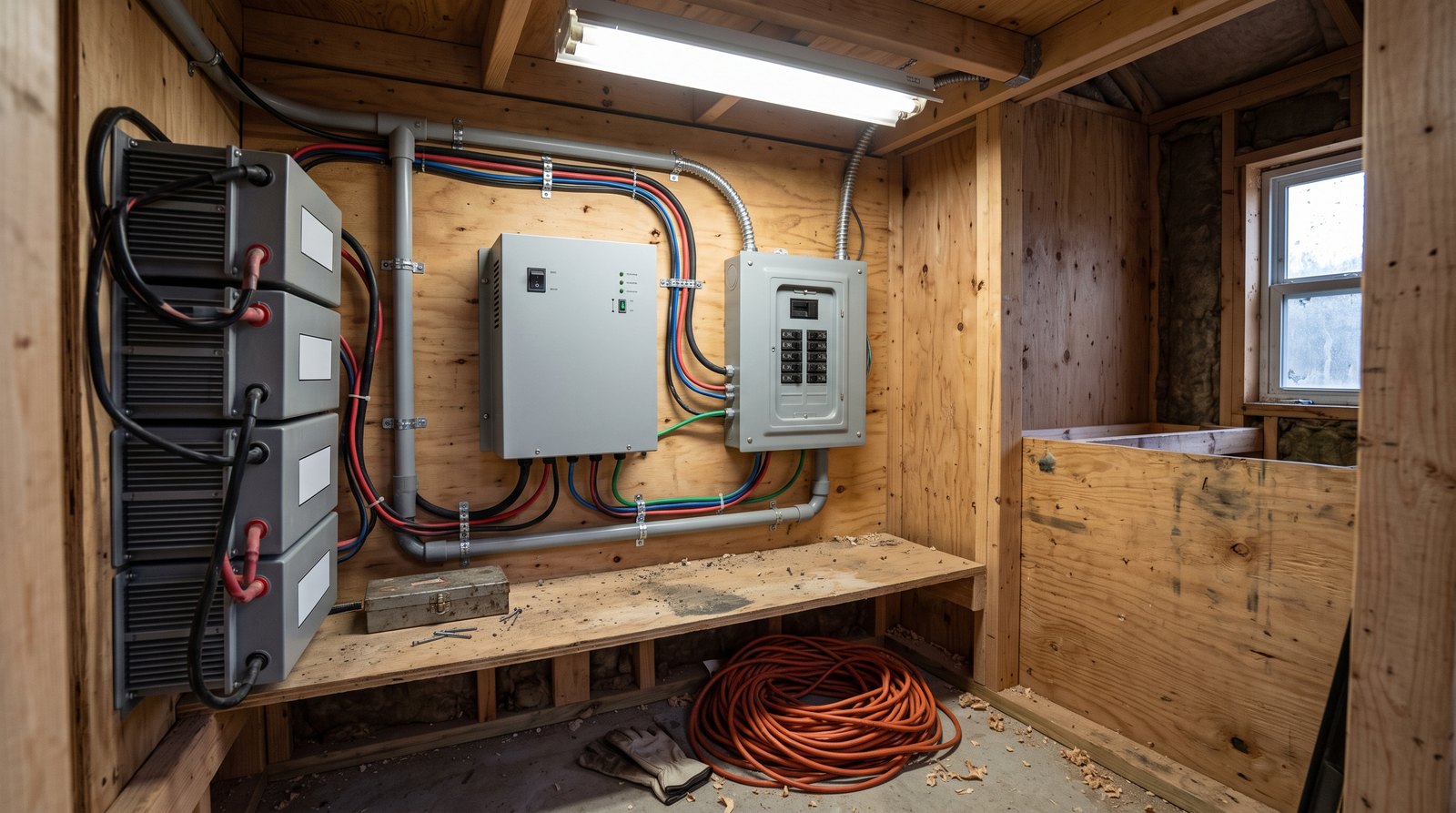
For a 5 kWh per day house wanting a day and a half of cushion, that is 7.5 kWh of usable storage, or a nominal LiFePO4 bank of roughly 9 to 10 kWh. Two 48V server rack modules of about 5 kWh each cover it neatly, and stacking modules is far easier than replacing an undersized single battery later.
Lead acid still shows up in budget kits and it is almost always a false economy in a tiny house. You need double the capacity for the same usable energy, the bank is much heavier on a trailer that has a weight rating, it wants ventilation and maintenance, and it typically dies in three to seven years against ten to fifteen for LiFePO4. Weight matters here in a way it does not in a basement.
Cold matters too. A LiFePO4 battery must not be charged below freezing without an internal heater, so plan on either a self heating model or a conditioned utility bay. Batteries mounted in an unheated exterior compartment through a northern winter is one of the more common and more expensive mistakes in this build.
Inverter and Charge Controller
Size the inverter to your largest simultaneous load plus surge, not to your daily energy. Most tiny houses land on a 2,000 to 3,000 watt pure sine inverter. Add up what could plausibly run at once, an induction burner at 1,800 watts plus a fridge plus lights, and leave headroom for motor startup surge from a pump or a compressor.
An all in one inverter and charger unit is usually the right answer for a tiny house. It combines the inverter, an MPPT charge controller, and a shore power or generator transfer switch in one wall mounted box. That means one thing to wire, one thing to mount, and a much smaller utility closet, which is exactly the constraint you are working under.
On the controller itself, MPPT beats PWM, and it is not close. MPPT harvests roughly 20 to 30 percent more energy from the same panels in cold or cloudy conditions, and it lets you wire panels in series at higher voltage, which means thinner and cheaper wire runs from roof to closet.
What a Tiny House Solar System Costs in 2026
Budget $4,000 to $12,000 for a complete off grid tiny house system in 2026, installation included. A do it yourself build with 1,600 watts of panel and 10 kWh of LiFePO4 storage runs roughly $4,500 to $7,000 in parts. Professional installation typically adds $2,000 to $5,000 on a system this size.
Component pricing as it stands in 2026:
- Panels: $0.80 to $1.40 per watt in do it yourself quantities, so about $320 to $560 per 400 watt panel.
- LiFePO4 batteries: roughly $215 to $293 per kWh for new 48V server rack modules. A 10 kWh bank is therefore about $2,200 to $2,900.
- All in one inverter and charger: $900 to $2,500 depending on wattage and brand.
- Racking, wire, breakers, fuses, disconnects, conduit: $600 to $1,500, and this line is chronically underestimated.
- Ground mount frame, if you go that way: add $800 to $2,000.
Two warnings on the money. First, the balance of system parts, meaning all the wire and breakers and lugs, routinely costs more than people plan for, and skimping there is how fires start. Second, a permitted and inspected install on a foundation home is a different animal from a system on a trailer, and if you intend to sell or insure the house later, documented work is worth what it costs.
Quick Answer by Situation
- Weekend or seasonal cabin, propane cooking and heat: 400 to 800 watts of panel, 2 to 5 kWh of battery, 1,500 watt inverter. Roughly $1,500 to $3,000.
- Full time, propane heat and hot water, efficient fridge: 1,200 to 1,600 watts, 8 to 10 kWh of battery, 2,000 to 3,000 watt inverter. Roughly $4,500 to $7,000.
- Full time all electric with a mini split, mild climate: 2,000 to 3,000 watts, 12 to 15 kWh of battery, 3,000 watt inverter. Roughly $8,000 to $12,000.
- Full time all electric in a cold climate: add a generator or a wood stove. Solar alone in December at 40 degrees north is a losing bet unless you overbuild badly.
- Parked where a meter is available: hook up to the grid and skip the batteries. Details below.
- Moving frequently: roof mount only, and keep the bank small. Weight is your enemy.
When Grid Tie Beats Off Grid
If a utility meter is available within reasonable trenching distance, connecting to it is almost always cheaper than going off grid. A grid connection removes the battery bank, which is half the system cost, and it removes the winter sizing problem entirely. Off grid is the right answer when a hookup is genuinely unavailable or absurdly expensive, not by default.
Utility connection costs vary widely by distance and terrain. A short run to an existing pole may cost $1,000 to $3,000. A long rural run needing new poles can pass $20,000, at which point off grid stops looking like the romantic choice and starts looking like the practical one. Get a written quote from the utility before you decide, because that one number settles the argument.
There is a hybrid worth knowing about. Grid tied with a modest battery gives you utility power as the baseline, solar to cut the bill, and a few kWh of storage to ride out outages. For a tiny house parked in a community with metered sites, this is usually the best value of the three.
Be aware that many tiny house communities and RV parks include electricity in site rent, and some prohibit permanent solar installations or ground mounts on a site you do not own. Read the site agreement before you buy panels. If you are still weighing where a tiny house fits against other options, our comparison of a tiny house against an RV for full time living covers the hookup differences in more depth.
Installation, Permits, and Maintenance
A tiny house on wheels is usually treated as an RV, so solar work often falls outside the residential permit process. A tiny house on a foundation is a house, and it needs a permit and an electrical inspection. Rules vary by city and county, so confirm with your local building department before you start.
Whichever category you fall into, wire it as though an inspector will see it. That means correctly sized conductors, overcurrent protection on both the direct current and alternating current sides, a battery disconnect you can reach in a hurry, proper grounding and bonding, and a labeled panel. Insurance carriers ask about this, and an unpermitted amateur electrical system is a reason a claim gets denied. Our guide to tiny house insurance costs covers what carriers look for.
Maintenance is genuinely light. Rinse the panels two or three times a year, more if you are near agriculture or a dirt road. Check the torque on the mounting hardware and the roof penetrations every spring, because a tiny house on wheels shakes its fasteners loose in a way a stationary roof does not.
Panels themselves typically carry 25 year output warranties and degrade around 0.5 percent a year. The inverter is the part that will fail first, usually somewhere between year eight and year fifteen, so budget for one replacement over the life of the system. That timeline lines up with the rest of the structure, and our article on how long tiny houses last puts the numbers in context.
Frequently Asked Questions
Can solar alone run a tiny house year round?
Yes, if the house is efficient and you size for your worst month. Propane or wood heat and propane hot water make it straightforward. All electric heating in a northern winter usually needs a generator or a grid connection as backup, because December sun hours simply are not there.
How many batteries does a tiny house need?
Plan on 8 to 12 kWh of lithium iron phosphate storage for full time off grid use at typical loads. That is usually two 48V server rack modules. Weekend use can drop to 2 to 5 kWh. Buy stackable modules so you can add capacity later without replacing what you already own.
Will a mini split run on solar?
Yes, and it is the most efficient electric heating and cooling you can put in a tiny house. A 9,000 BTU unit uses roughly 0.35 to 0.6 kWh per hour cooling and 0.75 to 1.1 heating. Budget an extra 800 to 1,200 watts of panel and several kWh of battery for it.
Is a tiny house solar system worth it if I have grid access?
Often not, financially. Grid power costs a fraction of what battery storage costs per kilowatt hour, and a meter never has a cloudy week. Solar makes sense with grid access when you want outage protection, when local rates are very high, or when you plan to move the house off grid later.
What size inverter does a tiny house need?
Most tiny houses need a 2,000 to 3,000 watt pure sine wave inverter. Size it to your largest simultaneous load plus motor startup surge, never to your daily energy total. If you cook on induction and run a well pump, stay at 3,000 watts. Modified sine inverters are not worth the savings.