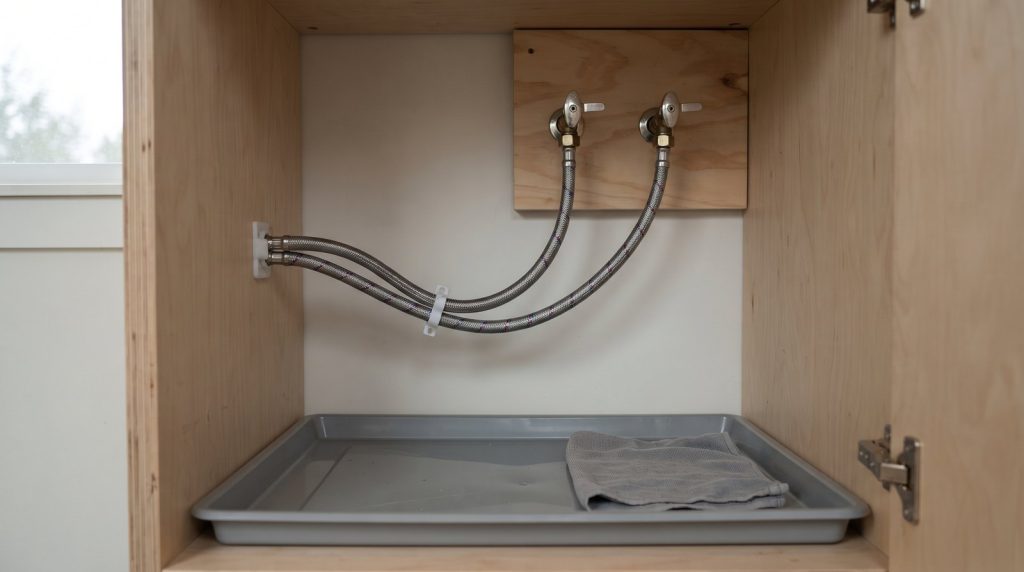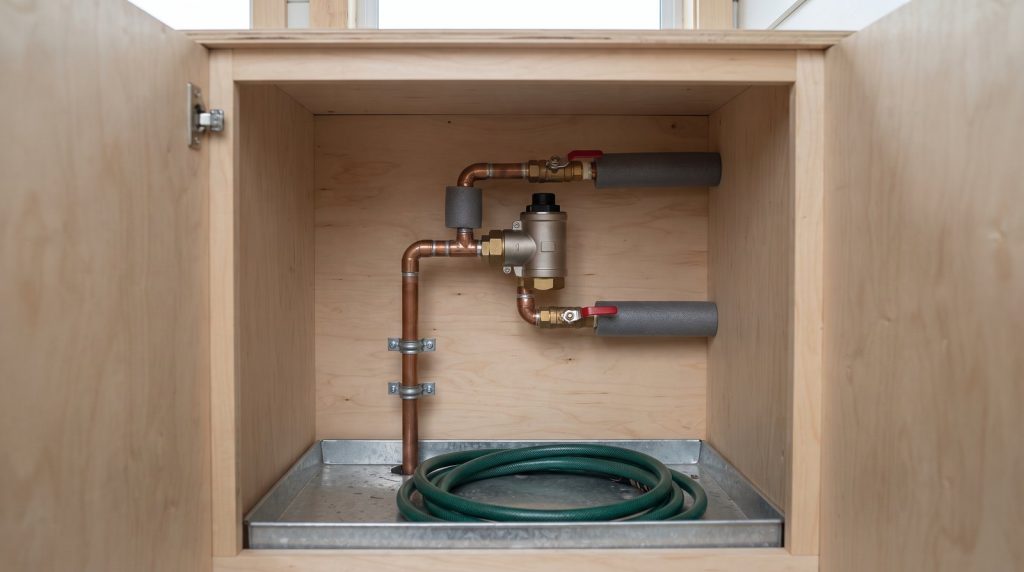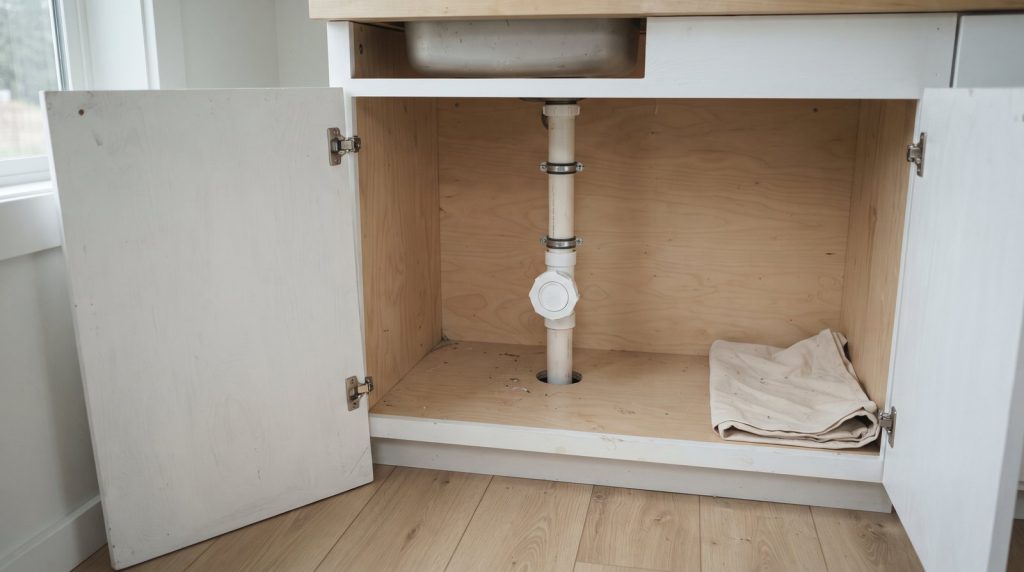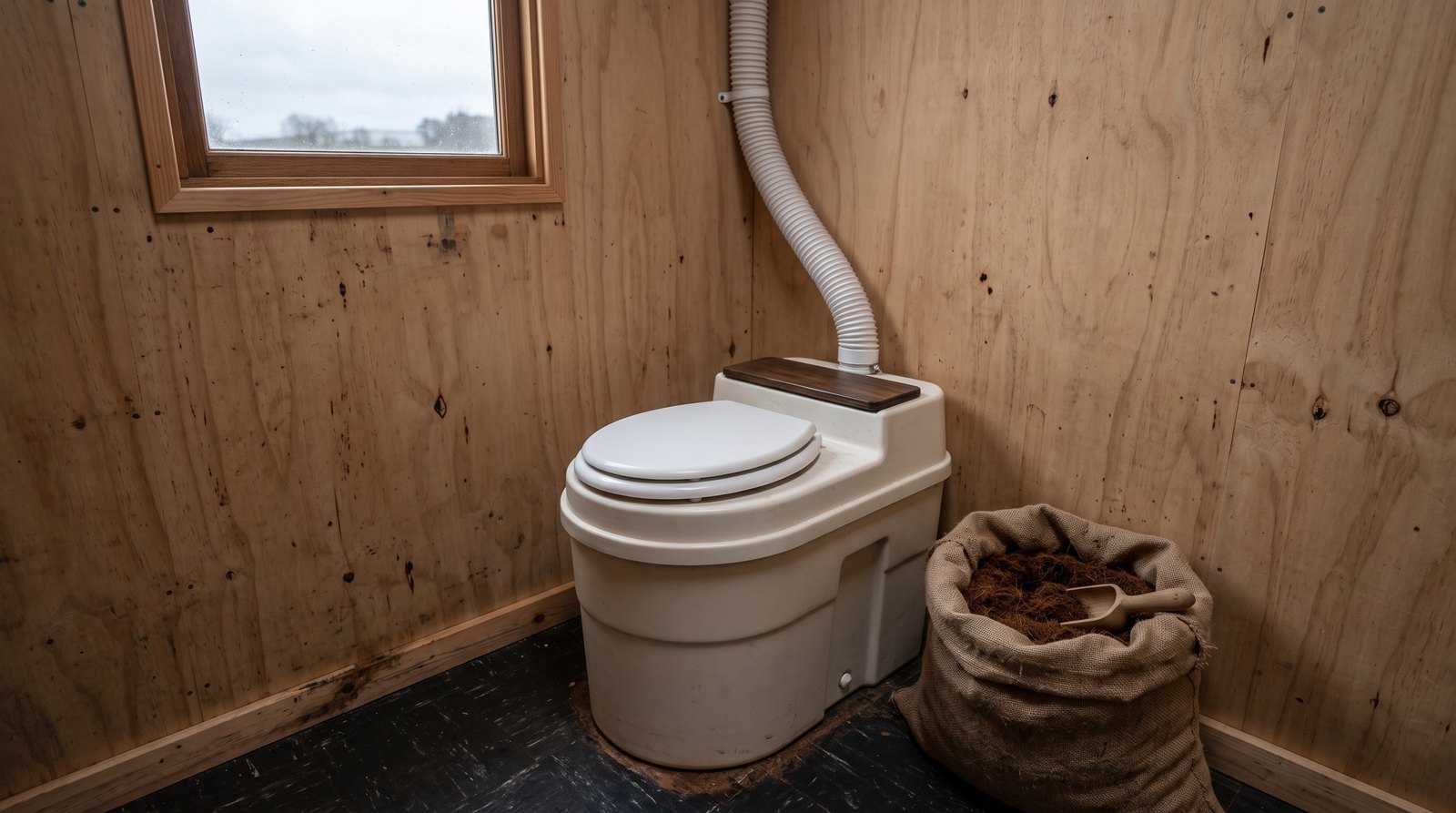
A tiny house composting toilet separates urine from solids at the bowl, mixes the solids with a dry carbon bulking medium, and runs a small vent fan that pulls moisture and odor outside. Most units are not really composters. They are dehydrating holding tanks, and the actual composting happens later, outside the house.
Table of Contents
How a Composting Toilet Actually Works
Urine and solids are kept apart from the first second. Urine drains forward through a molded channel into a sealed bottle or a drain line. Solids drop through a trap door into a chamber packed with coconut coir or peat moss. A fan pulls a constant trickle of air across the chamber and out a vent hose. Dry material does not smell.
Almost everything unpleasant about human waste comes from mixing the two streams. Urine is roughly ninety five percent water and carries most of the nitrogen. Solids carry the carbon and the bulk. Put them together in a sealed container and you get an anaerobic slurry, which is exactly what an RV black tank is and exactly why it smells the way it does. Keep them apart and the solids side stays dry enough for aerobic bacteria to work and too dry for the odor producing anaerobic ones. Most self contained units also have a crank on the side that turns an agitator through the chamber, which folds fresh waste into the medium and exposes more surface area to the moving air.
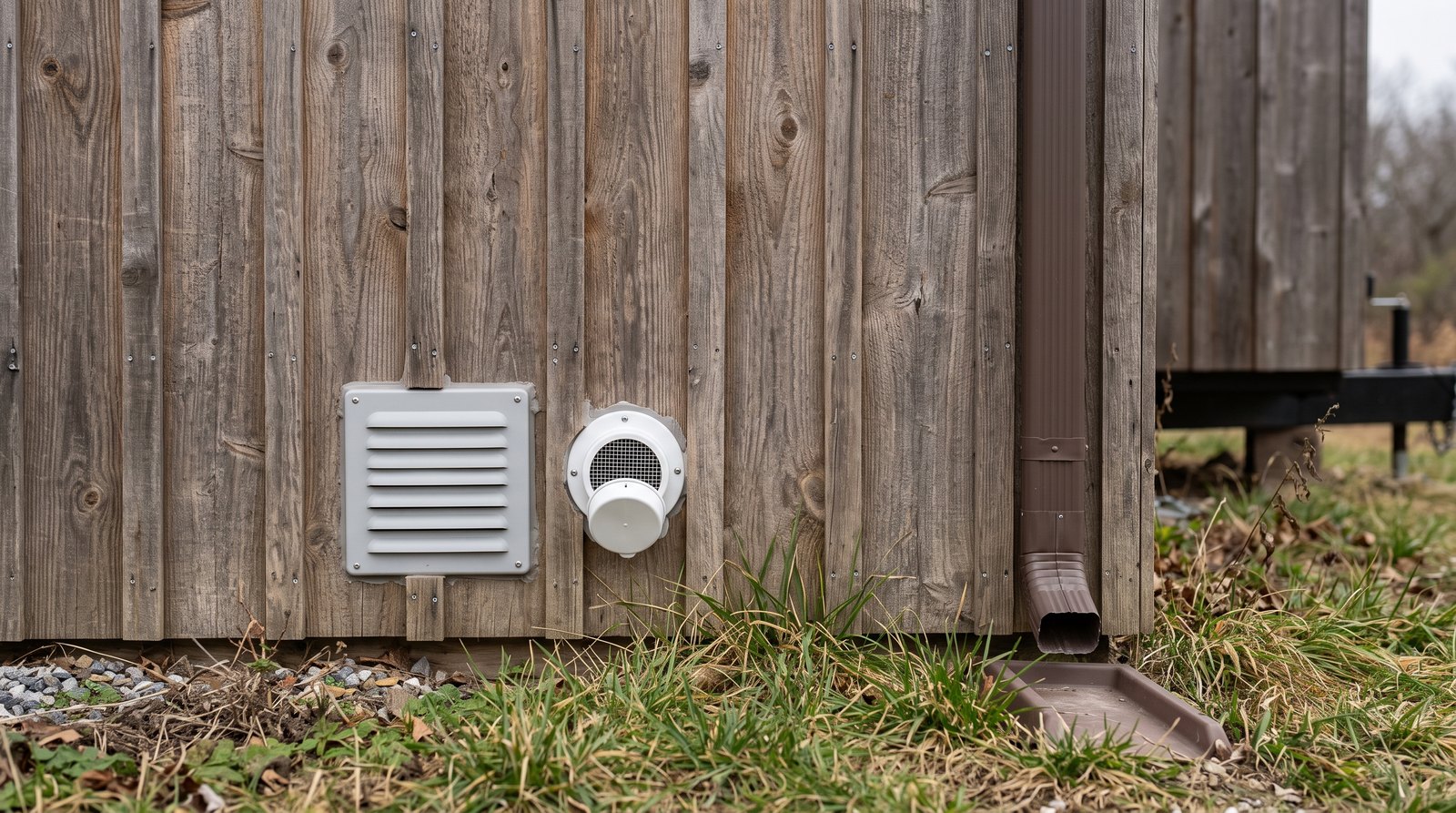
Venting, the Fan, and the Power It Draws
Every fan equipped composting toilet runs a small 12 volt fan continuously, drawing roughly 1.4 to 2.5 watts, or about 0.07 to 0.21 amps. Over twenty four hours that is around 0.03 to 0.06 kilowatt hours. On a solar tiny house that load is close to invisible, and it is the one circuit you should never switch off to save power.
The vent hose runs from the back of the unit to an exterior wall or through the roof, and shorter and straighter is better. Every ninety degree bend costs airflow, and a long horizontal run lets condensation pool in a low spot, which blocks the hose and pushes smell back into the bathroom. Slope any horizontal run slightly downward toward the outside.
Outside, the vent terminates in a small cap or louvered cover. Keep it away from operable windows and any fresh air intake, and screen it, because wasps and mud daubers will build in an open vent hose over one summer and choke the airflow completely. Wipe the fan blades once a season as well, since coir dust coats them over time. A spare fan in a drawer is cheap insurance.
Urine Diverting Versus Single Chamber Units
Urine diverting units, sometimes called separating toilets, split the two streams at the bowl and hold solids in a chamber you mix by hand. Single chamber or batch units drop everything into one container, usually lined with a compostable bag, and rely on drainage and airflow to shed liquid. Diverting units handle full time use better. Single chamber units are simpler and cheaper.
The diverting design is what most full time owners end up with. The tradeoff is that the diverter only works if you sit. Standing use sends urine into the solids chamber, wets the medium, and starts the exact smell you bought the toilet to avoid. Guests will not know this, and a small sign on the back of the door saves a lot of grief.
Single chamber units have their own logic. The bag goes out when it is full, with no agitator to crank and no urine bottle to carry. For a weekend cabin or a guest space, that simplicity wins. Under daily use by two people the bag fills fast and the liquid has nowhere to go, so single chamber units do not scale well to full time living. Some diverting units can instead be plumbed so the urine side drains to a greywater or septic line, which removes the worst chore in the system.
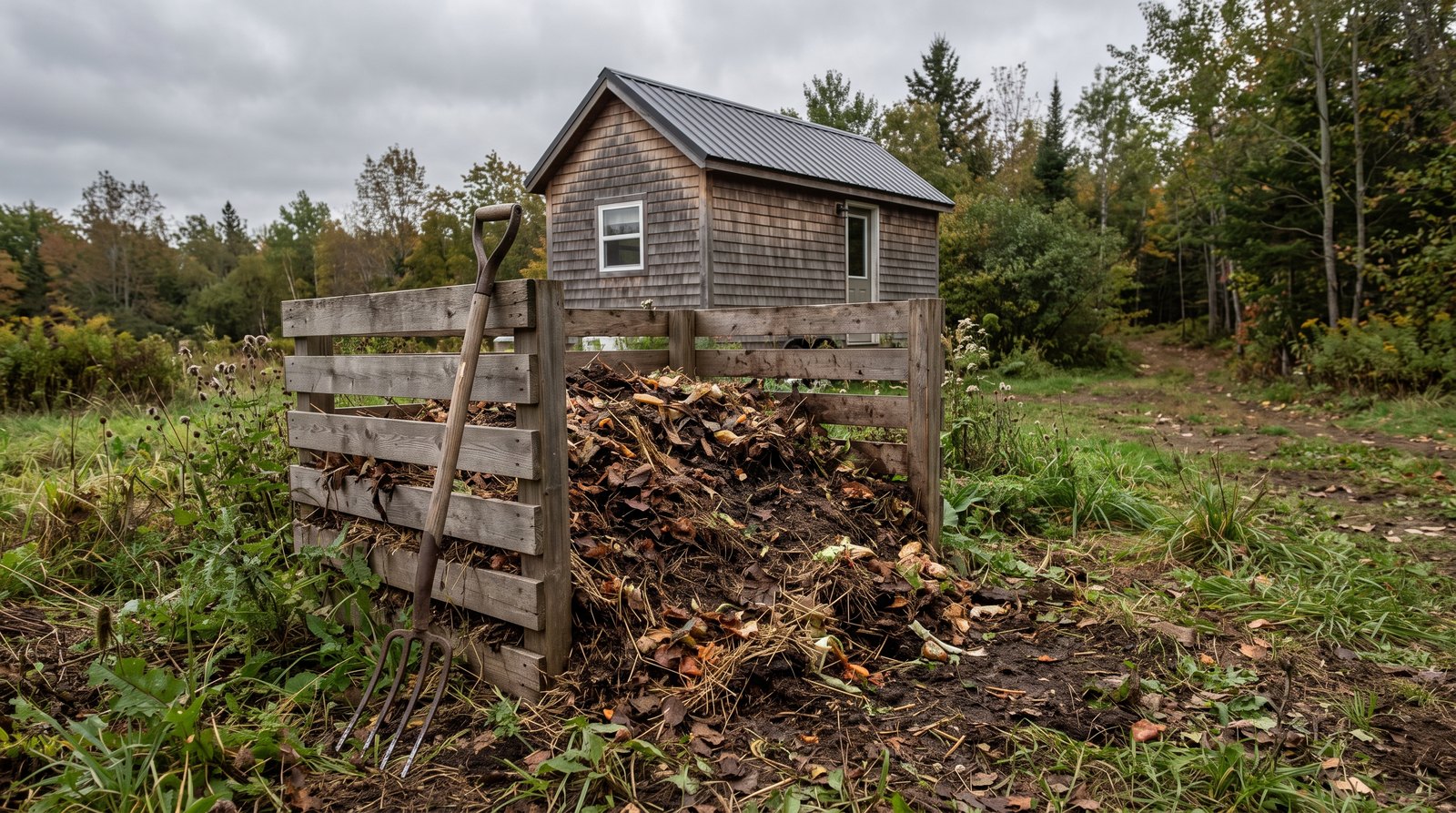
Where the Solids and the Urine Actually Go
This is the part most product pages skip. Material leaving the solids chamber is not finished compost and should not go on a vegetable garden. It needs a secondary stage, typically six to twelve months in a dedicated covered pile or bin, before it is safe for anything. Urine is nearly sterile at the source but is a concentrated fertilizer that needs dilution or an approved drain.
For urine, the common approaches are dilution at roughly eight to ten parts water to one part urine for ornamental plants and trees, or pouring it into an approved drain that leads to a septic system or sewer. Do not pour undiluted urine repeatedly in one spot. The salt and nitrogen load will burn the ground and, on a small lot, will eventually become a nuisance issue with a neighbor.
In most of the United States, composting toilets fall under onsite wastewater rules administered by the same county health department that reviews septic systems, and the common requirement is NSF/ANSI Standard 41 certification. Some states, Maine among them, explicitly permit certified units in primary residences. Others have very little written down, which leaves the decision to a local inspector. Rules vary by city and county, so confirm yours before you buy anything.
Two points catch owners repeatedly. First, a composting toilet does not remove the need to handle greywater. Sinks and showers still produce wastewater needing an approved disposal method, which is often the harder permit to get. Second, where a dwelling must have an approved sanitation system to be legally occupied, a composting toilet alone may not satisfy that, which matters for occupancy, insurance and lending. If you are weighing financing options for a tiny house, expect an underwriter to ask what the approved system is.
What the Bulking Medium Does
The bulking medium is a dry carbon material, usually coconut coir or sphagnum peat moss, that does three jobs at once. It absorbs residual moisture, it creates air pockets so the pile stays aerobic, and it supplies carbon to balance the nitrogen in the waste. Without it, the chamber goes anaerobic within a day and starts smelling like a neglected outhouse.
Coconut coir is the popular choice. It comes as a compressed brick, expands with water to several times its size, and is a renewable byproduct. Peat moss controls odor slightly better in most side by side reports, but it is harvested from bogs that regenerate very slowly. Kiln dried wood shavings work in a pinch but compact faster. Budget one brick per emptying cycle, at five to ten dollars each.
Getting the moisture right when you charge the chamber matters more than which medium you pick. Hydrate the coir, then squeeze it out hard. It should feel like a wrung out sponge, damp but with no water running from it. Too dry and the biology stalls. Too wet and you have created the exact anaerobic condition the whole design exists to avoid. Most first time smell complaints trace back to a chamber that was charged too wet.
How Often You Really Empty It
For two people living full time, the solids chamber on a standard diverting unit goes three to five weeks between emptyings, and most owners settle around four. The urine bottle is the real chore. A 2.2 gallon bottle fills in about two to three days for a couple, so plan on emptying liquid roughly every other day, all year round.
The solids job takes about ten minutes. You unclip the top, carry the base outside, and tip the contents into a compost bin or a bag. It is less unpleasant than people expect, because properly managed material is dark, crumbly and smells like damp forest floor rather than sewage. If it smells bad when you open it, something went wrong upstream, and it is almost always moisture.
The urine job is where composting toilets lose people. Carrying a full bottle across the yard every second evening in February, in the rain, gets old faster than any brochure suggests. That is the single biggest quality of life gap between a composting toilet and a plumbed one. If your site allows a drain line for the urine side, the whole system becomes far easier to live with.
Odor Control and What Goes Wrong
A correctly running composting toilet is close to odorless in the room, which surprises people. The negative pressure created by the fan means air flows into the bowl and out through the vent, never the other way. When one of these toilets does smell, the cause is nearly always one of four things: the fan stopped, the medium is too wet, urine got into the solids chamber, or the vent hose is blocked.
One note about the building rather than the toilet: the bathroom still needs normal ventilation for shower moisture, because the toilet fan vents the chamber, not the room. Chronic bathroom humidity is a quiet killer of small structures and factors directly into how long a tiny house lasts.
What It Costs Against an Incinerating or Cassette Toilet
A quality diverting composting toilet runs about $965 to $1,200 in 2026, with the popular models sitting near $1,000. Running costs are small: a few hundred dollars a year in bulking medium and a fan replacement every few years. Incinerating toilets cost $2,500 to $4,500 up front and burn real energy per use. Cassette toilets are cheapest to buy and the most annoying to live with.
Incinerating toilets solve the chore problem. Everything is reduced to a small amount of sterile ash you empty every week or two, with no bottle to carry and no pile to manage. The costs are the purchase price, a substantial electrical or propane supply, and roughly 1.5 to 2 kilowatt hours per burn cycle on electric models, which is a real load on a battery bank. They also need their own flue and the burn cycle is audible.
Cassette toilets, common in vans and small RVs, cost about $150 to $1,000. They flush, they look conventional, and the waste tank pulls out from the side. The catch is that everything mixes in that tank, which means chemical additives, an unpleasant emptying every two to four days, and a dump station to empty into. The tradeoffs mirror the wider tiny house versus RV comparison.
Which Option Fits Your Situation
The right toilet depends far more on your site and your tolerance for chores than on product specifications. Three questions settle it: is an approved drain available, how many people use the bathroom daily, and how much energy can you spare. The list below covers the common cases.
Quick answer by situation:
- Off grid, full time, one or two people: a urine diverting composting toilet is the standard answer. Low energy, manageable chores, lowest lifetime cost.
- Off grid with a permitted greywater or septic drain: a diverting unit with the urine side plumbed to that drain. This is the best version of the experience and it removes the bottle entirely.
- Weekend cabin or guest space: a single chamber bag style unit. Simple, cheap, and the low usage never overwhelms it.
- Grid tied with plenty of power and no appetite for chores: an incinerating toilet. Higher purchase price and energy cost, minimal handling.
- Moving frequently, van or towable: a cassette toilet if dump stations are convenient on your route, otherwise a compact diverting unit.
- Jurisdiction that requires an approved sanitation system for occupancy: start at the county health department before buying anything. An NSF/ANSI 41 certified unit plus an approved greywater plan is the usual path.
- Four or more people in one tiny house: be realistic. The solids chamber will need emptying weekly and the urine daily. A plumbed toilet is worth the permit fight.
Frequently Asked Questions
Do composting toilets smell?
A correctly installed unit with a running fan is close to odorless in the bathroom, because the fan pulls room air into the bowl and out through the vent. When one smells, the cause is almost always a stopped fan, medium that is too wet, urine entering the solids chamber, or a blocked vent hose. Check them in that order.
Is the material in the chamber safe to use in a garden?
Not when it leaves the toilet. Material from the solids chamber is partially broken down, not finished compost, and it still carries pathogens. It needs a secondary stage of roughly six to twelve months in a dedicated covered pile. Even then, most guidance limits the finished product to ornamental plants and trees rather than food crops.
Can you use toilet paper in a composting toilet?
Yes, regular toilet paper goes straight into the solids chamber and breaks down with everything else. Thinner single ply breaks down faster and takes up less volume, which stretches the time between emptyings. Do not put wipes, tampons, or anything labeled flushable into the chamber, because they will not break down and will jam the agitator.
How much power does a composting toilet use?
The 12 volt fan draws about 1.4 to 2.5 watts continuously, which works out to roughly 0.03 to 0.06 kilowatt hours per day. That is a negligible load on any solar system sized for a tiny house. Incinerating toilets are a different story, drawing 1.5 to 2 kilowatt hours per burn cycle.
Are composting toilets legal in a tiny house?
In most states yes, but they are regulated under onsite wastewater rules by the county health department, and the usual requirement is NSF/ANSI Standard 41 certification. Rules vary widely and some jurisdictions have very little written down. A composting toilet also does not remove the requirement to handle greywater. Confirm both with your city or county before you buy.