The best tiny house cabinet hardware fits the cabinet construction, carries the real load, and prevents doors and drawers from opening during travel. Use ordinary quality hinges and slides in a foundation home. For a tiny house on wheels, add positive latches and choose slides with ratings that apply to mobile, vibration-prone use.
Table of Contents
What matters most when choosing tiny house cabinet hardware?
Start with cabinet type, door thickness, drawer weight, available clearance, and whether the house will move. Hardware that looks right but does not match the box geometry will never adjust properly. In a mobile tiny house, every door and drawer also needs a separate plan for vibration, sudden stops, and rough roads.
Measure before shopping. Record the door thickness, overlay or inset style, face-frame width, cabinet side thickness, drawer length, drawer width, and the gap on each side of the drawer box. Keep those numbers with a photo of the existing hardware if you are replacing parts.
For concealed hinges, the hinge cup, mounting plate, opening angle, overlay, and boring pattern must work together. Current manufacturer literature also shows that door thickness and drilling distance change the minimum gap required between doors. That is why copying a neighbor’s hinge model without checking your own dimensions often leads to rubbing or doors that will not close.
For drawer slides, the advertised load is only a starting point. Ratings can change with slide length, drawer width, mounting orientation, duty cycle, vibration, and mobile use. Buy from a manufacturer that publishes a technical sheet, then follow its screw pattern and clearance requirements.
Quick answer by situation
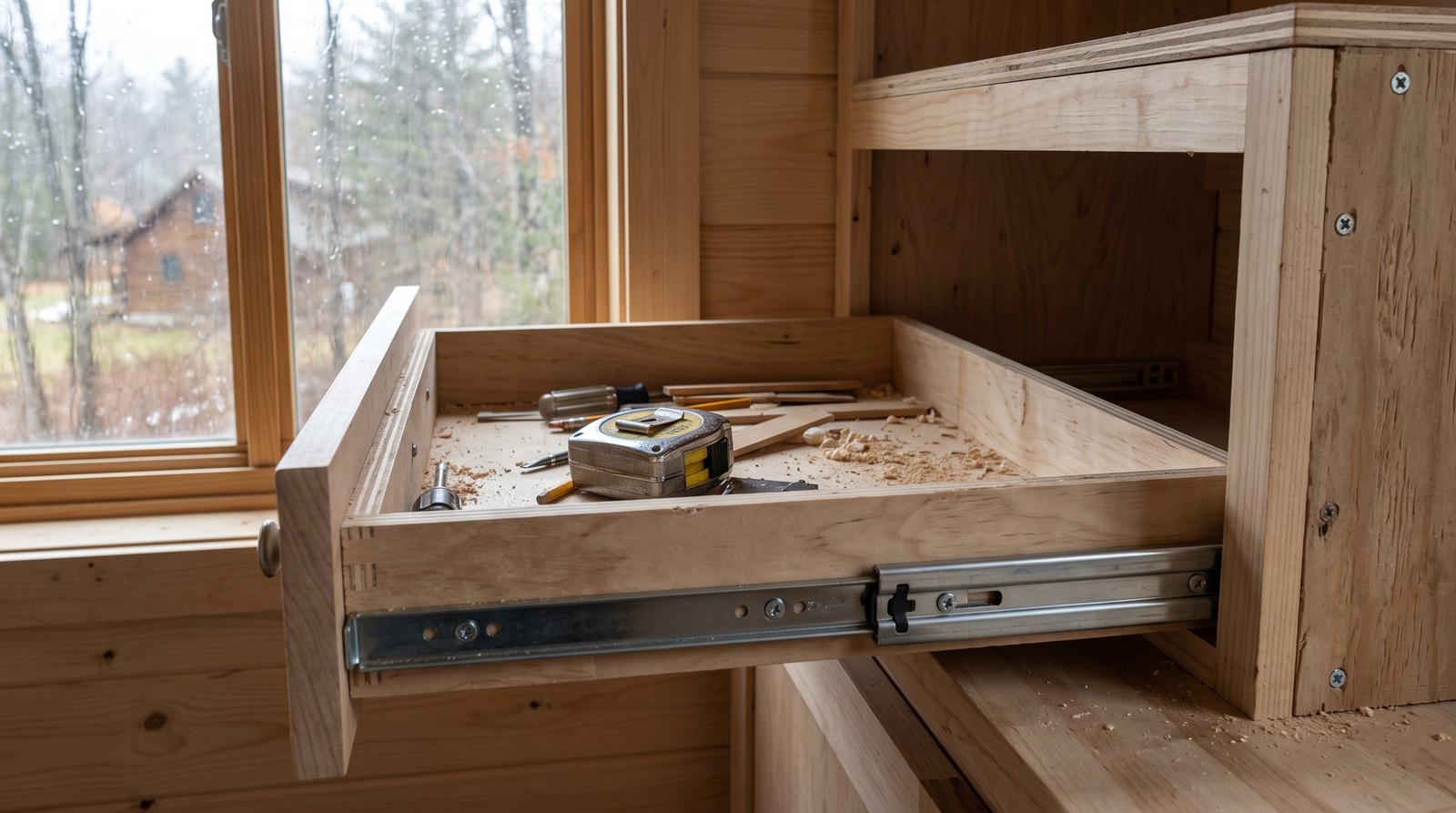
Most tiny houses need dependable, serviceable hardware rather than exotic hardware. The correct combination changes with how the house is used. A stationary cottage can prioritize quiet closing and easy adjustment, while a frequently moved THOW needs positive restraint, vibration resistance, and hardware that can be inspected without dismantling the cabinet.
- Foundation tiny house: Use quality concealed or surface hinges, soft-close slides, and magnetic or roller catches where needed.
- THOW moved occasionally: Add a positive travel latch to every door and drawer, even if the hinge or slide is self-closing.
- THOW moved frequently: Favor locking slides or robust secondary latches, through-bolted hardware where practical, and corrosion-resistant finishes.
- Lightweight cabinet doors: Choose compact hinges and small latches, but provide enough wood thickness for the screws.
- Heavy pantry drawers: Use full-extension slides with a documented load rating and reinforce the cabinet sides at the mounting points.
- Child-accessible storage: Add child-resistant devices where appropriate, but do not confuse them with travel-rated positive latches.
Which hinges work best in a tiny house?
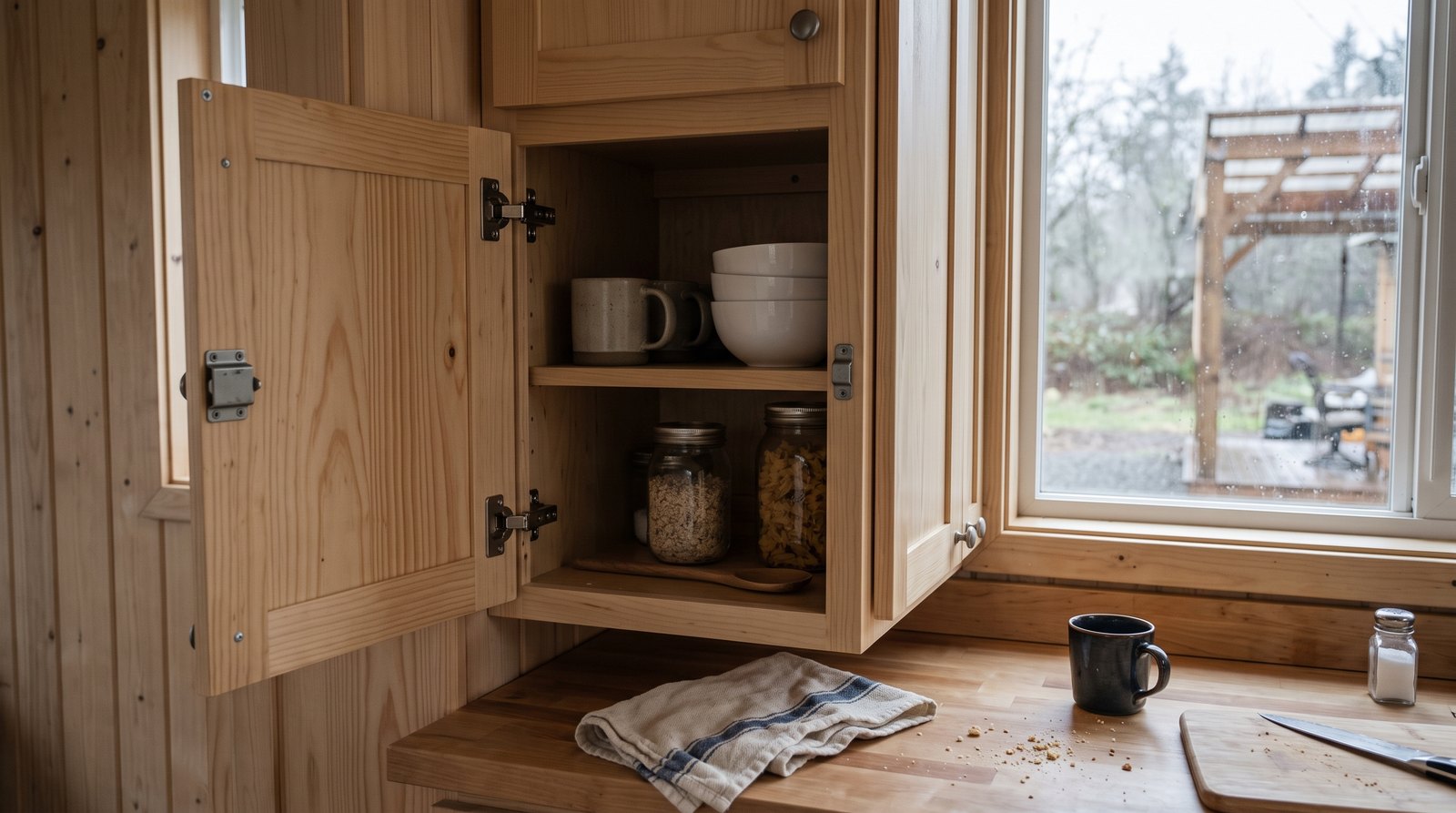
Concealed European-style hinges are usually the easiest choice for modern tiny house cabinets because they adjust in several directions and keep the hardware mostly hidden. Surface hinges suit thin doors, rustic cabinets, and simple repairs. In either case, match the hinge to the door style, thickness, weight, and required opening clearance.
A standard concealed hinge often opens about 110 degrees, which is enough for many upper and base cabinets. Wider-opening hinges can help beside walls or pull-out trays, but the door may project into a neighboring cabinet unless the geometry is planned. Soft-close models reduce slamming, yet soft close is not a travel lock.
Hinge quantity depends on door height, weight, material, and manufacturer guidance. Two hinges may serve a small light door, while a tall pantry door may need three or more. Do not rely on a universal chart from another brand. Dense hardwood, glass inserts, thick profiles, and storage racks attached to the door all add load.
Concealed hinge cups remove a meaningful amount of material from the back of the door. Current Blum installation information, for example, specifies a 13 mm boring depth for its integrated soft-close line, but other systems differ. Confirm the required cup diameter, depth, edge distance, and mounting plate before drilling. A test hole in matching scrap is cheap insurance.
How should you choose drawer slides?
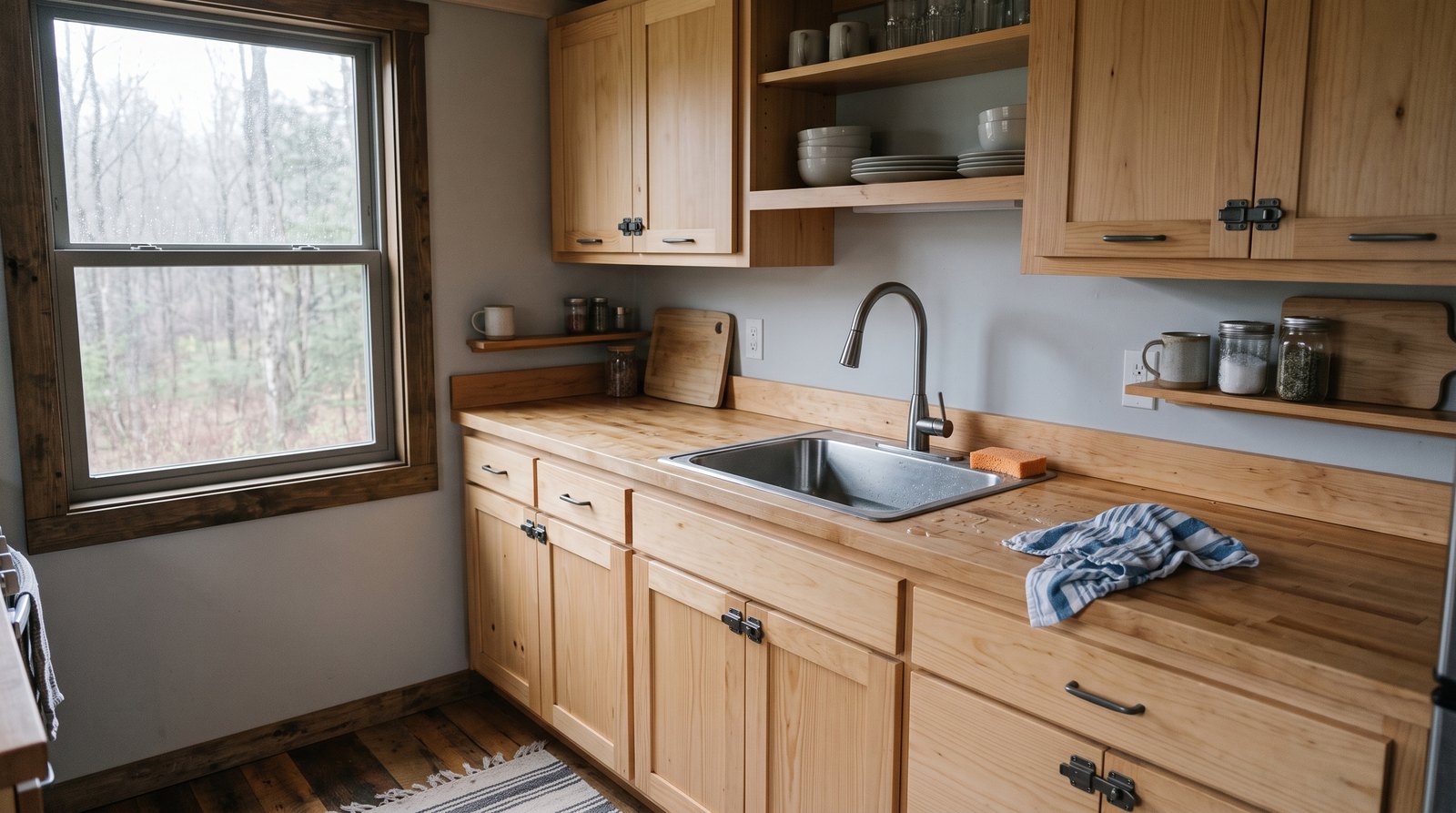
Choose drawer slides by measured drawer length, side clearance, extension, load, and travel conditions. Full-extension slides make deep tiny house storage easier to use. Soft-close slides improve daily comfort. For a THOW, use a positive latch or a true lock-in slide rather than assuming friction or a soft-close mechanism will hold on the road.
Estimate the loaded weight, not the empty drawer. A pantry drawer holding canned food, cookware, or tools becomes heavy quickly. Leave a sensible margin above the expected load. Also read the test conditions. Manufacturer data can assign a lower rating to the same slide in a vehicle or other vibration-prone application than in stationary furniture.
Lock-in and lock-out are different features. Lock-in holds the drawer closed. Lock-out holds it open, which can be useful for a work surface but may require a release lever. Some slides provide both. For kitchen storage, a separate low-profile positive latch is often less expensive and easier to replace than a specialty locking slide.
Do not mount a side-mount slide flat unless its technical sheet permits it. Flat mounting often reduces capacity substantially. Keep slides parallel and level, use the specified fastener locations, and add solid blocking if the cabinet side is thin. A slide screwed only into weak fiberboard can loosen even when the metal hardware is correctly rated.
What makes a good travel latch?
A good travel latch cannot release from ordinary vibration, yet it opens quickly when the house is parked. Positive mechanical latches are more dependable for travel than magnets, friction catches, or push-to-open mechanisms alone. The best location is easy to reach, does not snag clothing, and pulls the door firmly against its stop.
Common choices include draw latches, rotary latches, push-button latches, barrel bolts, hook latches, and simple turn buttons. Exposed latches are easy to inspect. Flush push-button hardware looks clean but requires accurate boring and enough clearance behind the door. Marine-style hardware can be useful in damp areas, although it may cost more.
Install the latch into solid material. If the cabinet has thin plywood, add a wood block behind the strike or latch body. Through-bolts with washers can be appropriate where the back is accessible and appearance allows. Recheck alignment after the house has been moved, since cabinet boxes and doors can shift slightly.
Before towing, empty especially heavy or breakable items from upper cabinets, engage every latch, and perform a pull test. The comparison in tiny house versus RV living explains why a THOW may resemble a house inside but still needs travel-minded storage habits.
Are knobs, pulls, magnets, and push-to-open hardware practical?
Knobs and pulls are practical when they are comfortable, low profile, and placed where they will not catch clothing in a narrow aisle. Magnets are useful for everyday closure in stationary homes. Push-to-open hardware creates a clean face, but it needs precise alignment and should receive a separate positive latch if the tiny house travels.
Test handles with your hand before buying a full set. A tiny finger pull may look minimal but feel awkward on a heavy drawer. Long bar pulls provide leverage but can snag pockets. Rounded tabs, cup pulls, and compact arches are often easier to live with in a tight kitchen.
Push-to-open catches need a consistent door gap and enough free movement for the spring to work. Warped doors, tight reveals, or over-compressed bumpers can make them unreliable. On a THOW, the push mechanism should manage normal opening while a separate latch handles road forces.
How do you mount and align cabinet hardware correctly?
Accurate layout and solid backing matter more than extra screws placed at random. Use the manufacturer’s template, drill square pilot holes, and install every required fastener. Align doors and drawers before setting latch strikes. Then cycle each part repeatedly under load and recheck it after the first trip or seasonal humidity change.
Cabinet sides made from thin plywood may need internal cleats or blocking. Plan those supports before the finished wall or adjacent cabinet closes access. If you are still building, photograph hidden blocking and save the dimensions. That record makes future repairs much easier.
Set hinges first, establish even reveals, then position catches and travel latches. A latch should draw the door closed without forcing it sideways. Drawer slides should remain parallel through their full travel. If a drawer binds, correct the cabinet or mounting geometry rather than using lubricant to hide the problem.
Movement also affects the rest of the home. Budget for a final hardware check when planning a relocation, along with the other items in our guide to tiny house moving costs in 2026.
How much does tiny house cabinet hardware cost in 2026?
For a small kitchen, expect roughly $250 to $800 for good hinges, slides, pulls, and travel latches before labor. A basic stationary installation can cost less, while premium undermount or locking slides can push the total higher. Count every door and drawer, then add mounting plates, strikes, screws, jigs, and spares.
Typical 2026 retail planning ranges are about $5 to $18 per concealed hinge, $15 to $45 per pair for ordinary full-extension slides, $50 to $120 or more for specialty locking or heavy-duty slides, $3 to $20 per pull, and $5 to $35 per positive latch. Sales, finish, length, and capacity change those figures.
Buy one sample of each unfamiliar part before ordering the whole kitchen. Test it on a mock-up or the least visible cabinet. Keep one spare latch, hinge, and slide disconnect in the house. Matching a discontinued finish several years later is often harder than storing a small labeled parts box.
How do you maintain cabinet hardware?
Inspect hinges, slides, pulls, and latches at least seasonally and after significant travel. Tighten loose fasteners before holes enlarge, clean debris from slide tracks, and replace bent or cracked parts. Use only lubricants approved by the hardware maker, since heavy oil can trap dust and contaminate wood finishes.
Watch for doors that sag, rub, or require more force than before. Those symptoms may mean a loose mounting plate, stripped screw, shifted cabinet box, or swollen door. Adjustment can solve a small alignment change, but a damaged screw hole needs repair or stronger backing.
In humid kitchens, bathrooms, and coastal climates, look for rust at screw heads, springs, and slide bearings. Replace corroded hardware before a latch loses strength. Stainless steel or corrosion-resistant finishes help, but the screws and backing material must also suit the environment.
Good hardware protects cabinets as well as dishes. Preventing doors from slamming and drawers from racking supports the long service life discussed in how long tiny houses last.
Frequently asked questions
Tiny house cabinet hardware works best when everyday convenience and travel safety are treated as separate jobs. The answers below cover the most common questions about latches, soft-close hinges, slide capacity, magnetic catches, and replacement holes. Manufacturer instructions and the condition of each cabinet still control the final installation.
Do all tiny house cabinets need travel latches?
A foundation tiny house usually does not need travel latches unless doors open from vibration or uneven floors. A tiny house on wheels should have a positive restraint on every door and drawer before towing. Soft-close hinges, magnets, and drawer friction improve daily use, but they are not dependable substitutes for mechanical travel restraint.
Can soft-close hinges keep cabinet doors shut while towing?
No. Soft-close hinges control the final part of closing and reduce slamming. They are not designed as highway travel locks. On a THOW, pair them with a positive latch that stays engaged under vibration and sudden movement. Test every latch by pulling firmly on the closed door before departure.
What load rating should tiny house drawer slides have?
Use the loaded drawer weight plus a practical safety margin, then confirm that the rating applies to your slide length, drawer width, mounting orientation, and mobile use. A 75 to 100 pound pair suits many kitchen drawers, but dense pantry goods, batteries, tools, or pull-out appliances may require a higher-rated system.
Are magnetic catches enough for a tiny house on wheels?
Magnetic catches are useful for neat everyday closure, but they should not be the only restraint during towing. Holding force depends on alignment, gap, and mounting strength, while road movement can act repeatedly on a loaded door. Add a mechanical latch that positively captures the door or drawer for travel.
Can I reuse existing screw holes when replacing hinges or slides?
Reuse holes only when the replacement hardware has the same verified pattern and the wood still holds screws firmly. Enlarged, stripped, or misaligned holes need repair, relocation, or added blocking. Do not force a different hinge or slide into old holes, since poor geometry causes binding, sagging, and early failure.