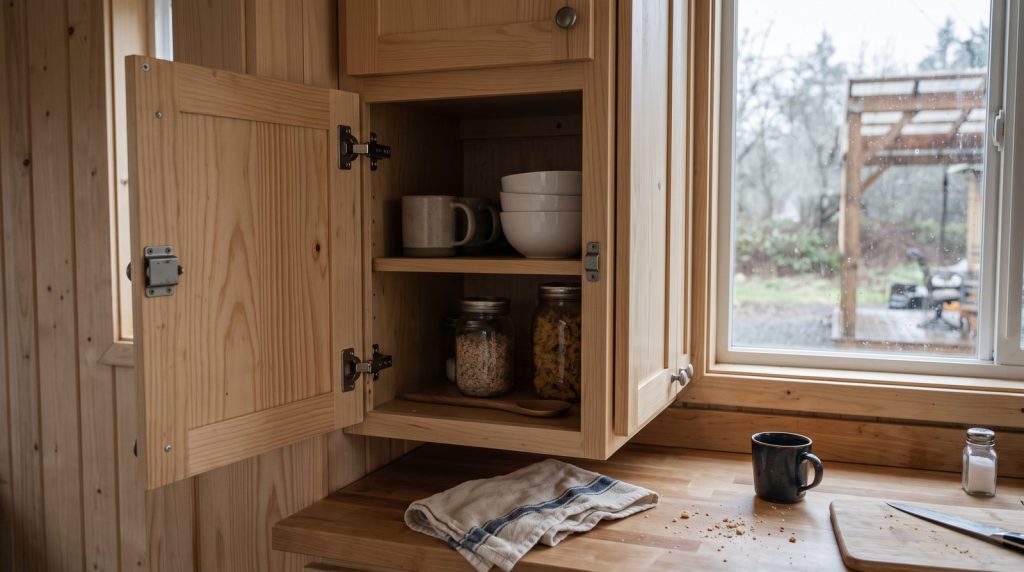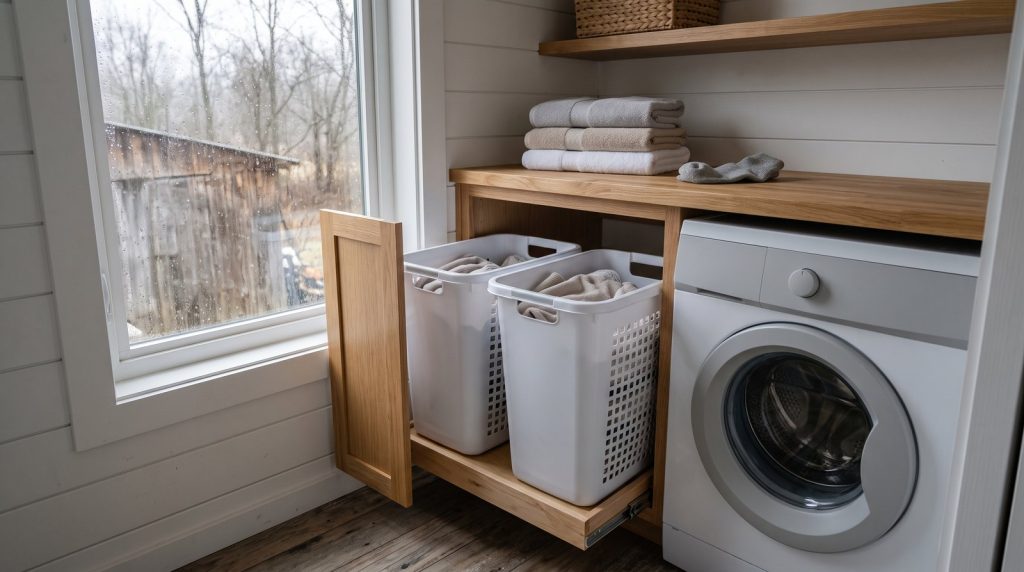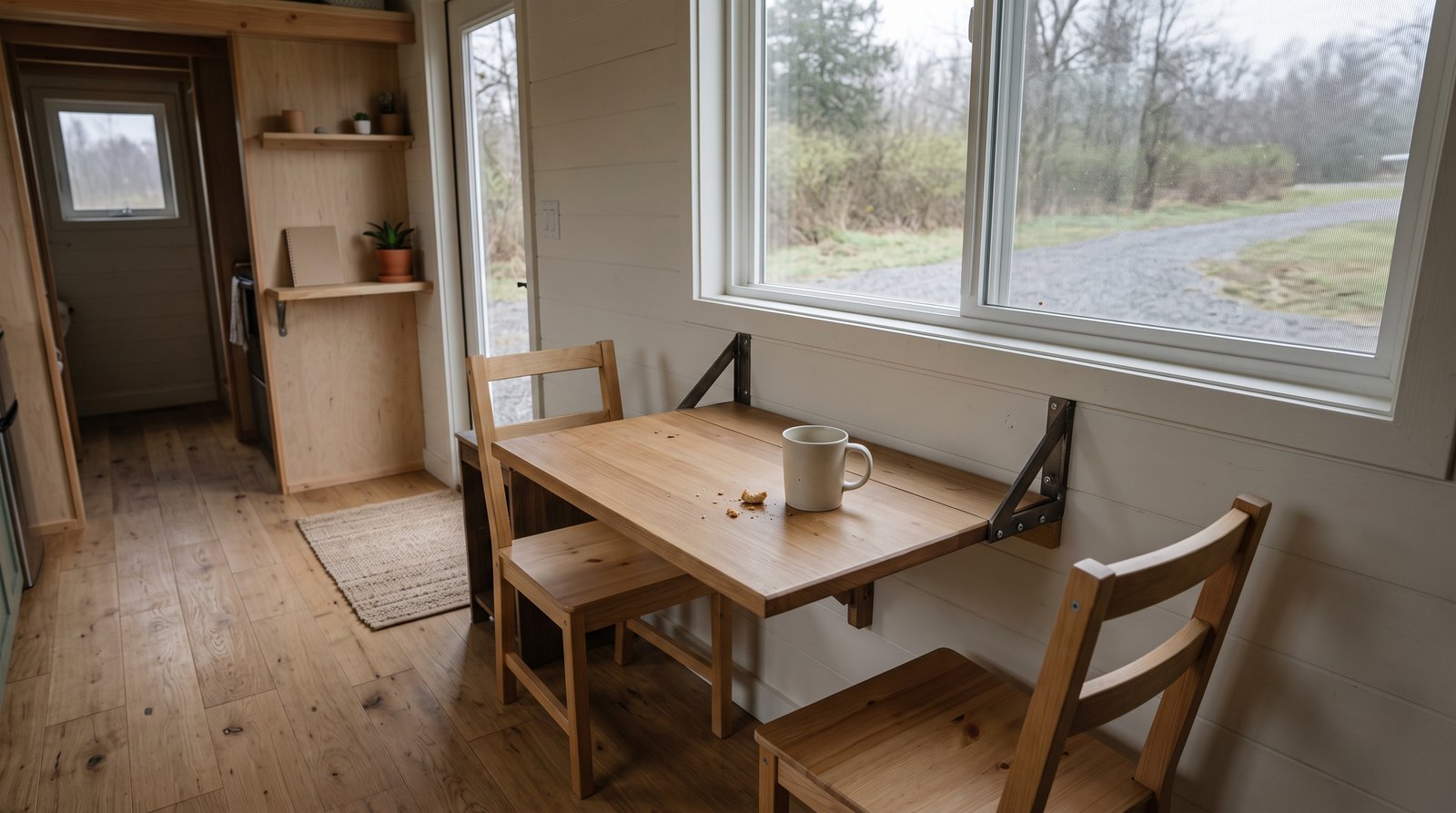
Tiny house convertible furniture works best when it solves a daily problem without creating a new safety or access problem. Choose pieces by measuring them both closed and open, confirm the stated load rating, fasten wall-mounted units into adequate structure, preserve exits and walkways, and add positive travel latches in any house that moves.
Table of Contents
Start With the Open Position, Not the Floor Plan
The correct furniture choice is the one that fits during its most demanding use. Measure floor space and headroom with chairs pulled out, a sleeper sofa fully extended, every cabinet door open, and the path someone needs to reach the bathroom or exterior door. A compact closed dimension can hide a surprisingly large operating zone.
Mark the proposed footprint on the floor with painter’s tape. Then mark the moving arc of a tabletop, bed platform, lid, or lift mechanism. Walk through the space while another person operates the piece. This simple test reveals collisions with ceiling fans, window trim, switches, cabinet pulls, and other furniture before money is spent.
Quick Answer by Situation
Match the mechanism to the job you perform most often, then favor the simplest design that handles it. Furniture that transforms three ways sounds efficient, but extra joints add weight, cost, and maintenance. The following starting points cover the most common tiny house needs without assuming one layout works for every owner.
- Daily dining for one or two: Use a wall-mounted drop-leaf table with folding chairs, provided the wall has suitable studs or blocking.
- Occasional remote work: Choose a shallow Murphy desk with a positive latch and enough depth for the actual laptop, monitor, and elbows.
- Regular overnight guests: Test a sleeper sofa in person and measure the bed fully open, including the route around it.
- Maximum storage per foot: Use a properly rated storage bench, but keep emergency gear and daily items outside deep bins.
- A THOW that travels: Prefer lighter pieces, mechanical travel latches, rounded corners, and attachment points designed for vibration.
- Full-time primary bed: Prioritize mattress support, ventilation, and dependable hardware over the smallest folded size.
Fold-Down Tables and Murphy Desks
A fold-down surface is usually the highest-value conversion in a very small room because it returns floor area when meals or work end. The safe version uses hardware sized for the top and expected load, fasteners matched to the wall structure, and a latch that cannot release accidentally when the surface is stored.
Decide whether the surface must hold only plates and a laptop or whether someone may lean on it. Those are different load cases. Published ratings apply only under the manufacturer’s installation conditions. One current heavy-duty bracket pair, for example, is rated to 500 pounds only with specified dimensions and mounting into wood studs. That rating does not transfer to unknown brackets, drywall anchors, or a wider top.
Place brackets far enough apart to resist twisting, but follow the hardware instructions rather than inventing spacing. Keep the top shallow enough that the front edge does not create excessive leverage. Use through-bolts or the specified structural screws where required. Ordinary drywall screws are brittle finish fasteners, not a substitute for structural attachment.
For a work surface, provide a protected path for charging cables. A cable should not cross a hinge, rub on a sharp edge, or hang where it can be caught when the desk closes. Store the monitor separately unless both the desk and mount are designed to fold together. Loose electronics can become projectiles in a moving house.
Convertible Sofas, Benches, and Beds
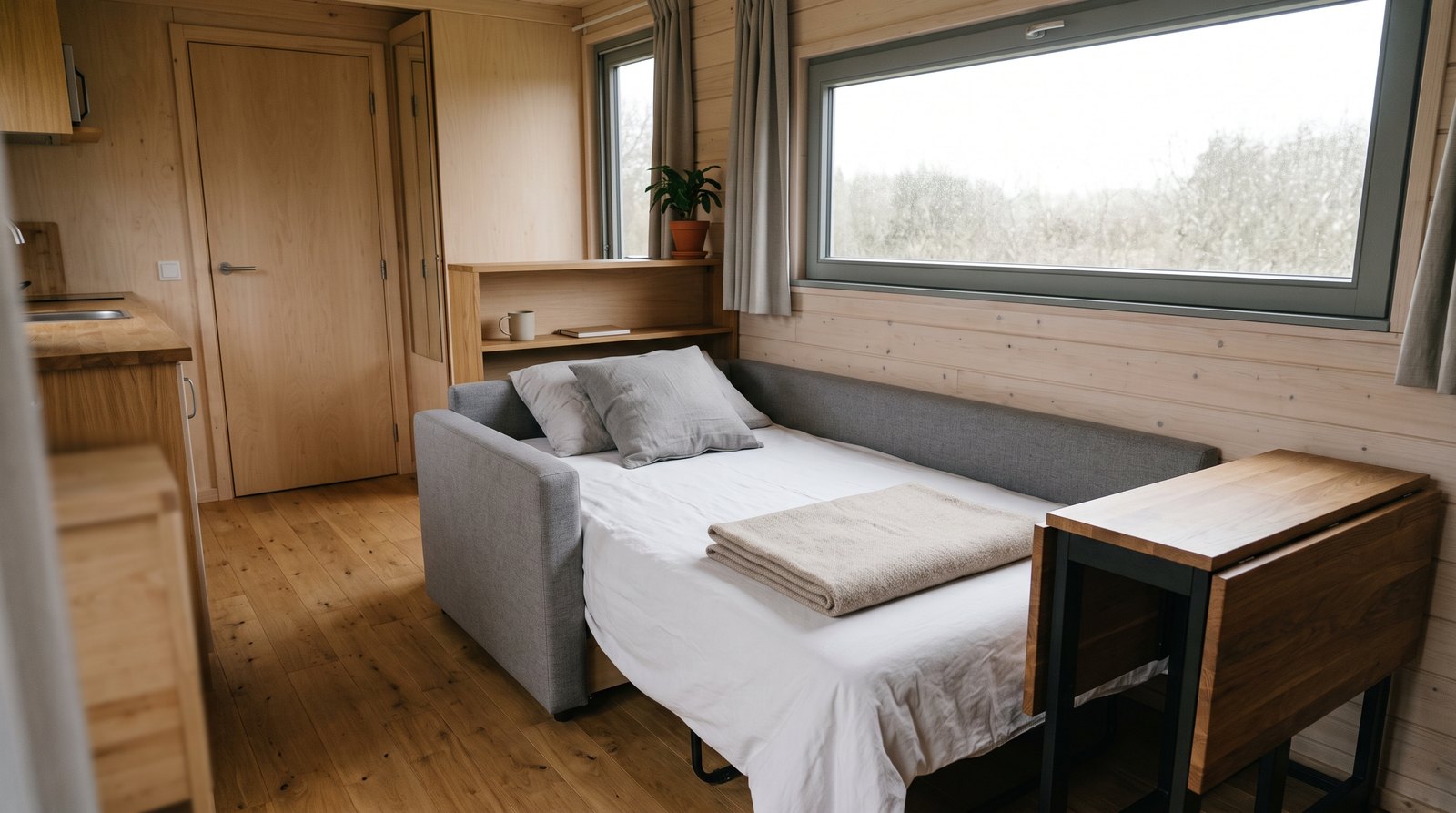
Convertible seating and beds earn their space only when both modes are genuinely usable. A sofa bed must remain comfortable for sitting, open without blocking the door, and support the sleeper without sagging. A storage bench must carry seated loads, ventilate its contents, and have a lid that cannot slam onto fingers.
Test a sleeper mechanism several times. Look for exposed scissor points, awkward lifting force, noisy joints, and cushions that have no storage location after conversion. Sit near the arms and front edge, not only in the middle. If guests will use it often, lie on the mattress for several minutes and check seams and support bars.
For storage benches, use the manufacturer’s seating capacity rather than assuming every box can serve as a seat. Hinged lids benefit from soft-close or lid-support hardware, but the hardware still needs periodic inspection. Do not fill the compartment with enough weight to make safe opening difficult. Frequently used items belong near the top or in smaller removable bins.
Wall beds and Murphy beds demand particular care. Recent CPSC wall-bed recalls involved units that could detach from the wall and fall. Use the exact installation instructions, correct wall type, specified anchors, and a qualified installer when the manufacturer calls for one. Never improvise around plumbing, wiring, or an uncertain wall assembly.
Blocking, Fasteners, and Structural Capacity
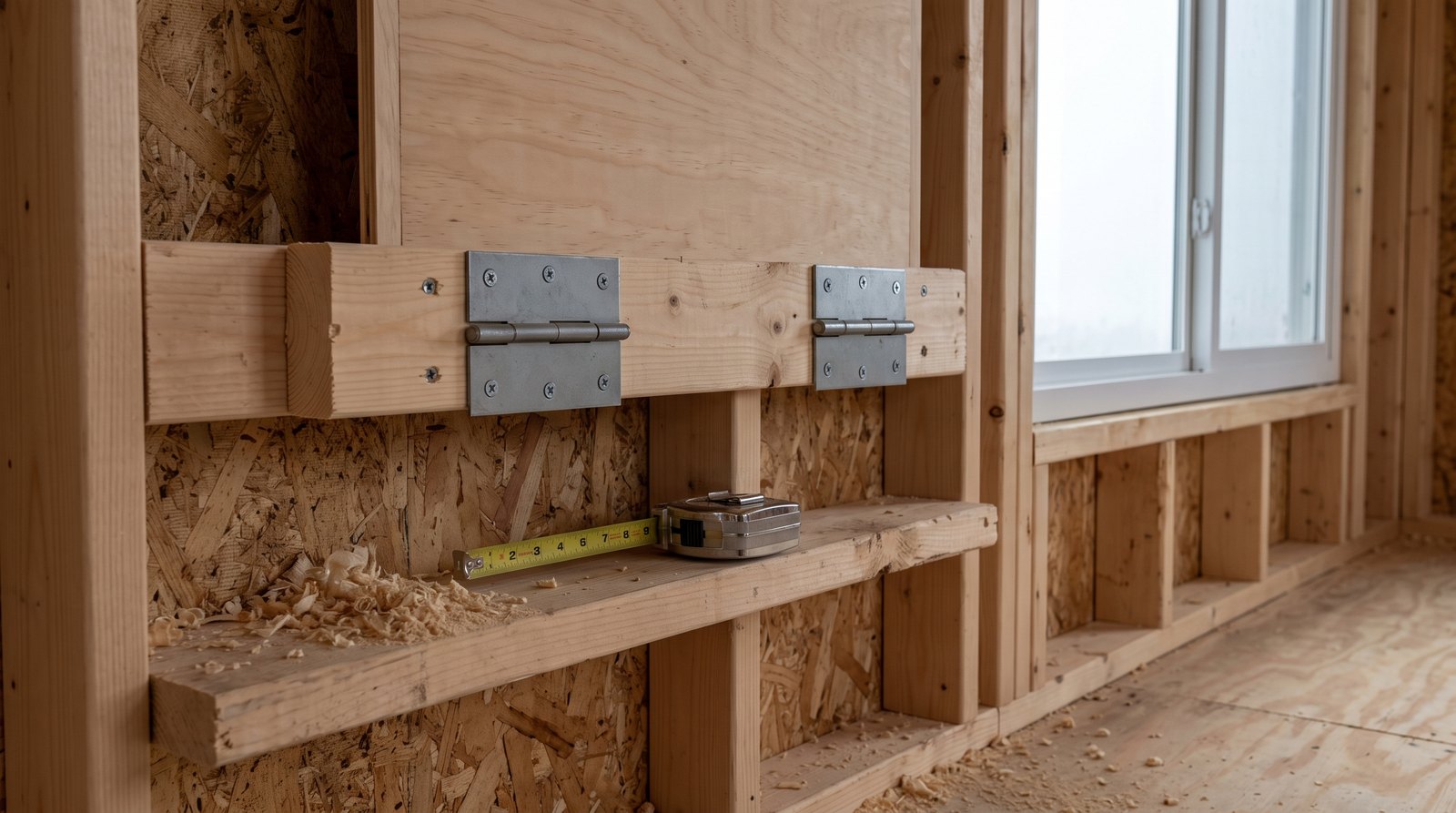
Wall-mounted furniture is only as reliable as the structure behind its visible hardware. The best time to add solid blocking is before interior wall panels go on. In a finished house, locate framing accurately, identify utilities, and confirm that the selected attachment method suits both the wall assembly and the furniture instructions.
Photograph blocking with a tape measure before covering the wall. Record dimensions from a fixed corner, floor, and window opening. Keep the photos with the house documents so a future owner can locate the structural backing without exploratory holes. Label the record, not the visible wall, and include the blocking material and fastener plan.
Do not treat a load rating as a promise for every installation. It may assume a specific number of fasteners, stud species, edge distance, bracket spacing, and rigid wall. The tabletop’s own weight counts against the capacity. Dynamic loads, such as a person dropping onto a bench or a table bouncing during travel, can exceed quiet household loads.
If the framing, fastener capacity, or load path is uncertain, ask the tiny house builder, furniture manufacturer, or a qualified structural professional. This matters especially near large windows, narrow wall piers, pocket doors, and thin metal framing. A neat installation can still be unsafe if the force has nowhere adequate to go.
Clearance, Pinch Points, and Emergency Access
Convertible furniture should never require an occupant to trade emergency access for floor space. Keep exterior doors, required escape openings, electrical panels, heat sources, and essential controls usable in every normal furniture position. Local building, fire, and vehicle rules vary, so confirm the exact requirements with the authority responsible for the home.
Operate each mechanism slowly and watch every joint. Common pinch zones include folding legs, lift-top linkages, sofa pullouts, bench lids, and the gap between a drop leaf and wall. Rounded edges, guarded hardware, soft-close supports, and deliberate handholds reduce risk. Children and pets should not be able to release a heavy folded panel.
Check the night layout separately. A bed that opens across the room may be acceptable only if someone can still reach the main door without climbing over another person. Keep smoke and carbon monoxide alarms unobstructed. Do not let bedding touch a heater, cover a floor register, or trap moisture against an exterior wall.
Travel Latches and Weight Distribution for a THOW
Furniture in a tiny house on wheels must be treated as cargo whenever the house moves. Secure every moving panel with a positive mechanical latch, restrain loose cushions and tabletop items, and verify the loaded house on a scale. A magnet or cabinet catch that works while parked may release under road vibration.
Use latches that require an intentional action to open, then position them where vibration cannot work the mechanism loose. Test the table, bench lid, sofa drawer, and wall bed before each move. Remove heavy loose objects from high cabinets. Protect windows and doors from furniture that could shift into them during braking or a sharp turn.
Added furniture changes total weight, axle load, side-to-side balance, and tongue weight. Guidance collected by NHTSA describes roughly 10 to 15 percent tongue weight for conventional trailers, but the tiny house manufacturer, trailer ratings, hitch ratings, tire ratings, and tow vehicle limits control. Weigh the fully loaded rig rather than estimating from catalog weights.
A 150-pound sleeper sofa placed far behind the axles does not affect the trailer like the same sofa near the axle group. Before changing heavy furniture, ask the builder how the layout affects the design balance. For broader comparisons between movable and code-built homes, see tiny house versus RV living and the guide to tiny house moving costs.
What Convertible Furniture Costs in 2026
Budget furniture can solve simple needs for under $200, while a finished wall-bed system can cost several thousand dollars before delivery and installation. Compare complete project cost, not only the product price. Blocking, fasteners, finish work, freight, professional labor, mattress requirements, and floor protection can materially change the total.
Current retail examples show the spread. A basic wall-mounted drop-leaf table is listed near $110, and a pair of heavy-duty folding worktop brackets is also near $110 before adding a top. Storage benches commonly run about $80 to $300. Sleeper sofa listings range from roughly $300 to $1,700, with size and upholstery driving much of the difference.
Wall-bed mechanism kits can start around $800, while more complete cut-and-milled kits are commonly above $2,000. Finished real-wood wall beds currently begin around $2,700 and can exceed $5,000 before options. Prices change, so use these as planning ranges and get a written quote that includes delivery, installation, warranty terms, and required wall preparation.
Spend first on the mechanism, structural attachment, and a useful open layout. Decorative finishes can be upgraded later. A durable piece often costs less over time than replacing a loose, uncomfortable, or overly complicated one. The same maintenance-first thinking appears in the guide to how long tiny houses last.
Cleaning, Inspection, and Daily Setup
Convertible furniture stays dependable when cleaning and inspection are part of the setup routine. Keep tracks free of grit, vacuum upholstery seams, tighten only the fasteners the manufacturer says to service, and stop using a mechanism that binds or shifts. Small changes are warnings, not invitations to force the furniture closed.
Every few months, look for elongated screw holes, cracked wood around fasteners, rust, loose hinge pins, frayed straps, bent latches, and rubbing cables. Check wall-mounted pieces after a move and after major humidity changes. Wood movement can alter fit, while road vibration can loosen hardware even when nothing looks displaced at first glance.
Practice the conversion sequence until every household member can do it safely. Clear the surface, move chairs, release the latch, support the panel, and lock the open position in the same order each time. Before travel, reverse the process and perform a separate latch check. A short checklist near the tow equipment can prevent an expensive mistake.
Frequently Asked Questions
Tiny house convertible furniture questions usually come down to strength, usable clearance, travel safety, and whether a complex mechanism will still feel convenient after the novelty fades. These concise answers cover the decisions owners most often face, but the product instructions and the home’s actual structure remain the final authority.
Is a wall-mounted table safe in a tiny house?
Yes, when the table is sized for the space, mounted into adequate framing or designed blocking, and installed with the specified fasteners and bracket spacing. Confirm the load rating includes the tabletop itself. Do not rely on drywall anchors alone unless the manufacturer explicitly approves that exact wall and anchor system.
What is the best convertible furniture for a THOW?
Lightweight, mechanically simple pieces with positive travel latches are usually best. A folding table, storage bench, or compact sleeper can work well if it stays within the trailer’s ratings and preserves balance. Weigh the loaded house, restrain every moving part, and follow the builder’s guidance before relocating heavy furniture.
How much clearance does a sleeper sofa need?
Use the manufacturer’s fully open dimensions, then add room to operate the mechanism and walk around the bed. Tape that footprint on the floor before buying. Confirm the open sofa does not block an exterior door, required escape opening, heater, electrical panel, bathroom route, or the only practical path through the home.
Can I attach a Murphy desk or wall bed to any wall?
No. The wall assembly, stud or blocking location, fasteners, utilities, and product instructions all matter. Some installations require professional work or specific anchors. Large windows, pocket doors, thin metal framing, and unknown renovations deserve extra caution. If the load path is uncertain, consult the manufacturer, builder, or a qualified professional.
Is custom convertible furniture worth the cost?
Custom work is worth considering when a standard piece blocks circulation, wastes an awkward corner, or adds too much weight. It is less compelling when a simple fixed bench and movable table already solve the problem. Compare drawings, materials, load ratings, hardware, installation, warranty, and repair access before approving the build.