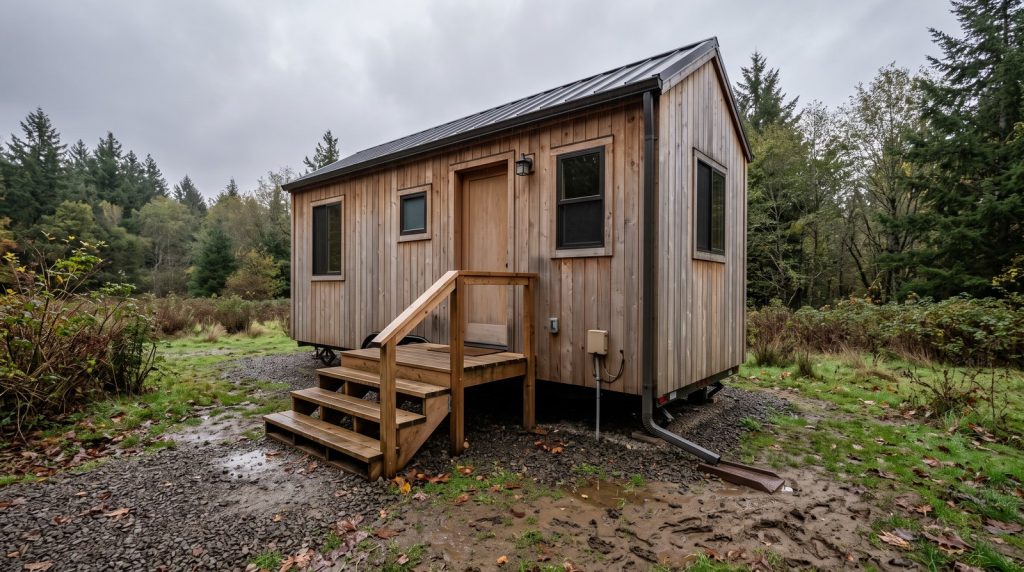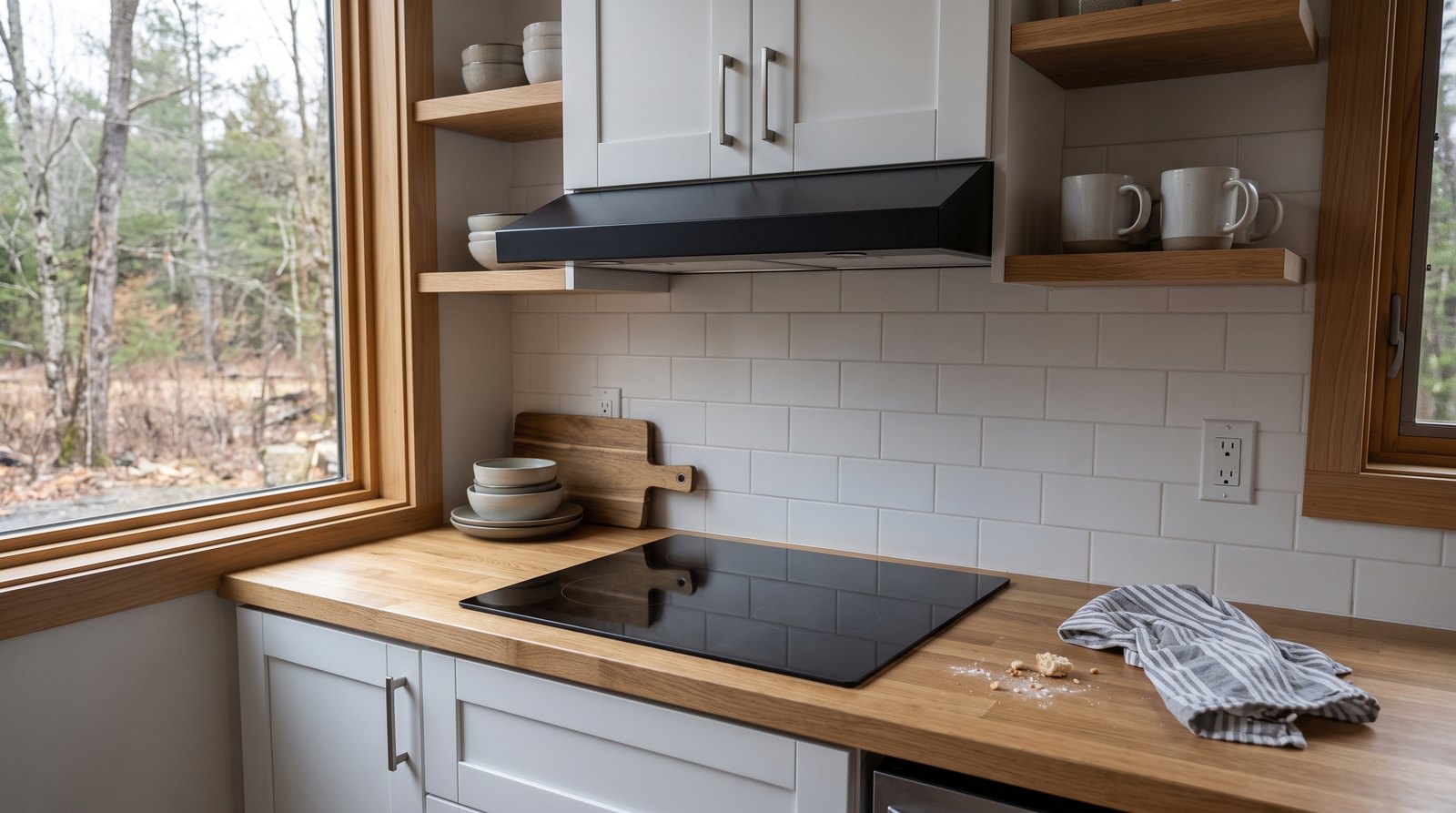
For most tiny houses, a range hood should vent outdoors. A ducted hood removes cooking moisture, grease, odors, heat, and airborne particles instead of returning them to a very small room. Choose recirculation only when an exterior duct is impractical, then accept that it is filtration, not true exhaust.
Table of Contents
Should a Tiny House Range Hood Vent Outside?
Yes, outdoor venting is the better choice whenever the structure and site allow it. A ducted hood captures contaminants at the cooktop and carries them out. A recirculating hood passes air through filters, but it leaves cooking moisture, excess heat, and any combustion byproducts inside the tiny house.
The EPA recommends venting a range hood outdoors when possible. It also advises using the hood whenever you cook, favoring the back burners for better capture, and leaving the fan on for 10 to 20 minutes afterward. Electric and induction cooktops avoid combustion at the burner, but the food and cooking oil still produce particles and moisture.
A recirculating hood can still be worthwhile in a rental, a temporary installation, or a tiny house where an exterior penetration is prohibited. Its metal grease filter catches some grease, and an activated carbon filter can reduce some odors. It cannot send water vapor or heat outdoors, and a saturated carbon filter stops helping until it is replaced.
Quick Answer by Situation
Match the hood to how you cook and where the tiny house is placed. Frequent frying, propane cooking, and tightly sealed construction favor a ducted hood. Light induction cooking may be manageable with a recirculating model, but only if you also control moisture and provide dependable whole-house ventilation.
- Foundation tiny house: Use a ducted hood with the shortest practical route to an exterior wall or roof.
- Tiny house on wheels used full time: Prefer a short wall duct, secure every component for travel, and protect the exterior cap from water and road vibration.
- Occasional induction cooking: A recirculating hood may be acceptable if exterior venting is impossible and a separate exhaust fan or ventilation system handles moisture.
- Propane or natural gas cooking: Use outdoor exhaust and have a qualified professional check depressurization, combustion air, and carbon monoxide protection.
- Rental or no-penetration site: Choose a convertible recirculating hood with accessible replacement filters, then open a window or use another outdoor exhaust path when conditions permit.
A THOW may be treated as an RV, a park model, or a dwelling depending on its certification, placement, and local rules. That classification can change which building, mechanical, fire, or campground requirements apply. Our tiny house versus RV comparison explains why the label matters, but the local authority and appliance instructions make the final call.
How Much Airflow Does a Tiny Kitchen Need?
A compact hood does not need extreme airflow, but it does need reliable capture at the cooking surface. Around 100 cfm is a useful starting point for a typical residential range, while 150 to 300 cfm gives many small kitchens more useful capacity. The correct number depends on the appliance, hood shape, duct, and code.
Delivered airflow also falls as resistance rises. A long duct, a reduced duct diameter, several tight elbows, a dirty grease filter, or a restrictive wall cap can turn a nominal 300 cfm hood into a weak performer. Compare the manufacturer's duct table and maximum equivalent length, not just the number printed on a product page.
Noise matters because an unused hood moves zero air. Compare sones at normal cooking speed, not only the loudest setting. A quiet low or medium speed that you run every day is more valuable than a high setting that is so loud you switch it off. Run the fan before cooking starts so airflow is established.
Duct Size, Route, Cap, and Backdraft Damper
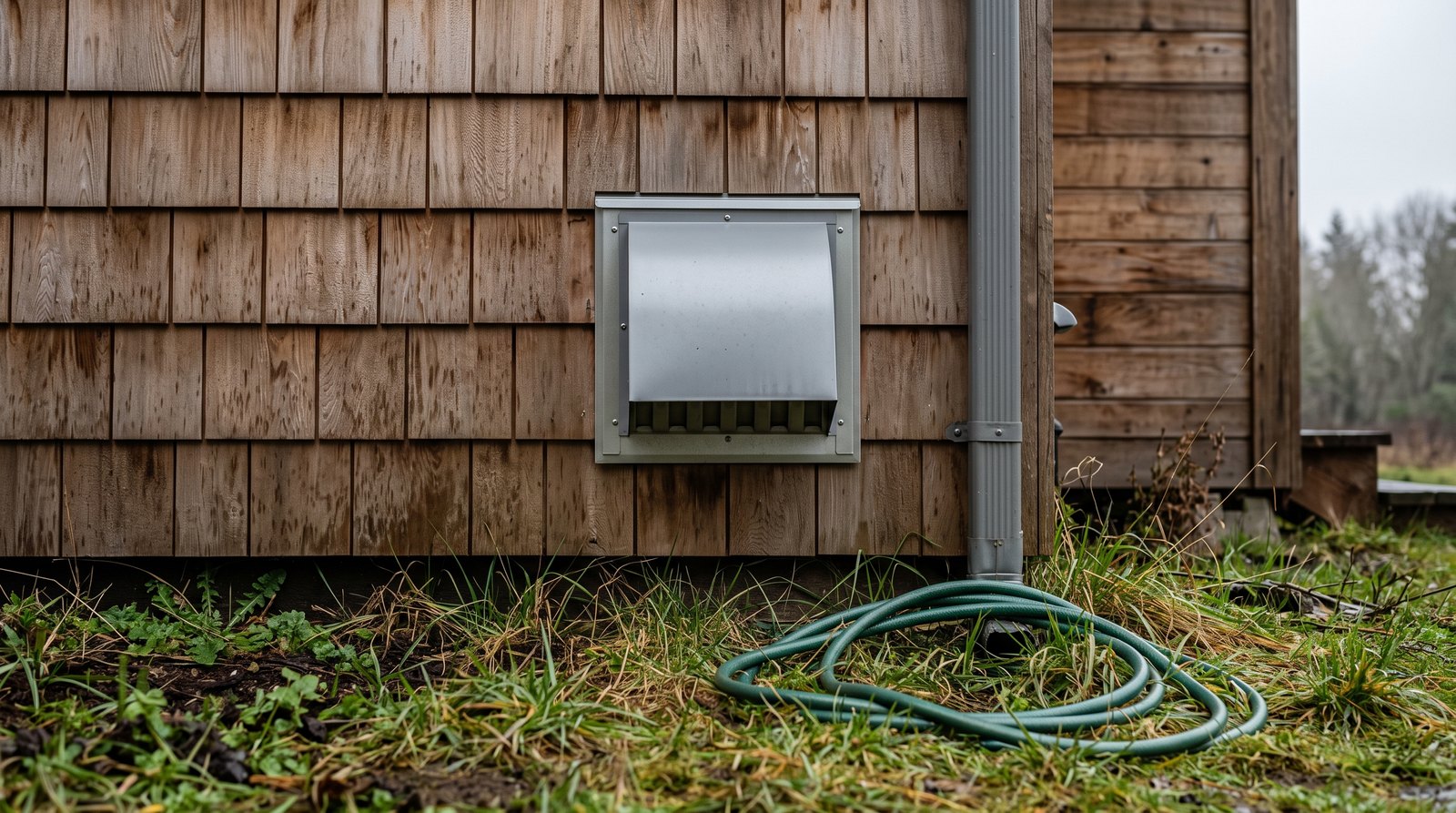
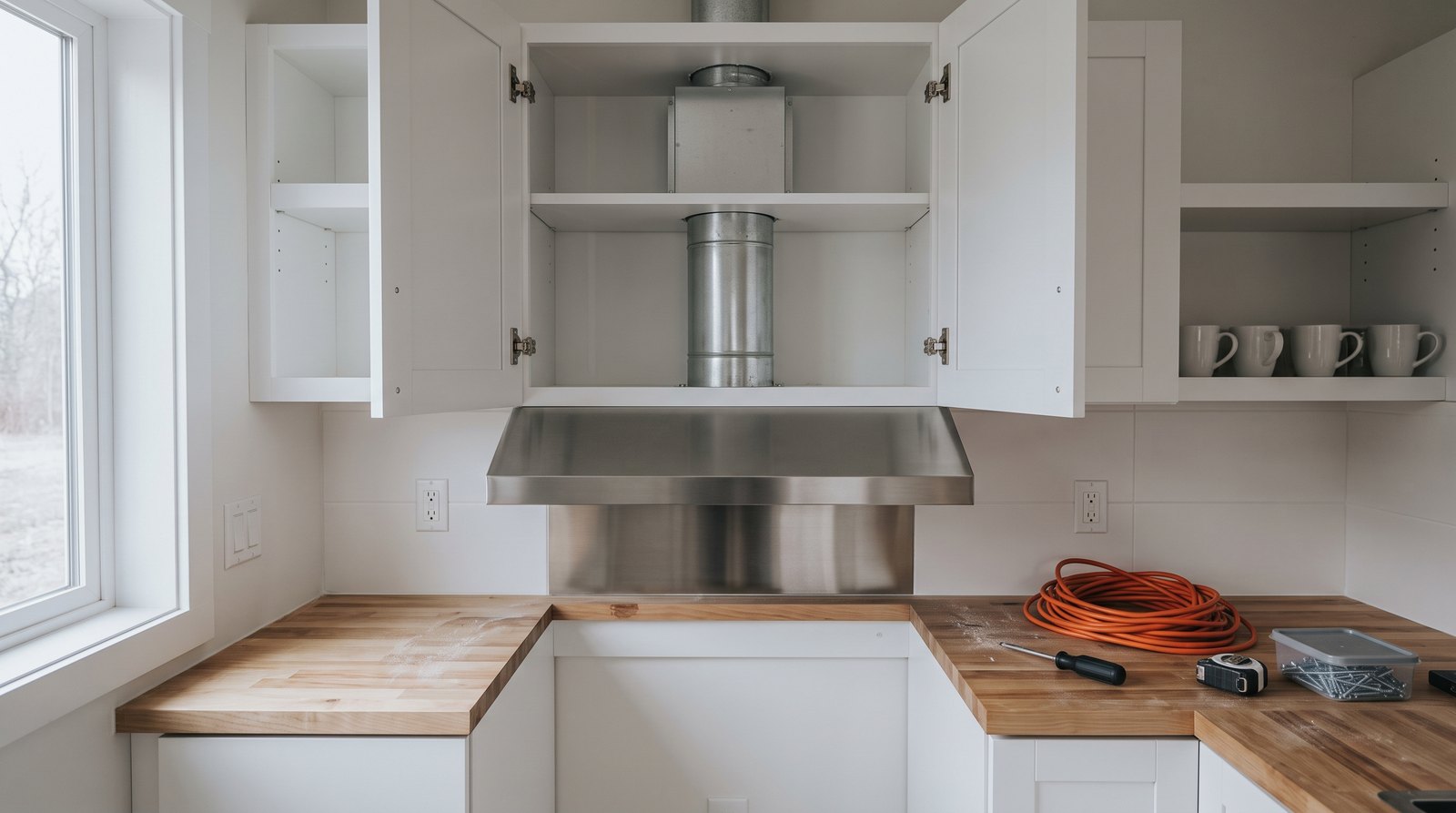
Use the duct size and material required by the hood manufacturer, keep the route short, and terminate outdoors with a proper cap. Six-inch round metal duct is common, but it is not universal. Never reduce a listed outlet just to fit a convenient cavity unless the instructions specifically allow that configuration.
Smooth rigid metal is usually the practical choice because grease can collect in the exhaust path and corrugated flexible duct adds resistance. Plan the route before buying the hood. A straight run through the wall behind or above the cabinet is often easier to seal and service than a roof run with multiple elbows.
The outlet must end outdoors, not in an attic, floor cavity, crawlspace, storage bay, or enclosed trailer skirt. The U.S. Department of Energy's kitchen exhaust guidance likewise says the fan should vent outdoors rather than into concealed building spaces. Warm, greasy air dumped into a cavity can create odors, stains, and moisture damage.
Use a listed wall or roof cap sized for the duct, with a backdraft damper that opens freely at the hood's actual airflow. Seal duct joints as the hood instructions specify, and seal the exterior penetration with compatible flashing and sealant. Do not rely on a layer of interior caulk to manage rain at the outer wall.
Makeup Air and Combustion Safety
A powerful exhaust fan can depressurize a tight tiny house, so makeup air deserves attention before installation. Air leaving through the hood must be replaced. Without a planned path, the fan may pull air through cracks, a wood stove, a natural-draft water heater, or another combustion vent, creating a backdraft risk.
The EPA specifically warns that high-airflow range hoods can draw carbon monoxide and other combustion products from natural-draft appliances into the living area. Many model codes use 400 cfm as an important makeup-air threshold, but adopted rules differ. Some jurisdictions set other limits or require testing based on the whole appliance layout.
Do not treat 399 cfm as automatically safe. A very tight shell, a small volume, several exhaust fans, or an atmospherically vented heater can create trouble at lower airflow. Have an HVAC or combustion-safety professional evaluate the house if it contains a wood stove, propane water heater, gas furnace, or other equipment that takes combustion air from indoors.
Clearances, Cabinets, and Electrical Details
The hood and cooking appliance manuals control mounting height, combustible clearances, and electrical connections. Do not borrow a clearance from a different model or assume that induction and propane installations are identical. Local mechanical, electrical, and fire rules may add requirements beyond either manual, especially in a certified THOW or park model.
Before ordering, measure the cooktop width, cabinet depth, ceiling height, and the space needed for the duct transition. The hood should cover the cooking surface as completely as the small kitchen allows. If a cabinet hides the duct, preserve access to electrical connections, filters, fasteners, and any damper that requires service.
Most small residential hoods use 120-volt power, but plug-in and hardwired models have different connection rules. Protect the circuit as required by the adopted electrical code and the manufacturer. Never route a flexible power cord through a wall, pinch it behind a cabinet, or share an undersized circuit with a high-load countertop appliance.
Installing a Range Hood in a THOW
A tiny house on wheels needs the same ventilation performance plus travel-ready support. Fasten the hood and duct to framing or approved blocking, not thin finish paneling alone. Add restraints where a filter, cabinet door, or removable duct cover could shake loose, and inspect the exterior cap after every move.
Do not place a wall cap where a tow vehicle, awning, porch component, or removable deck will block it at the destination. If the cap projects beyond the road-legal envelope or is vulnerable to branches, choose a lower-profile listed termination. Never tape a damper shut for travel and forget to release it.
Before moving, clean the grease filter, latch the cabinet, secure removable pieces, and check that the cap is closed. After arrival, inspect the joint, exterior seal, and damper before using the fan. Movement-related maintenance is part of the ownership cost, just like the items in our guide to moving a tiny house in 2026.
Filters, Cleaning, Noise, and Daily Use
Clean filters and an open exhaust path matter more than extra fan features. Wash a reusable metal grease filter on the schedule in the manual, replace disposable filters when loaded, and replace carbon filters in recirculating mode. A greasy filter cuts airflow and can become a fire hazard near the cooking surface.
Check the blower wheel and accessible housing for grease buildup after disconnecting power. Clean the cooktop area and crumbs that may smoke. Inspect the wall cap and damper for lint, insect nests, rust, or a sticky hinge. Do not spray cleaner into the motor or wash a filter that the manufacturer labels disposable.
Use the back burners when practical, turn the hood on before heat is applied, and leave it running for 10 to 20 minutes after cooking. Put lids on boiling pots when suitable. These habits reduce the amount of steam and particles that escape into the sleeping and living areas.
What Does a Tiny House Range Hood Cost?
Budget about $100 to $400 for a basic compact hood, with premium quiet models often costing $500 to $1,000 or more. Installation can cost less than the appliance for a direct replacement, or several times more when the job needs new ductwork, cabinet changes, electrical work, roof flashing, or makeup air.
For planning in 2026, a simple recirculating replacement may total roughly $200 to $700. A short, accessible ducted run through an exterior wall often lands around $600 to $1,800. A difficult roof route, structural work, upgraded wiring, or an automatic makeup-air system can push the project to $1,500 to $4,000 or more.
Do not save money by venting into a cabinet or concealed space, reducing the duct below the listed size, or leaving a rough hole around the cap. A modest hood on a short, correctly sealed duct usually gives better real-world service than an expensive high-cfm unit fighting a poor installation.
Final Installation Checklist
Choose the cooking appliance first, then design the hood, duct, power, and replacement-air path as one system. Confirm the local approval path before cutting the shell. The best tiny house range hood is one that fits the cooktop, captures reliably, stays quiet enough to use, and remains serviceable after the cabinets are finished.
- Read both appliance manuals and confirm the required mounting height and clearances.
- Verify that the hood width and depth cover the active cooking area.
- Use the listed duct size, a short rigid-metal route, and as few elbows as possible.
- Terminate outdoors with a compatible cap and working backdraft damper.
- Check makeup-air and combustion-safety requirements with the local authority.
- Provide the required electrical connection and circuit protection.
- For a THOW, secure the hood, duct, filters, and cabinet components for travel.
- Test airflow, noise, vibration, damper operation, and exterior sealing before closing the cabinet.
Frequently Asked Questions
Can a tiny house use a ductless range hood?
Yes, a tiny house can use a ductless or recirculating range hood when exterior venting is impractical. It can catch grease and reduce some odors with clean filters, but it does not remove moisture, heat, or combustion gases. Provide another reliable ventilation method and follow local and appliance requirements.
Is a 100 cfm range hood enough for a tiny house?
One hundred cfm can be a reasonable baseline for a small residential cooktop with a short, well-sized duct and good hood coverage. It is not an automatic answer. Gas input, cooking style, hood geometry, duct resistance, makeup air, and adopted code can justify a different airflow rating.
Does an induction cooktop still need a range hood?
Yes. Induction avoids burner combustion, but frying, searing, boiling, and baking still release particles, grease, odors, heat, and water vapor. A ducted hood remains the best source-control option. A recirculating hood can reduce grease and odors, but it cannot carry cooking moisture outdoors.
Can a range hood vent into a tiny house attic or loft cavity?
No. A ducted range hood should terminate outdoors through a listed wall or roof cap, not discharge into an attic, loft cavity, crawlspace, cabinet, or trailer skirt. Hidden discharge can deposit grease and moisture where it is hard to see, creating odor, damage, and fire concerns.
Do tiny house range hoods need makeup air?
They may. Many codes focus on hoods above 400 cfm, but a tight tiny house or a home with natural-draft combustion equipment can have depressurization problems at lower airflow. Ask the local authority and an HVAC or combustion-safety professional to evaluate the complete system before installation.