A tiny house water system is built one of three ways: a permanent hookup to city or community water, an onboard fresh water tank fed by a 12 volt pump, or a private well. Most people end up with a hybrid, using a hose hookup when one is available and a tank when it is not.
Table of Contents
Quick Answer by Situation
The right water system depends far less on the house than on the lot it sits on. A serviced RV pad, a rural parcel with no utilities, and a back yard behind someone else’s house all push you toward different equipment. Start with what the site can actually give you, then build the plumbing to match.
- Serviced lot or RV park with a water post: hose hookup, pressure regulator, inline filter, and heat tape. Simplest and cheapest path, usually $150 to $400 in parts.
- Raw land with no water service: fresh water tank plus a 12 volt pump to start, then price a well once you know how long you are staying.
- Rural land you own long term: a drilled well is the only path to unlimited water. Budget several thousand dollars and confirm well permitting with the county health department first.
- Moving every few months: keep it RV style. Tank, pump, quick disconnect hoses, and nothing plumbed rigidly to the ground.
- Cold climate, staying put all winter: heated hose or buried and insulated line, skirting, heat tape, and a tank you can drain fast if the power fails.
City Water Hookup: What You Need at the Post
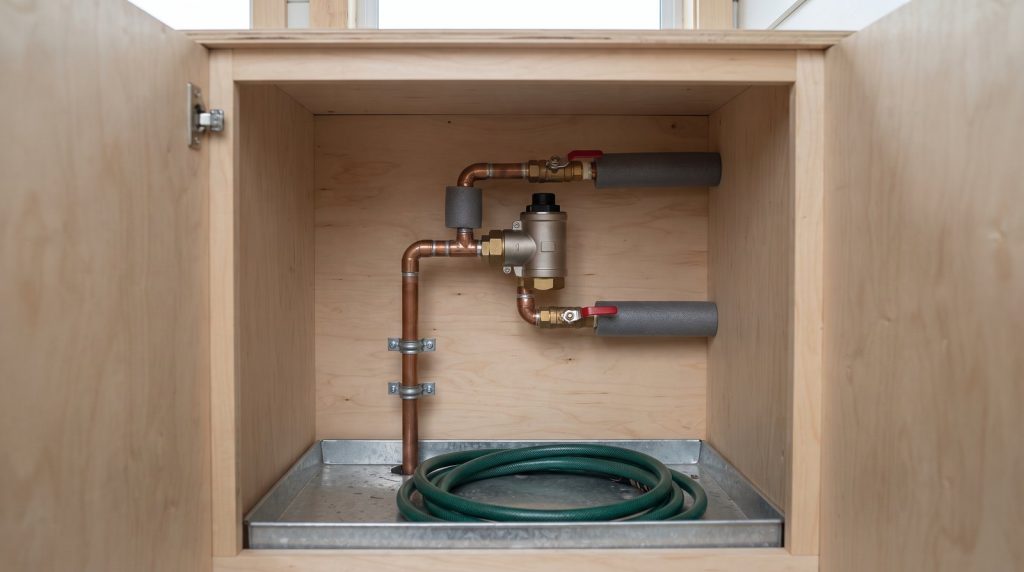
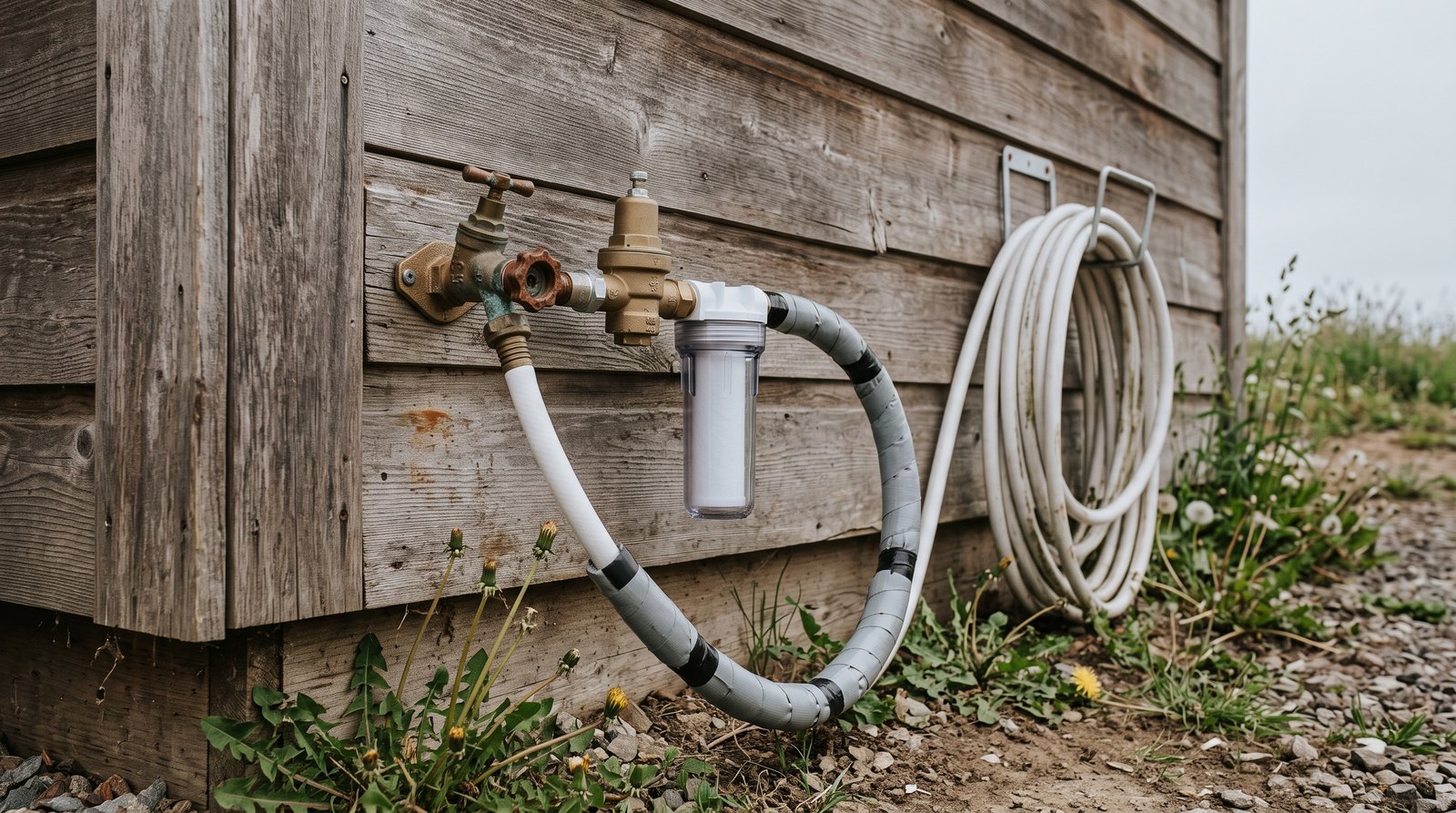
A city hookup is a hose from a spigot to an inlet on the wall of the house. It needs three cheap parts to be safe: a pressure regulator, an inline sediment filter, and a drinking water safe hose. Skip the regulator and you risk splitting a fitting the first time the municipal pressure spikes.
Household and campground water pressure commonly runs from 50 psi to well over 100 psi, and tiny house plumbing is usually PEX with crimp or push fit fittings built to RV standards. Most guidance for RV and tiny house systems puts the safe working range at roughly 40 psi to 50 psi, which is why fixed regulators are sold in that band. An adjustable regulator with a gauge costs more but lets you see what the post is actually delivering.
The hose matters too. Use a white or blue hose rated for drinking water rather than a garden hose, which can leach into water that sits in the line on a warm day. Add an inline filter at the inlet to catch sediment and rust, and change the cartridge on a schedule instead of waiting for the flow to drop.
Then protect the run from freezing with heat tape and a foam sleeve, or use a purpose built heated hose. A frozen supply line is the most common winter failure on a tiny house, and that repair is small money compared to what a burst line inside a wall does to a subfloor. Slow water damage is exactly what shortens the life of a build: see how long tiny houses last.
Fresh Water Tanks, Pumps, and Filters
An onboard tank makes the house independent of any hookup. A fresh water tank of 30 to 60 gallons, a 12 volt on demand pump, and an accumulator or pressure switch will run a sink and a shower normally. Two careful people typically use 15 to 25 gallons a day, so a 50 gallon tank is roughly two to three days between fills.
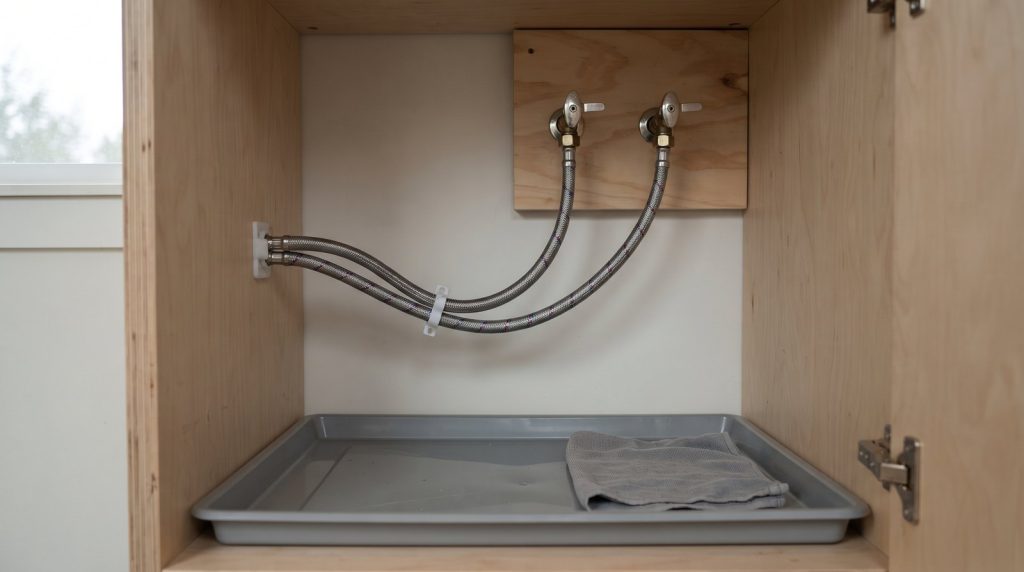
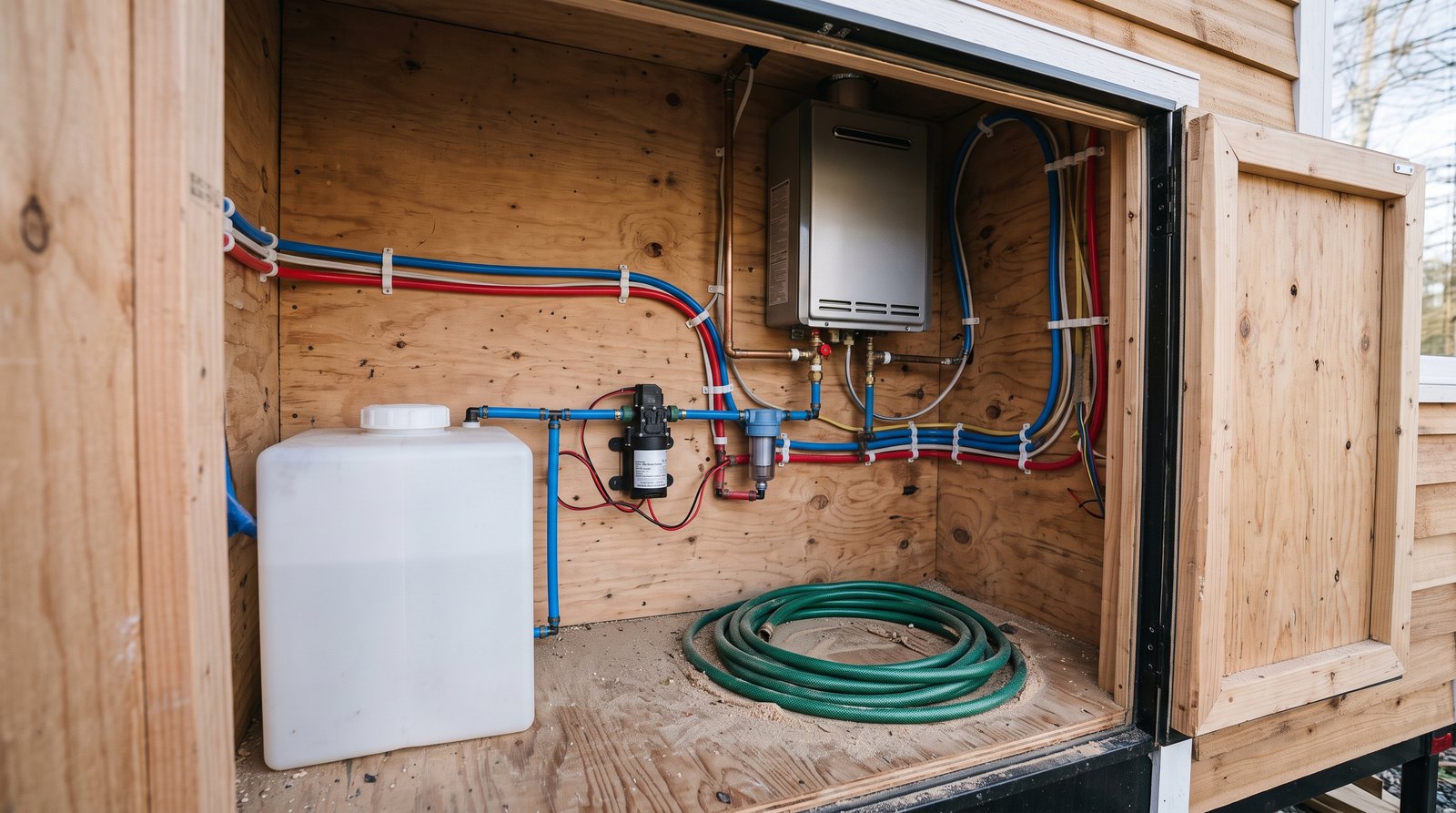
The pump is the heart of the system. A standard RV style diaphragm pump delivers around 3 to 5.5 gallons per minute and switches on whenever a tap drops the pressure. Mount it on rubber feet or a scrap of closed cell foam, because a pump bolted straight to plywood turns the whole floor into a drum. Put a strainer on the inlet side, and add a short braided flex line on each side so vibration does not work the fittings loose.
Filtration depends on the source. A municipal tap needs little more than a sediment filter. A spring, a shallow well, or an untested supply on someone else’s property needs a carbon block plus either an ultraviolet sterilizer or a point of use system for drinking water. Test any private source before you trust it, and test it again after flooding.
Filling is the part people underestimate. A gravity fill port on the exterior wall and a 50 foot potable hose covers most situations. If you are hauling, a 275 gallon tote in a truck bed plus a transfer pump is the common setup, and it is a wet, heavy job in January. Plan the fill route before you plan the shower.
Water Heaters for a Tiny House
Three options dominate: a tankless propane heater vented through the wall, a small electric tank of 2.5 to 6 gallons under the counter, and a 110 volt tankless electric unit. Propane gives long hot showers on a very low electrical draw. Electric is simpler to install but limited by the amperage the site can deliver.
Tankless propane is the default for off grid and for anyone on a 30 amp service. A typical RV or tiny house unit produces hot water continuously at a modest flow rate and draws only enough electricity to run the ignition and fan. The trade off is venting. It has to be installed to the manufacturer’s clearances with a proper vent kit, never improvised and never vented into a sealed space. Carbon monoxide is not a code technicality, it is the reason to hire a licensed installer if you are unsure.
A small electric tank suits anyone plugged into a 50 amp pedestal or a house panel. Six gallons is enough for a short shower and dishes if you are not doing both at once, and there is no combustion, no propane, and no venting to get wrong. Tankless electric sounds appealing, but the units that actually deliver hot water pull serious amperage, often more than a shared campground pedestal can give you. Whatever you pick, insulate the hot line and keep the run from heater to fixtures short.
Wells and Hauled Water
A private well is the only way to get unlimited water on raw land, and it is the single most expensive line item in a tiny house water system. National figures published for 2026 put complete residential well installation at roughly $25 to $65 per foot depending on geology, with drilling only quoted lower and hard rock quoted higher.
Depth is set by the aquifer, not by your budget. A shallow well in sandy soil may hit water in 50 feet, while granite country can mean 300 feet or more. Contractor pricing for 2026 shows soft soils at the low end of that per foot range and hard rock at the top, and a complete 200 foot well including casing, pump, pressure tank, and electrical commonly lands in the five figures. Get two or three local quotes, because geology moves the number far more than any national average can.
Before you call a driller, call the county. Most jurisdictions require a well permit, a minimum setback from any septic field or property line, and a water quality test before the well can serve a dwelling. Some counties will not permit a well for a structure they do not recognize as a legal dwelling, which is a real problem for a house on wheels. Confirm your own city or county rules in writing rather than relying on what a builder or a forum post tells you.
Hauling water is the honest middle path. It costs almost nothing to set up, it works anywhere, and it is genuinely tedious. Plenty of people haul for a year while they save for a well, and plenty decide hauling is fine because they are only on the land seasonally. If that sounds like RV living, that is because the systems overlap heavily: tiny house versus RV for full time living covers where the two actually diverge.
Grey Water and Black Water: Where It All Goes
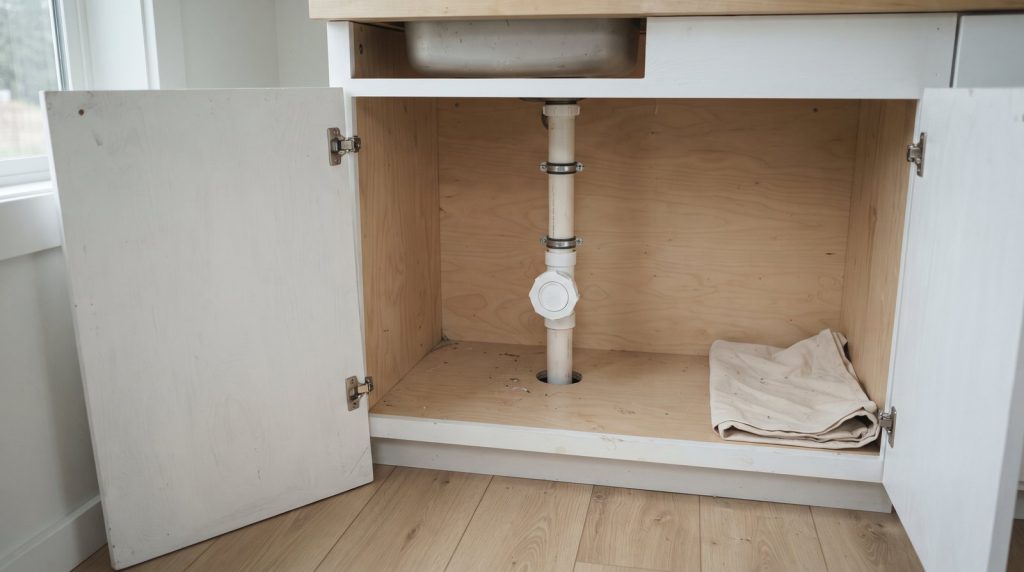
Grey water is everything from the sink and shower. Black water is toilet waste. Separating them is what makes a small system workable, because grey water can often be dispersed on site under state rules while black water almost always has to go to a septic system, a sewer, or a composting toilet.
Grey water rules vary widely and they have been moving. Arizona allows residential grey water systems under 400 gallons per day without a permit if you follow the state guidelines, New Mexico sets its no permit threshold at 250 gallons per day, and Massachusetts allows under 400 gallons per day for household irrigation and toilet flushing without a permit. Colorado House Bill 24 to 1362 took effect on January 1, 2026 and authorizes grey water use statewide, though it is aimed at new construction and indoor reuse rather than outdoor irrigation. California adopted onsite reuse regulations through the State Water Board in 2025 that set treatment and pathogen reduction standards.
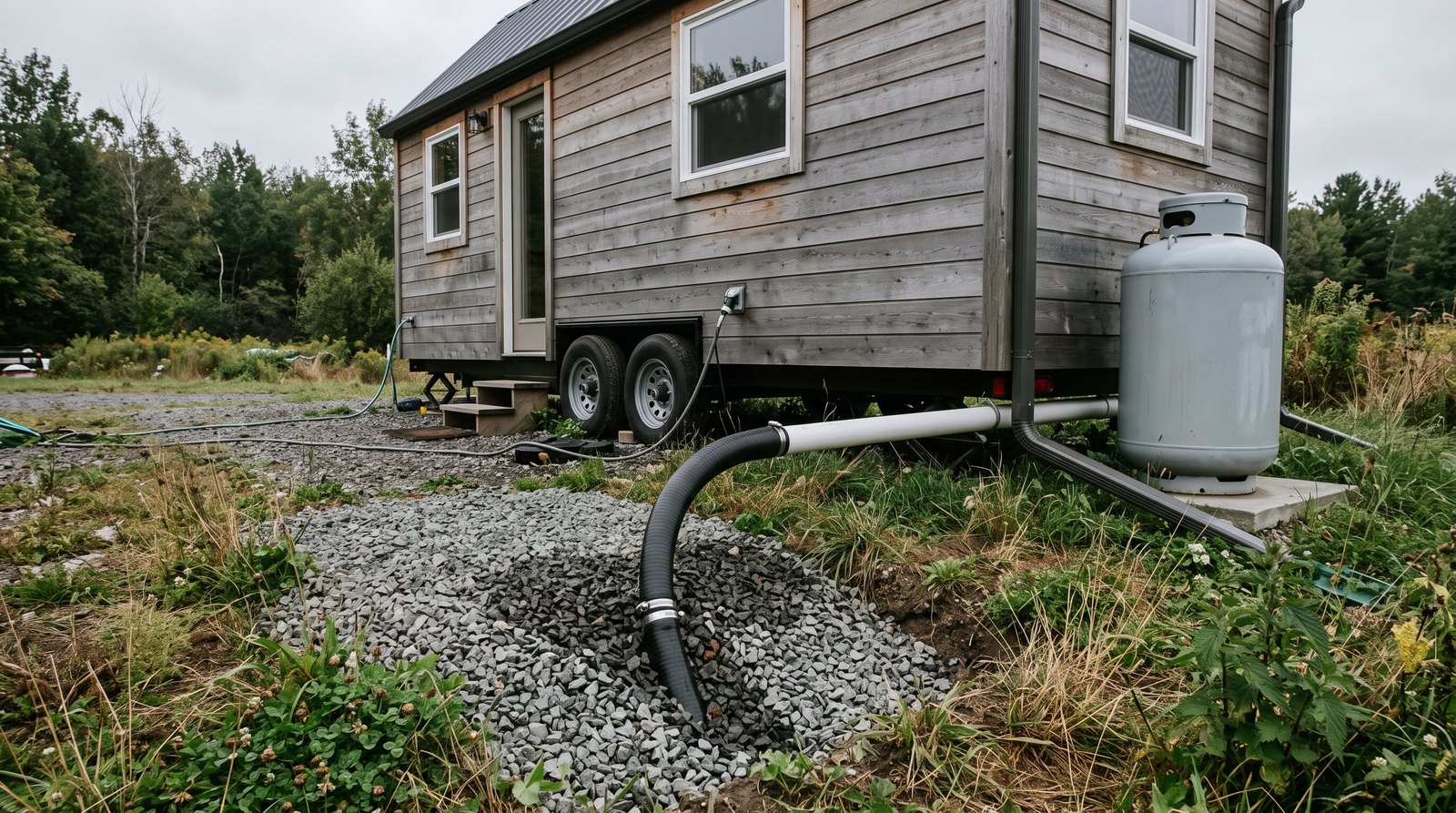
The pattern is consistent even where the numbers differ. Subsurface irrigation below mulch or soil is the most widely permitted use, surface ponding and runoff are prohibited, and kitchen sink water is treated more strictly than shower water because of grease and food solids. A gravel dispersal bed fed by a drain line is the common tiny house answer, sized for your soil and set back from wells and property lines. Confirm those setbacks with your city or county before you dig.
For black water, the practical choices are a composting toilet, an incinerating toilet, a cassette or holding tank you empty at a dump station, or a connection to septic or sewer. Composting is popular in tiny houses because it removes the black tank entirely, but it is not accepted everywhere as the sole sanitation for a dwelling. Ask your county what they will approve before you buy the unit.
Winterizing and Freeze Protection
Freeze protection is the difference between a water system that survives winter and one that costs you a subfloor. Protect four things: the supply line from the post, the tank and pump bay, the drain lines, and any pipe running through an uninsulated cavity. Anything that holds water and sits outside the insulation envelope is at risk.
If you are staying put on a hookup, use a heated potable hose or wrap the line in self regulating heat tape with a foam sleeve over it, and skirt the trailer so wind cannot move under the floor. Keep the utility bay inside the heated envelope if you can, or add a small thermostatically controlled heater rated for that space.
If you are leaving for the season, drain the system properly. Shut off the supply, open every tap hot and cold, drain the fresh tank and the water heater, blow the lines out with low pressure air, then pull RV antifreeze through the pump. RV antifreeze is nontoxic propylene glycol, not the automotive kind, and the difference matters because these lines carry drinking water. Leave the taps and the low point drains open while the house sits.
One more piece of advice from people who have lost a winter to this: know how your policy treats freeze damage before it happens. Coverage terms often turn on whether the house was occupied and heated at the time, which is a detail worth reading in advance rather than after. Our breakdown of tiny house insurance costs covers where those lines usually fall.
What a Tiny House Water System Costs in 2026
A hookup based system is the cheapest at roughly $150 to $400 in parts. A full tank, pump, filter, and water heater build lands in the $900 to $2,500 range depending on the heater. A drilled well is a different category entirely, commonly running from several thousand dollars into the five figures once casing, pump, and electrical are included.
Here is how the pieces price out for a typical build. A 40 to 60 gallon fresh water tank runs $120 to $350. A 12 volt diaphragm pump with a strainer is $80 to $220. A pressure regulator, inline filter, and potable hose together are $60 to $150. A tankless propane water heater is $250 to $700 plus the vent kit, while a small electric tank is $180 to $400. PEX, fittings, and a manifold for a house this size add $150 to $400 if you do the labor yourself.
Grey water handling is cheap on a rural lot and expensive anywhere with an inspector. A gravel dispersal bed you dig yourself is a weekend and a few hundred dollars in stone and pipe. A permitted, engineered system with a surge tank and a filter runs into the thousands. Septic connection, where it is required, is its own project and should be priced before you buy the land, not after.
The one number nobody quotes is your time. Filling a tank, hauling totes, thawing a hose at six in the morning, and emptying a cassette are small jobs that add up over a winter. That is the honest reason most people who stay in one place eventually run a permanent line or drill a well, even though the tank worked fine.
Frequently Asked Questions
How many gallons of water does a tiny house use per day?
Two people who are conscious of usage typically run 15 to 25 gallons a day for a sink, a short shower, and dishes. Add a washing machine or a long shower habit and it climbs quickly toward normal household numbers. A 50 gallon tank is roughly two to three days for a careful couple.
Can you use a regular garden hose for a tiny house water hookup?
Not for drinking water. Standard garden hoses are not rated for potable use and can leach into water that sits in the line. Use a hose labeled drinking water safe, add a pressure regulator in the 40 psi to 50 psi range, and put an inline sediment filter at the inlet.
Do you need a permit for a tiny house grey water system?
It depends on the state and the volume. Arizona and Massachusetts allow residential systems under 400 gallons per day without a permit when you follow the state guidelines, and New Mexico sets its threshold at 250 gallons per day. Many other states require a permit for any system, so confirm with your city or county.
What size water pump does a tiny house need?
A 12 volt diaphragm pump delivering roughly 3 to 5.5 gallons per minute handles a tiny house with one bathroom and a kitchen sink. Anything larger cycles hard and wastes water. Mount it on rubber feet, use flex lines on both ports, and install a strainer on the inlet side.
Is it cheaper to drill a well or haul water?
Hauling is far cheaper to start and far more tedious to live with. A well commonly runs from several thousand dollars into the five figures once casing, pump, and electrical are included. If you own the land and plan to stay more than a few years, the well usually wins on both cost and sanity.