Tiny house window coverings should provide privacy without sacrificing ventilation, safe egress, or usable wall space. Cellular shades are the best all-around choice for insulation, roller shades are simplest for travel, and washable curtains add softness. Choose cordless hardware, keep coverings clear of cooking heat, and check frequently for trapped condensation.
Table of Contents
Which window covering works best in a tiny house?
For most tiny homes, a cordless cellular shade is the strongest single choice because it combines privacy, a compact profile, and meaningful insulation. A cordless roller shade is better where easy cleaning and secure travel matter most. Curtains work well as a decorative second layer, but rarely make the best only layer.
The right answer depends on the window, not on a single look used throughout the house. A loft window may need a low-profile shade that cannot brush a sleeper. A kitchen window needs a cleanable covering that stays away from heat and splatter. A large living-area window can support layered privacy and insulation.
Quick answer by situation
- Cold climate: Use snug cellular shades, preferably with side gaps kept small.
- Hot, sunny site: Choose a reflective or light-colored cellular or roller shade, while still managing ventilation.
- Tiny house on wheels: Use cordless roller or cellular shades with positive lower retainers for travel.
- Kitchen window: Favor a short, washable roller shade or blind that cannot reach a burner.
- Bedroom egress window: Use a covering that releases instantly and stacks fully outside the required opening.
- Lowest budget: Start with stock cordless blinds or a simple curtain, then upgrade the coldest windows first.
Are cellular shades worth it for a tiny house?
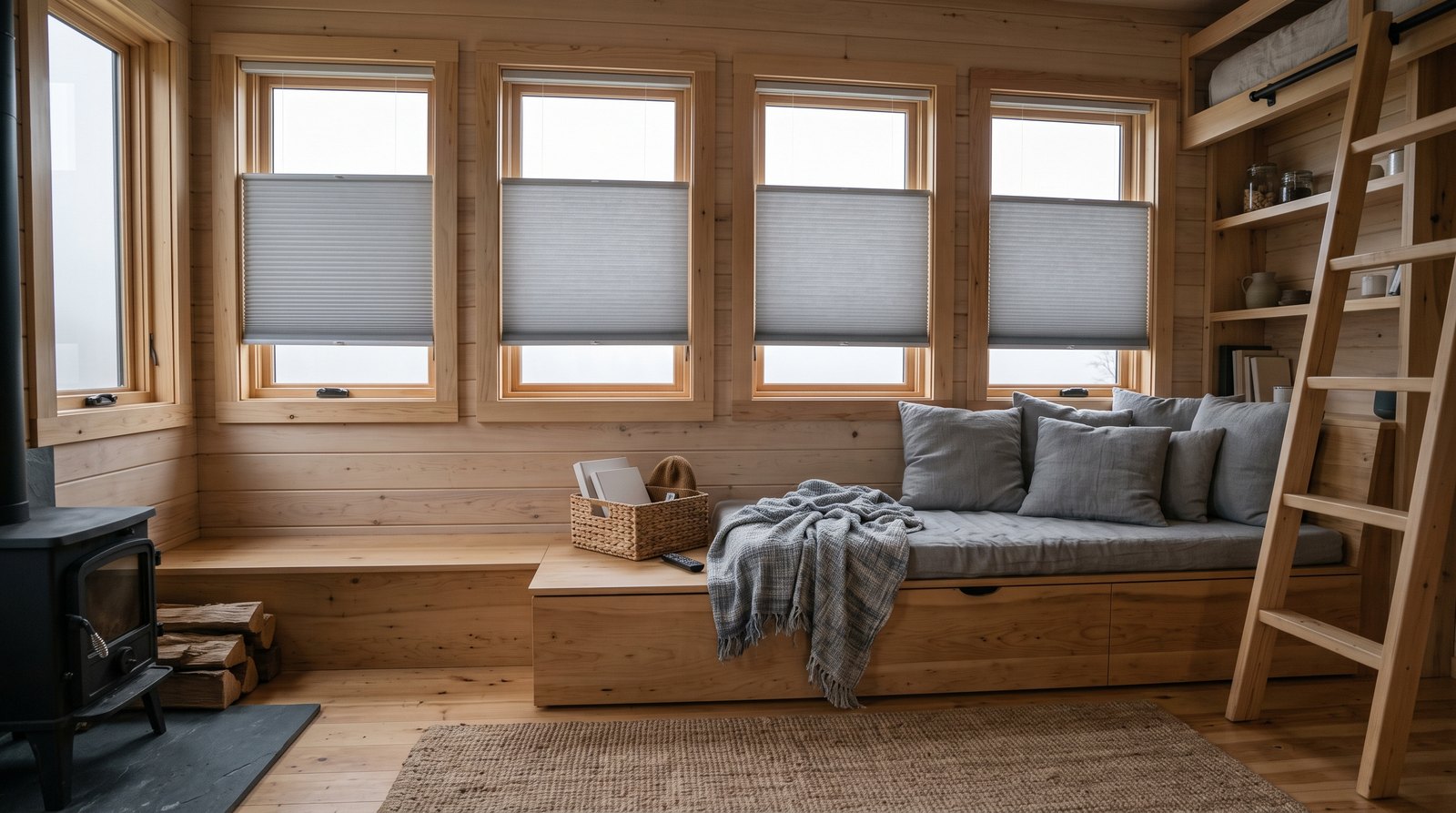
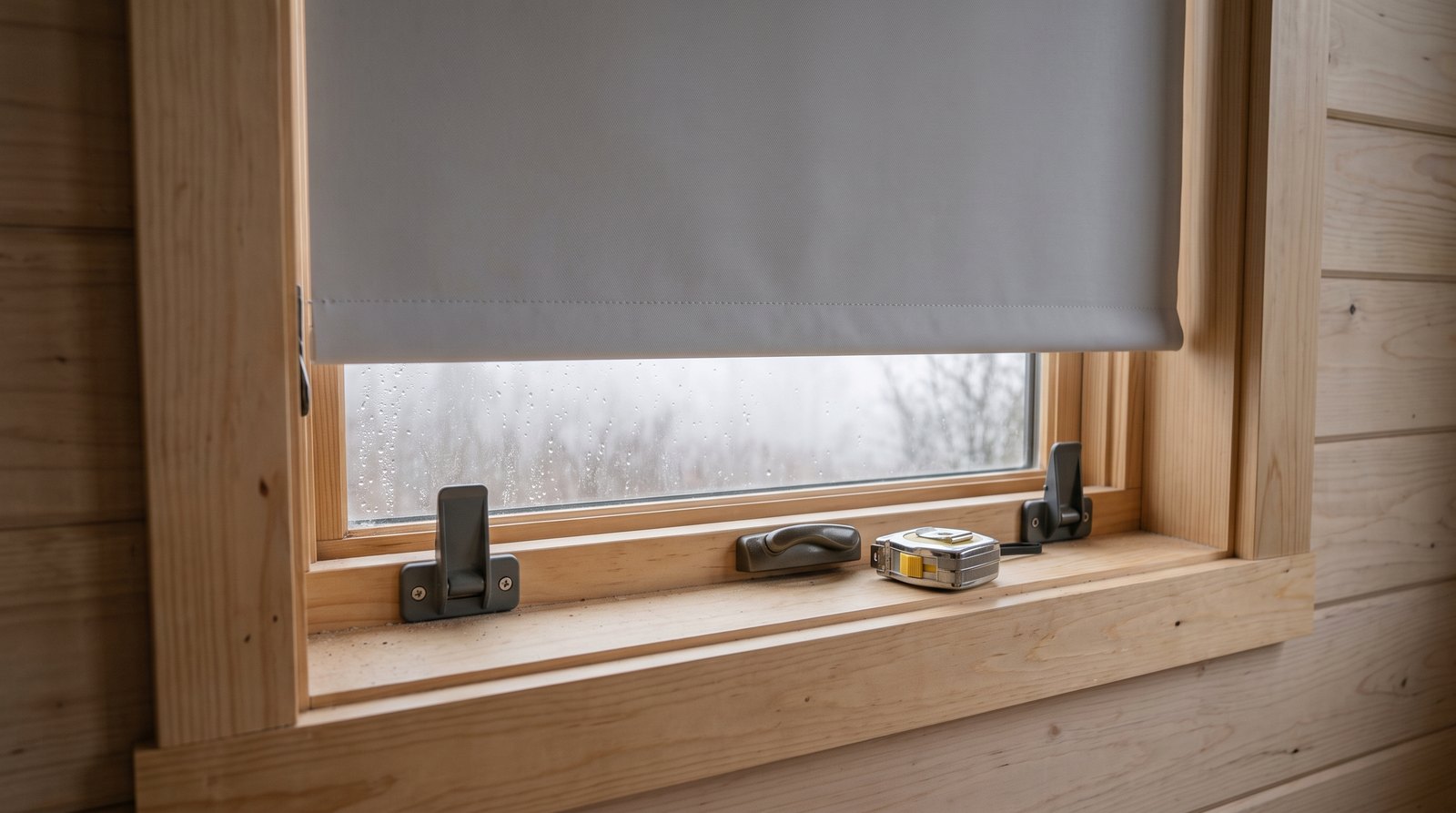
Cellular shades are usually worth paying more for when a tiny home has cold glass, strong summer sun, or limited heating and cooling capacity. Their honeycomb pockets trap air, so they insulate better than ordinary slatted blinds. An inside mount keeps the treatment compact, although accurate measuring is essential.
The U.S. Department of Energy reports that well-fitted cellular shades can outperform conventional vinyl blinds. In controlled research and modeling, cellular shades saved up to 20 percent of heating energy and up to 15 percent of combined heating and cooling energy compared with having no shade. Those are study results, not a promise for every house.
Fit matters almost as much as material. Large gaps at the sides and top let room air circulate behind the shade, reducing its benefit. Double-cell fabric generally insulates more than a thin single-cell product, but it costs more and forms a thicker stack when raised. For a frequently used egress window, verify that the raised stack and headrail stay out of the clear opening.
When are roller shades or blinds the better choice?
Roller shades are better when you want a shallow, easy-to-clean covering with few moving parts. Slatted blinds are useful when you need precise daylight control while preserving some privacy. Neither normally matches a good cellular shade for insulation, but both can be practical in wet, dusty, or travel-heavy tiny houses.
A quality roller shade disappears into a small roll, which is helpful above a countertop or beside a loft. Blackout fabric can improve sleep, while a light-filtering fabric reduces glare without turning the room dark.
Mini blinds are inexpensive and easy to tilt, but their cords, ladders, and thin slats collect dust. Aluminum slats can rattle on the road and bend if unsecured. Faux-wood blinds are stiffer but heavier and deeper. In a movable home, test the fully raised and fully lowered positions, then add manufacturer-approved hold-down brackets if available.
Do curtains make sense in such a small room?
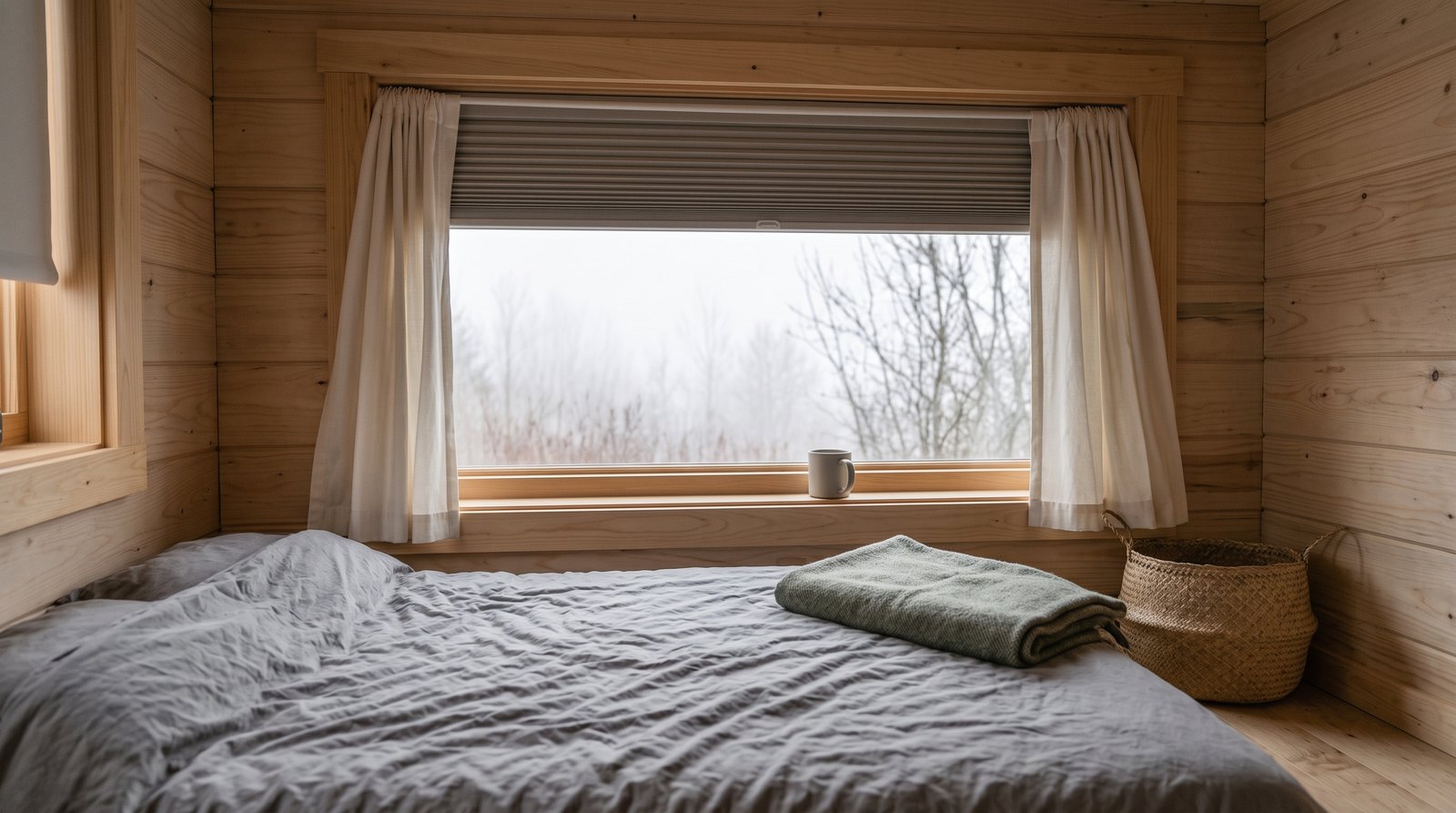
Curtains make sense when they are short, washable, and restrained by the layout. They soften hard surfaces and can improve nighttime privacy, but full-length panels consume visual space and can cover outlets, heaters, storage, or an emergency window. In most tiny homes, curtains work best as a light secondary layer.
Mount the rod wider than the glass so panels can stack beside the opening instead of across it. In a sleeping loft, cafe-length curtains or narrow side panels reduce fabric near pillows. In a kitchen, the U.S. Fire Administration advises keeping curtains and anything else that can catch fire away from the stovetop. Follow the appliance maker’s clearance instructions.
Removable insulated panels are another useful option for severe weather or occasional occupancy. A fabric-covered foam insert can reduce drafts overnight, then store under a bench during the day. Do not leave an airtight panel pressed against damp glass for long periods, and never use a slow or complicated panel on a required emergency opening.
How do you balance privacy, daylight, and the view?
Use top-down, bottom-up operation when close neighbors can see in but the upper part of the window faces sky or trees. For full daytime privacy, choose an opaque or privacy-rated fabric rather than assuming a light-filtering shade blocks silhouettes. At night, test the covering from outside with the interior lights on.
A layered setup can be surprisingly compact: one inside-mounted cellular or roller shade for real privacy, plus short side curtains for texture. Avoid bulky valances and deep double rods unless wall space is generous. If the tiny house doubles as a workplace, position screens perpendicular to the brightest window and use an adjustable shade for glare.
Use strong privacy treatment at eye level and lighter coverings on clerestory windows. For more layout context, compare tiny house versus RV living.
Can shades make condensation worse?
Yes, a tightly closed shade can make condensation worse by reducing warm-air circulation across cold glass. Check behind insulated coverings on winter mornings, wipe wet sills promptly, and open the shade for part of the day. The goal is insulation without creating a hidden pocket where moisture repeatedly wets wood or fabric.
ENERGY STAR specifically recommends window treatments that allow airflow over the window surface. The EPA says indoor relative humidity should remain below 60 percent where possible, with 30 to 50 percent an ideal general range. In a tiny house, cooking, showering, drying laundry, and unvented combustion can change humidity quickly because the air volume is small.
Run an externally vented bath fan during showers and a range hood during cooking, then continue ventilation afterward. Use an inexpensive hygrometer rather than guessing. If water appears daily, address the moisture source, air leakage, window installation, or ventilation system instead of treating the shade as the entire problem. Persistent wetting can damage finishes and shorten service life, a concern also covered in how long tiny houses last.
What safety rules matter most?
The priorities are simple: choose cordless products, preserve every required emergency opening, keep fabric away from heat, and install hardware into sound material. A covering must not require a key, tool, or complicated sequence to clear an egress window. Rules vary, so confirm the adopted code with the local building department.
The Consumer Product Safety Commission says cordless coverings are the safest choice where young children are present. Current federal guidance for stock products generally requires operating cords to be cordless, inaccessible, or short. Do not create a travel tie that forms a new loop, and do not place a bed or climbable furniture beside an accessible cord.
Codes commonly require certain sleeping-room windows to serve as emergency escape and rescue openings. ICC provisions focus on operability from inside and on preserving the required clear opening. A curtain rod, hold-down clip, deep headrail, insect screen, or storage shelf should not make escape slower. Open the window fully during your installation test, not just the shade.
Near cooking equipment, use a short treatment that cannot swing toward a flame or heating element. Near a wall heater, wood stove, or baseboard heater, follow the equipment listing and installation manual. Do not invent a generic clearance. The required distance depends on the appliance, shielding, wall construction, and local approval.
How should coverings be secured for travel?
In a tiny house on wheels, the best covering is one that stays quiet and controlled in both raised and lowered positions. Use positive retainers supplied or approved by the manufacturer, remove loose decorative parts, and test on a short trip. Never let a travel clip prevent emergency operation once parked.
Roller shades can use small lower hold-down brackets. Some cellular shades accept side tracks or bottom-rail clips. Slatted blinds usually need bottom brackets, but the slats may still chatter. Curtains need tiebacks or snap straps that release easily. Avoid improvised screws through a moving rail, which can damage the mechanism or create a sharp edge.
Before towing, close and latch the windows, secure every bottom rail, and check that no fabric can catch in a crank or door. After arrival, release any transport-only strap around an egress opening. Window treatments add little weight individually, but every installed item matters when you plan moves, as explained in this guide to moving a tiny house in 2026.
How do you measure and install them correctly?
Measure each opening at the top, middle, and bottom, because tiny-house framing and trim may not be perfectly square. Follow the product’s deduction instructions instead of subtracting a guessed amount. Confirm handle clearance, shade-stack height, screw depth, and the fully open egress path before ordering or drilling.
For an inside mount, use the narrowest width measurement and verify the required mounting depth. For an outside mount, extend the covering beyond the glass enough to reduce light gaps without blocking adjacent cabinets. Mark hidden wiring and plumbing zones before driving screws. Thin finish boards alone may not support repeated operation on the road.
Operate the finished covering at least ten times. Check for rubbing, crooked travel, loose brackets, and interference with the sash lock. Then inspect it with the window fully open. On a towable unit, repeat the bracket and fastener inspection after the first trip and as part of seasonal maintenance.
What do tiny house window coverings cost in 2026?
Plan roughly $25 to $90 per window for basic stock cordless blinds or roller shades, $45 to $180 for stock cellular shades, and $150 to $450 or more for custom cordless treatments. Curtains can cost $10 to $100 per pair before rods. Unusual sizes, motorization, and professional installation raise the total.
These are practical U.S. retail planning ranges, not quotes. A tiny house with eight windows might spend about $300 using basic stock products, $600 to $1,200 on mixed cellular and roller shades, or well above $2,000 for custom units. Before buying, price each actual opening because one narrow custom window can cost more than several standard ones.
Spend first on safe cordless operation, correct fit, and the coldest or most exposed windows. Decorative upgrades can wait. A mixed package often offers the best value: cellular shades in the sleeping and living areas, a washable roller shade near the kitchen, and simple curtains only where they add something useful.
FAQ
Most tiny-house window covering questions come down to fit, moisture, egress, and movement on the road. The answers below summarize the practical rules: favor cordless hardware, preserve airflow and escape paths, measure every opening, and use retainers that stay secure in transit but release easily when parked.
What is the best window covering for a tiny house?
A cordless cellular shade is the best all-around option for most tiny houses because it adds privacy and insulation without projecting far into the room. Use a roller shade where easy cleaning or travel restraint matters more. Whatever you choose, confirm that it clears handles, ventilation paths, and required emergency openings.
Should tiny house shades be inside or outside mounted?
Inside mounts look compact and protect hardware from bumps, but they require enough depth and a reasonably square opening. Outside mounts hide uneven trim and reduce light gaps, although they use more wall area. Measure three places, follow the maker’s deduction instructions, and test the planned stack against the open window.
How do I stop window condensation behind a shade?
Open the shade daily, allow room air to reach the glass, run kitchen and bath exhaust fans, and monitor indoor humidity with a hygrometer. Dry wet glass and sills promptly. If condensation is frequent, investigate ventilation, air leakage, window installation, and indoor moisture sources instead of relying only on a different covering.
Can curtains cover a bedroom egress window?
Curtains may be used only if they can be swept aside immediately and do not reduce or complicate the required clear opening. Keep rods, furniture, clips, and shade stacks out of the escape path. Because local code adoption and tiny-house classification vary, confirm the specific window requirement with the local building official.
How do I keep shades from moving while towing?
Use manufacturer-approved bottom-rail hold-downs, side tracks, or positive clips, and secure curtains with quick-release straps. Test every covering during a short drive, then inspect for rubbing and loose screws. Remove transport-only restraints after parking if they interfere with normal ventilation or the immediate operation of an emergency window.