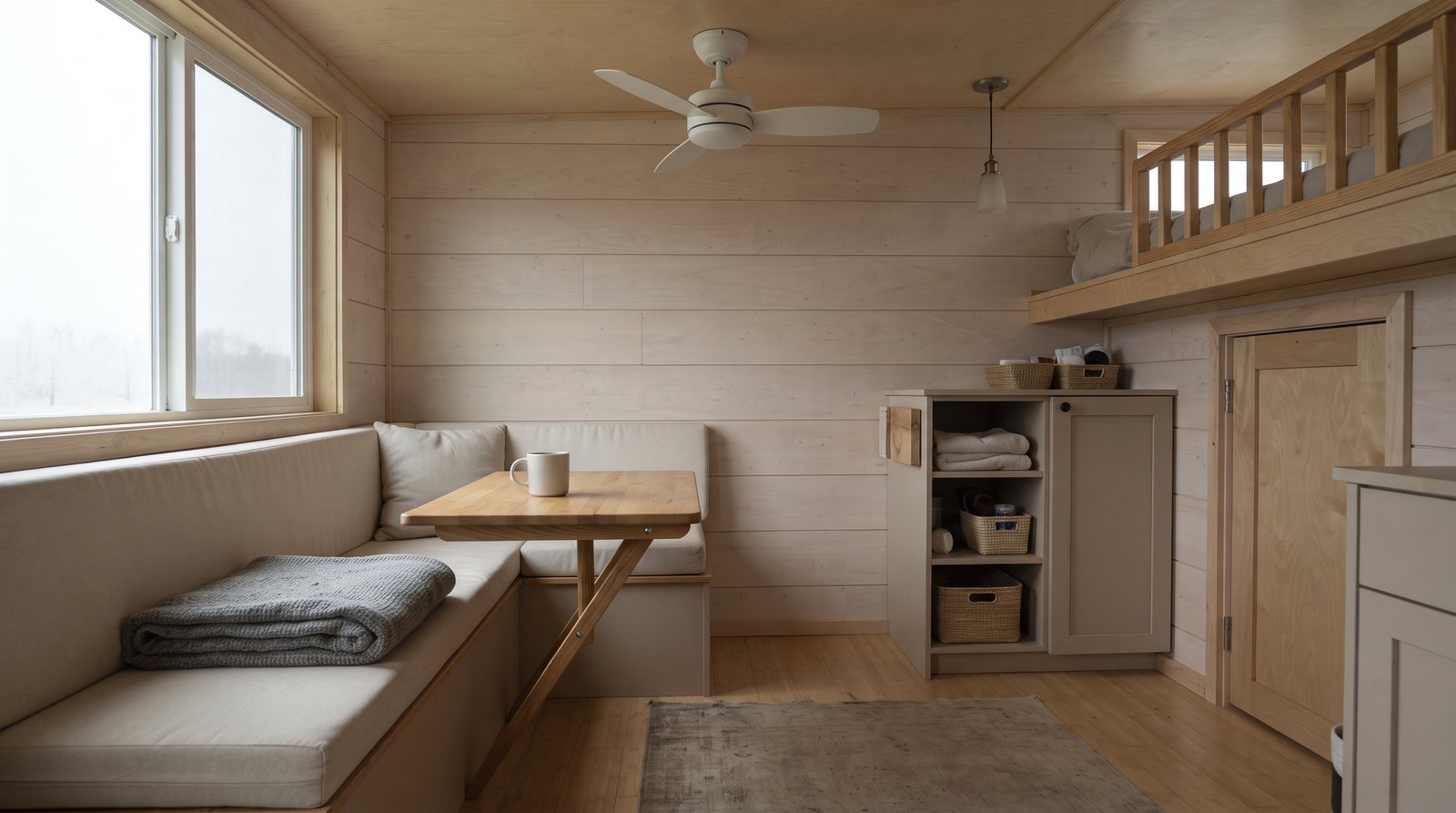
Tiny house ceiling fans work best when the blade span fits the usable room, the blades clear floors and nearby obstacles, and the mount is built for a moving fan. Most tiny homes need a compact, low-profile model, but a tape measure, the fan manual, and a fan-rated electrical box should decide the final choice.
Table of Contents
Are Ceiling Fans a Good Fit for Tiny Houses?
A ceiling fan can make a tiny house feel more comfortable without taking up floor or counter space. It moves air across occupants, helps even out temperatures near a loft, and can reduce reliance on air conditioning. It does not lower the room temperature, so placement and operating habits matter.
The Department of Energy explains that fans create a wind-chill effect for people rather than cooling an empty room. Turn the fan off when nobody is using the space. When air conditioning is running, moving air may let you use a higher thermostat setting while remaining comfortable.
A reversible fan can also help with winter comfort. At a low speed, the winter setting draws cooler air upward and gently circulates warmer air that has collected near the ceiling. This is especially useful in a tall tiny house where a sleeping loft traps heat while the main floor stays cool.
There are limits. A ceiling fan is a poor choice when the only possible location conflicts with a loft edge, door swing, ladder, cabinet, smoke alarm, heater, or low walking path. A wall-mounted fan or a quiet floor fan may be safer in an extremely tight layout.
What Size Ceiling Fan Works in a Tiny House?
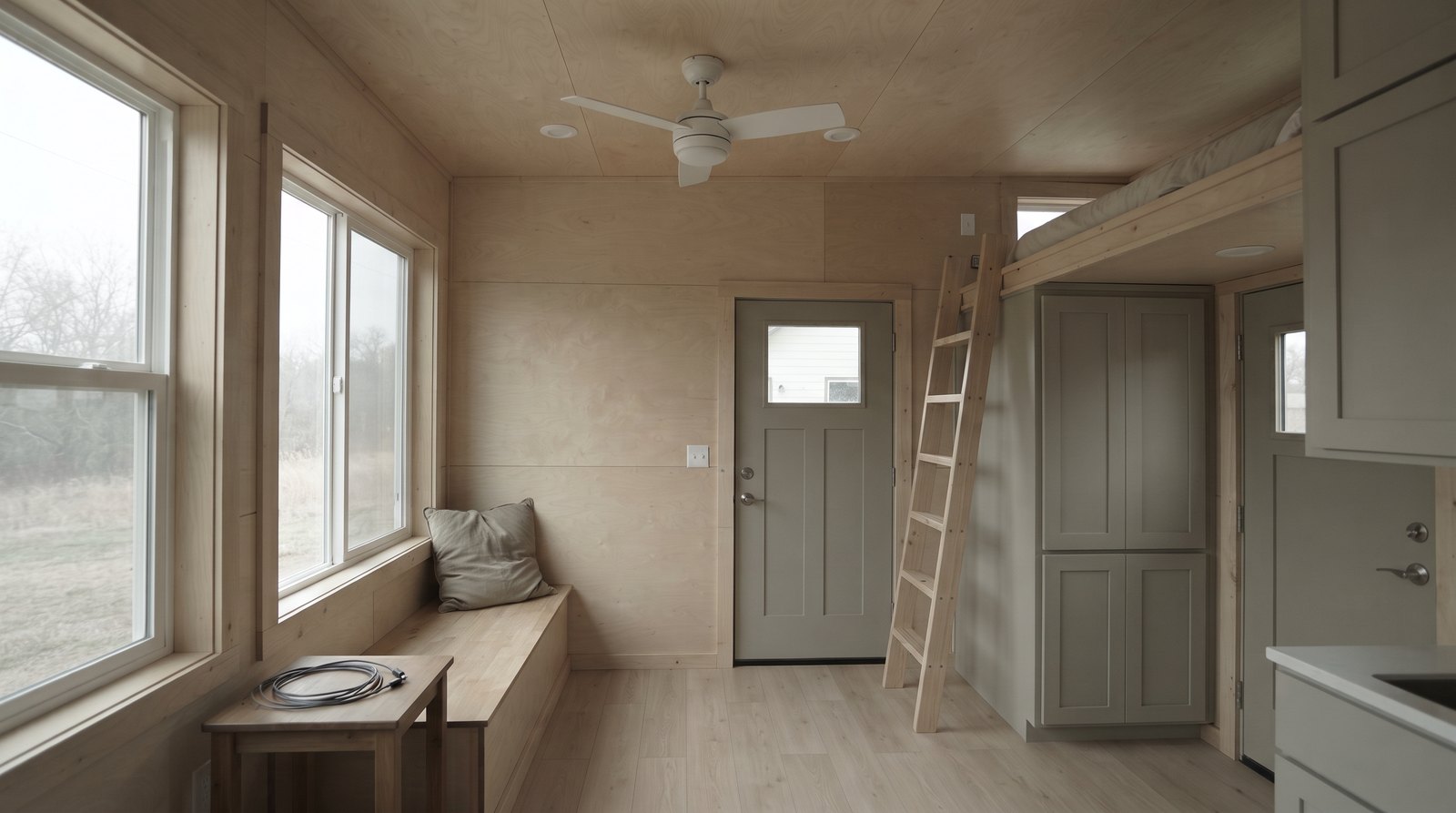
Start with the clear rectangle around the proposed fan, not the total square footage of the house. A 29 to 36 inch fan often suits a compact zone under about 75 square feet, while a 36 to 44 inch fan can serve a larger open room when every blade has safe clearance.
Manufacturer sizing charts are only a starting point. Hunter, for example, places 29 to 36 inch fans in rooms under 75 square feet and 36 to 44 inch fans in rooms up to 144 square feet. Tiny houses complicate that advice because lofts, tall cabinets, and partial walls interrupt airflow.
Measure from the planned center point to the closest wall, loft rail, ladder, open cabinet door, pendant light, and exterior door. Double the smallest safe radius to find the largest possible blade span. Then compare that limit with the installation manual. Many conventional manuals call for about 30 inches between a blade tip and the nearest obstruction.
Quick answer by situation
- Very small sleeping or office nook: Consider a fan under 30 inches, or use a wall fan if blade clearance is tight.
- Main room around 60 to 100 square feet: A 30 to 42 inch fan is often the practical range, subject to the manual and surrounding objects.
- Open main floor over 100 square feet: A 42 to 44 inch fan may work if the loft, doors, and cabinets leave a genuinely open sweep.
- Low ceiling: Choose a low-profile or hugger design and verify the actual blade height, not just the product label.
- Traveling THOW: Favor a light, compact model with secure hardware and a plan for inspection before and after towing.
How Much Clearance Does a Tiny House Fan Need?
The blades should normally be at least 7 feet above the finished floor and about 30 inches from walls or other obstructions when the manufacturer requires those clearances. Tiny house lofts create additional hazards, so measure from every standing surface, stair tread, ladder position, door, and reachable loft edge.
A low-profile fan reduces the distance between the ceiling and the blades, but low profile does not mean zero clearance. Air still has to enter above the blades, and the motor housing, light, and blade tips have their own dimensions. Check the side-view drawing in the product specifications before buying.
Do not measure only from the main floor. A person sitting on a loft edge, a child standing on a built-in bench, or somebody climbing a ladder may be much closer to the blades. Open each cabinet and door through its complete swing. Include removable furniture if it can reasonably be placed under the fan.
Keep the fan and its airflow away from heat-producing equipment according to the heater or stove manufacturer’s instructions. The same principle applies to smoke and carbon monoxide alarms. Follow each alarm’s placement instructions and local requirements so moving air, a high ceiling pocket, or a nearby supply vent does not delay detection.
Mounting, Blocking, and Electrical Boxes
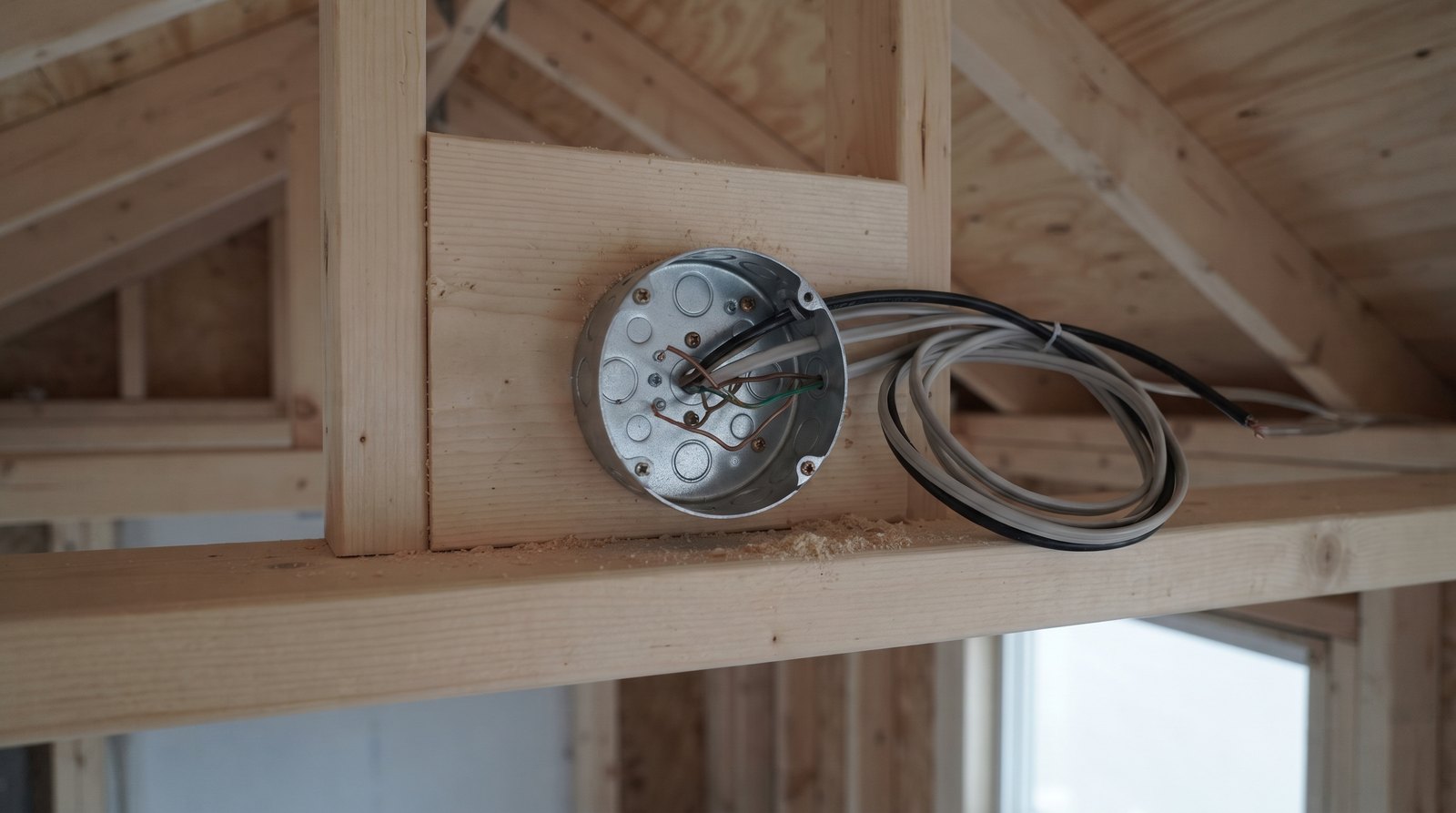
A ceiling fan must attach to solid structure or to an electrical box specifically listed and installed for fan support. A box that safely held a light is not automatically suitable for a rotating load. In a new build, plan the blocking, box, cable path, and controls before ceiling panels close the cavity.
The fan creates vibration and changing forces that a stationary light fixture does not. Use the mounting bracket, fasteners, and hardware specified by the fan manufacturer. Do not rely on finish paneling, thin plywood, or drywall anchors. If the framing location is awkward, use a listed fan brace or redesign the center point with the builder.
Turn off the circuit at the service panel and verify that power is off before any wiring work. The circuit, conductors, box fill, grounding, switch, and fan controls must match the electrical system and applicable local rules. A licensed electrician is the right choice when adding a new circuit, replacing questionable wiring, or working in a metal-framed trailer.
For a factory-built home or THOW, ask whether drilling or modifying a ceiling assembly affects structural engineering, warranties, or certification. Owners comparing a movable tiny home with a stationary one can review tiny house versus RV considerations before treating a residential installation detail as universal.
DC Versus AC Motors and Real Power Use
A DC-motor fan is usually the better tiny house choice when low electricity use, quiet operation, and several speed settings matter. AC-motor fans can cost less and use simpler controls. Compare the tested watts, airflow, sound, controls, and standby behavior of specific models rather than relying only on the motor label.
Current products show how wide the range can be. One 44 inch Hunter DC model lists 8 watts for the fan motor and 3,458 cubic feet per minute on high. Comparable 36 to 44 inch AC models list roughly 29 to 46 watts. Lights are separate loads and can add another 14 to 20 watts.
For a planning example, a 20 watt fan running eight hours uses 0.16 kilowatt-hours. At 20 cents per kilowatt-hour, that is about 3 cents per day. A 40 watt fan used the same way costs about 6 cents per day. Your rate, speed setting, light use, and inverter losses determine the actual total.
Off-grid owners should look beyond peak watts. A remote receiver or smart controller may draw a small standby load around the clock. Confirm whether the fan works from a normal wall switch, remembers its last setting after power loss, and behaves correctly on the home’s inverter. Check the inverter maker’s guidance if motor noise or control glitches appear.
Controls, Noise, and Everyday Comfort
Choose controls that remain easy to reach without standing on furniture or climbing into the loft. A wall control is hard to lose, while a remote can handle speed, light, and reverse functions without extra switch wiring. Quiet low-speed operation is more important than maximum airflow in such a small room.
Listen for motor hum, receiver buzz, clicking pull chains, and blade turbulence. Reviews can reveal patterns, but installation quality also affects noise. An out-of-level box, loose blade screws, mismatched blades, or a canopy touching the ceiling can turn a decent fan into a constant irritation.
Secure a remote in a wall cradle or latched drawer for travel. If the fan includes a light, check its lumen output, dimming range, and whether the LED module is replaceable.
Special Rules for a Tiny House on Wheels
A THOW fan needs a travel plan as well as a household installation plan. Road vibration can loosen screws, stress the box, and flex blades or light covers. The builder, fan manufacturer, trailer engineer, insurer, and local requirements should control whether the fan stays installed, receives extra restraint, or is removed for travel.
Before every move, switch off the circuit and inspect the canopy, bracket, blade screws, light globe, and remote. Remove any accessory that the manual allows and that could shake loose. Do not invent a strap that bends the blades or loads the motor shaft. Keep the manual and the correct tool in the house.
After arrival, look for a changed gap at the canopy, new wobble, rubbing, cracked blades, loose trim, or damaged wiring before operating the fan. Stop using it if anything has shifted. Repairs after a rough tow may also raise an insurance question, so review the distinctions in tiny house insurance coverage and cost.
Installation Cost and Buying Budget
Budget roughly $70 to $350 for a compact fan, then add local labor and any structural or electrical work. Current installation services commonly quote about $100 to $300 for straightforward labor. A new fan location, new circuit, difficult ceiling cavity, permits, or trailer-specific reinforcement can raise the total substantially.
Ask an installer to separate the quote into the fan, fan-rated box or brace, blocking, wiring, switch or remote, installation, permit, and finish repair. That makes comparisons meaningful. It also prevents a low labor quote from hiding the fact that the existing light box and cable are not adequate.
For a new build, adding blocking and cable before the ceiling is finished is usually simpler than retrofitting later. Photograph the framing and keep measurements in the house file. That record helps future maintenance and supports the broader durability planning discussed in how long tiny houses last.
Maintenance and Warning Signs
Clean the blades and inspect the hardware several times a year, and check a THOW after each move. Stop the fan if wobble, scraping, electrical odor, intermittent operation, a hot control, or a widening canopy gap appears. Tightening random fasteners is not a substitute for finding the underlying structural or electrical cause.
Dust buildup changes blade balance and can spread quickly through a compact home. Turn the circuit off, wait for the blades to stop, and support each blade while cleaning it. Use the manual’s approved method. Avoid soaking wood or composite blades, and do not bend a blade arm while reaching across the room.
A small amount of movement can be normal, but a new or worsening wobble deserves attention. Confirm that blades are matched, fasteners are secure, and the mounting surface has not shifted. Replace cracked or warped parts with approved components. Do not tape a crack, add improvised weights, or operate a fan with damaged wiring.
Frequently Asked Questions
Most tiny house ceiling fan questions come down to five issues: available blade sweep, height above every reachable surface, structural support, electrical compatibility, and travel conditions. The product manual and the actual room measurements should override a generic sizing chart, especially in a lofted home or a house that moves.
Can you put a ceiling fan in a tiny house?
Yes, if the fan can meet its required floor and obstacle clearances and can attach to proper structural support or a fan-rated box. A compact low-profile model often works best. If a loft, ladder, door, cabinet, heater, or alarm conflicts with the blade sweep, choose another location or another type of fan.
What size ceiling fan is best for a tiny house?
Many tiny houses use a 29 to 44 inch fan, but the safe clear zone matters more than total house size. Measure from the center to every obstruction, consider the actual airflow zone, and follow the model’s manual. A smaller fan at an appropriate speed is better than crowded blades near a loft or door.
How high should ceiling fan blades be?
Common residential guidance calls for at least 7 feet from the finished floor to the blades, with about 30 inches from blade tips to nearby obstructions. Your fan manual and local rules control. In a tiny house, also measure from benches, stair treads, ladders, loft edges, and any other reachable raised surface.
Do DC ceiling fans use less electricity?
Often yes, but compare individual ratings. Current compact and mid-size DC models can use far fewer fan watts than some AC models while offering more speeds. The light kit and standby receiver use additional power. For off-grid planning, use the listed watts at each speed and include inverter losses and daily operating hours.
Should a ceiling fan be removed before towing a THOW?
There is no universal answer. Follow the tiny house builder, trailer engineer, fan manufacturer, and insurer. Some installations may remain in place after a documented inspection, while others need removable blades or complete removal. Never improvise a travel restraint that bends blades or loads the motor shaft, and inspect everything after arrival.