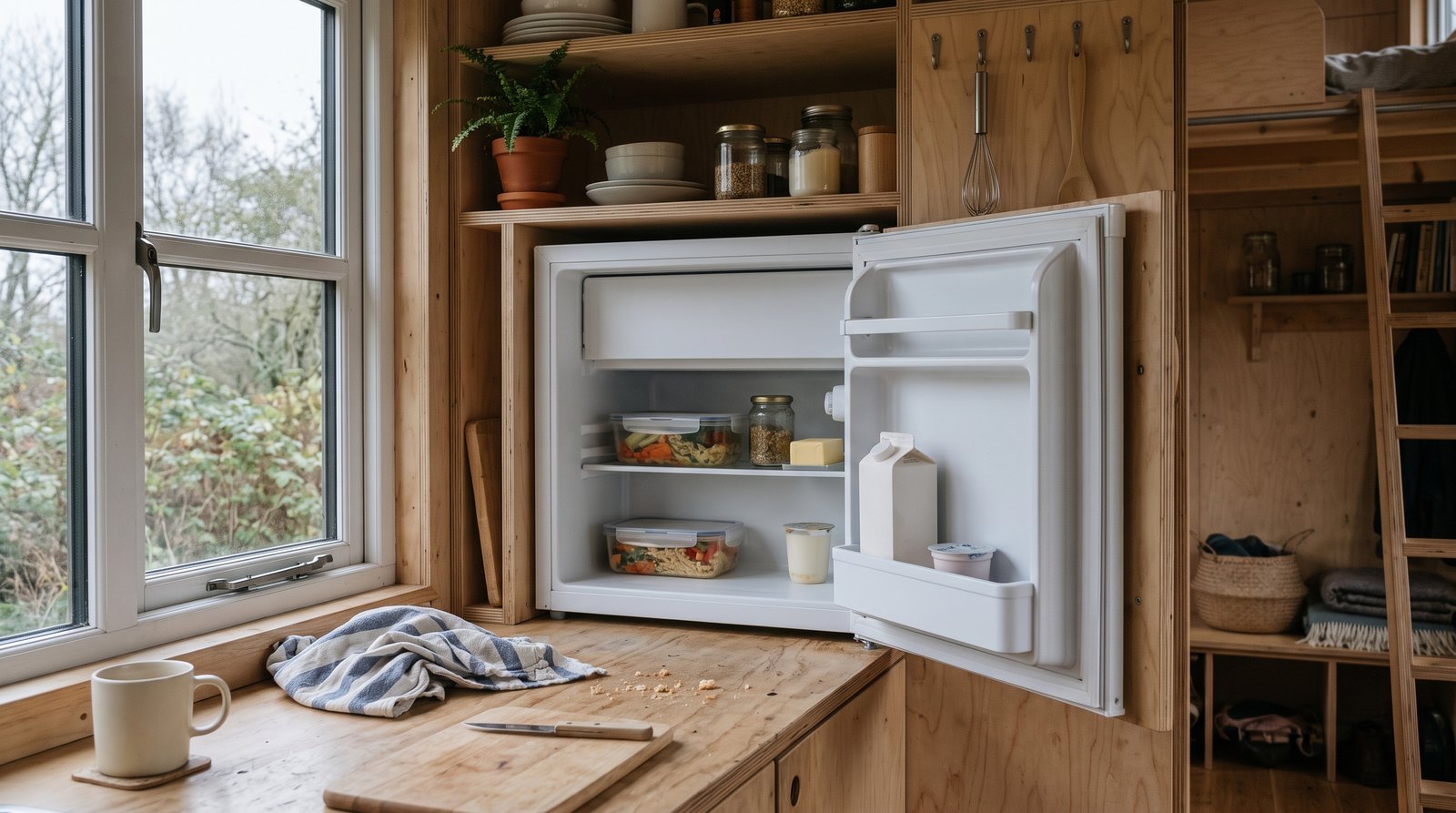
The best refrigerator for a tiny house is usually a compact 120-volt model for a grid-connected home or a 12-volt compressor model for a mobile, solar-powered build. Propane absorption refrigerators still suit some remote sites, but they cost more, need careful venting and leveling, and make sense only when propane availability outweighs those drawbacks.
Table of Contents
Which Refrigerator Type Is Best for a Tiny House?
Choose by power source before capacity or appearance. A 120-volt refrigerator gives most foundation homes the lowest purchase price and widest service network. A 12-volt compressor refrigerator avoids inverter losses in a battery-based system. A propane absorption unit is a specialized choice for long stays where electricity is scarce but bottled gas is dependable.
Do not assume that the smallest refrigerator uses the least electricity. Compare the yellow EnergyGuide label or the manufacturer’s tested annual consumption. ENERGY STAR says certified compact refrigerators under 7.75 cubic feet use at least 10 percent less energy than the federal minimum for their product class. Configuration, insulation, defrost type, and freezer size all matter.
Quick Answer by Situation
The right answer becomes simpler when you match the refrigerator to the house’s normal operating condition. Buy for the way you live most weeks, not for a rare camping weekend or outage. These starting points cover the situations most tiny-house owners face, but the appliance manual and electrical design still control the final choice.
- Foundation home with reliable grid power: Choose a 7 to 11 cubic foot, 120-volt top-freezer refrigerator with a strong efficiency rating and local repair support.
- Tiny house on wheels with solar and batteries: Choose a purpose-built 12 or 24-volt compressor refrigerator with a door latch, low-voltage protection, and published daily energy use.
- Mostly parked THOW with shore power: Either type can work. A 120-volt model is cheaper, while a mobile 12-volt model handles travel better.
- Remote cabin with weak winter solar: Consider propane absorption only if the installation can be exterior-vented and professionally serviced.
- Occasional weekend use: A 3 to 5 cubic foot compressor refrigerator may be enough if limited freezer space fits your food habits.
- Full-time couple who cooks: Start around 7 to 10 cubic feet, then check actual grocery routines and freezer needs before ordering.
12V vs. 120V vs. Propane Refrigerators
All three types can keep food cold, but they create different demands on a tiny house. Standard 120-volt models win on price and availability. Direct-current compressor models win on mobile durability and battery integration. Propane absorption models operate quietly without a compressor, yet demand the most disciplined installation and usually cool more slowly in difficult conditions.
Standard 120-volt electric: This is the normal household option. It plugs into a dedicated grounded receptacle and is easy to replace through appliance retailers. For an off-grid house, however, the inverter must run whenever the refrigerator needs power. Check both average energy consumption and compressor starting requirements when sizing the inverter.
12-volt compressor: This uses the same basic vapor-compression principle as a residential refrigerator but accepts direct-current power. Many mobile models operate on either 12 or 24 volts, have secure latches, and tolerate vibration. They cost more up front, but they remove the refrigerator’s inverter conversion step and fit solar-first electrical systems neatly.
Propane absorption: Heat drives the cooling cycle, so there is no compressor hum. Some RV units select between LP gas and 120-volt power. The tradeoff is a sealed combustion installation, specified exterior ventilation, periodic burner service, and careful operation. Dometic’s operating guidance also says a parked vehicle should be reasonably level for proper absorption cooling.
How Much Electricity Will the Refrigerator Use?
Use the appliance’s tested annual kilowatt-hour figure or published watt-hours per day, not a guess based only on running watts. Divide annual kilowatt-hours by 365 for an average day, then account for inverter loss, hot weather, door openings, defrosting, and battery reserve. Solar panels must support the whole house, not just the refrigerator.
For example, a refrigerator rated at 200 kilowatt-hours per year averages about 0.55 kilowatt-hour per day. That is roughly 46 amp-hours at 12 volts before conversion loss. Real consumption will rise during hot weather, initial cool-down, frequent door openings, or when warm groceries are added.
With a direct-current model, confirm the allowed wire length and voltage drop. A refrigerator that sees low voltage at the end of undersized cable may shut down even while the battery monitor looks healthy. Follow the manufacturer’s wire-size table, protect the circuit at its source, and use a qualified installer when the electrical design is outside your experience.
Efficiency claims are only comparable when the test methods and temperatures match. ENERGY STAR’s current product database shows that compact refrigerators of similar size can have very different annual energy figures. Compare the exact model, freezer configuration, and climate rating rather than relying on a brand-wide claim.
What Size Refrigerator Fits Tiny-House Living?
For most full-time owners, usable capacity matters more than the smallest exterior dimensions. About 3 to 5 cubic feet can suit one light cook, 7 to 10 cubic feet is a practical starting range for a couple, and 10 to 14 cubic feet helps families or bulk shoppers. Your habits should decide, not a generic formula.
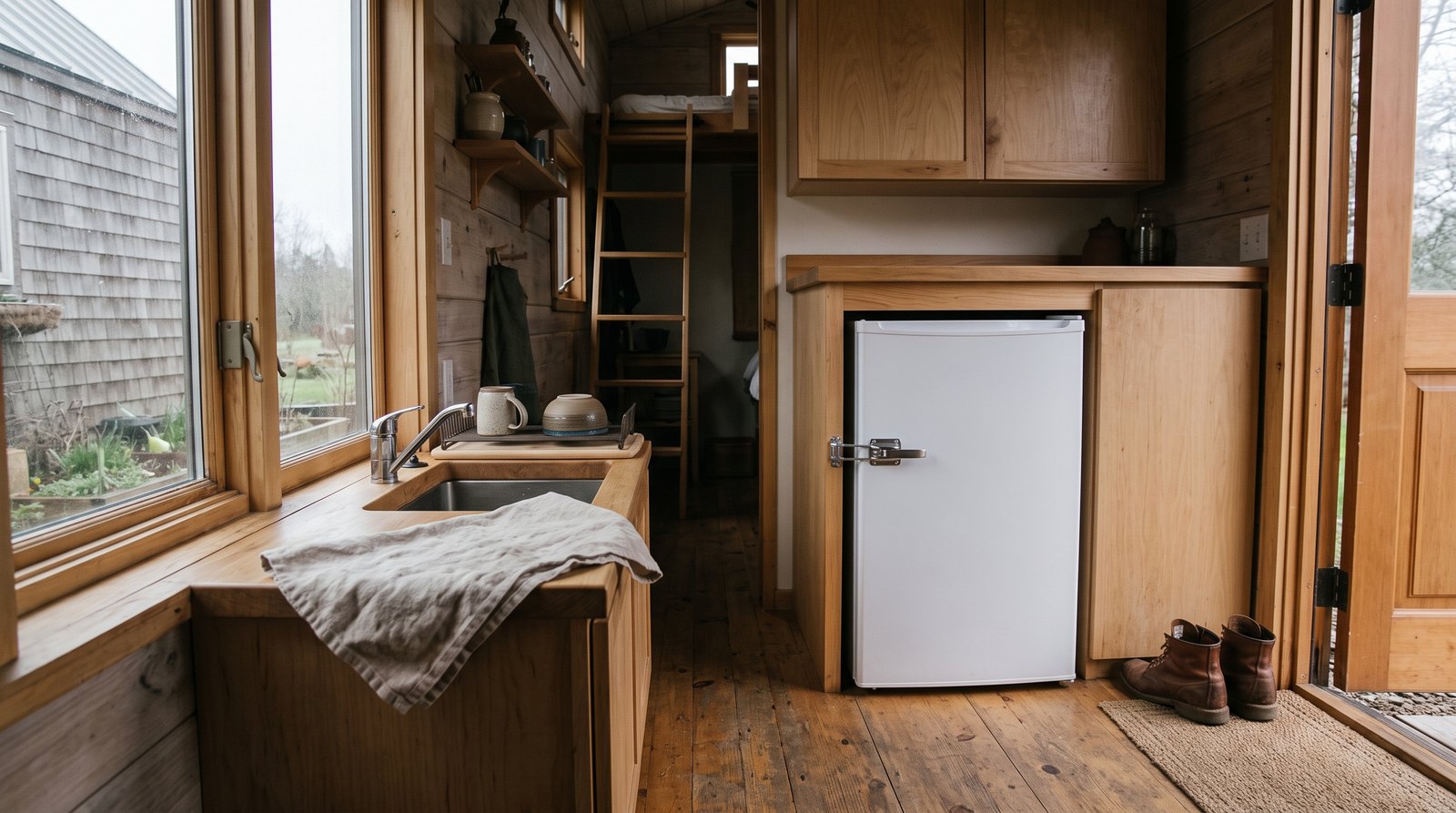
Measure width, height, cabinet depth, and the full door swing. Include the handle, hinge cap, power connection, required ventilation space, and enough room to remove shelves. Check whether the appliance can pass through the tiny house door after construction. A removable trim panel can save a major headache years later.
Interior layout matters too. Bring measurements for the containers you actually use. Deep shelves are not helpful when food disappears behind other food, and oversized door bins can steal cabinet volume. Adjustable shelves, a reversible hinge, and a removable freezer compartment can be more useful than a decorative finish.
Installation, Ventilation and Travel Safety
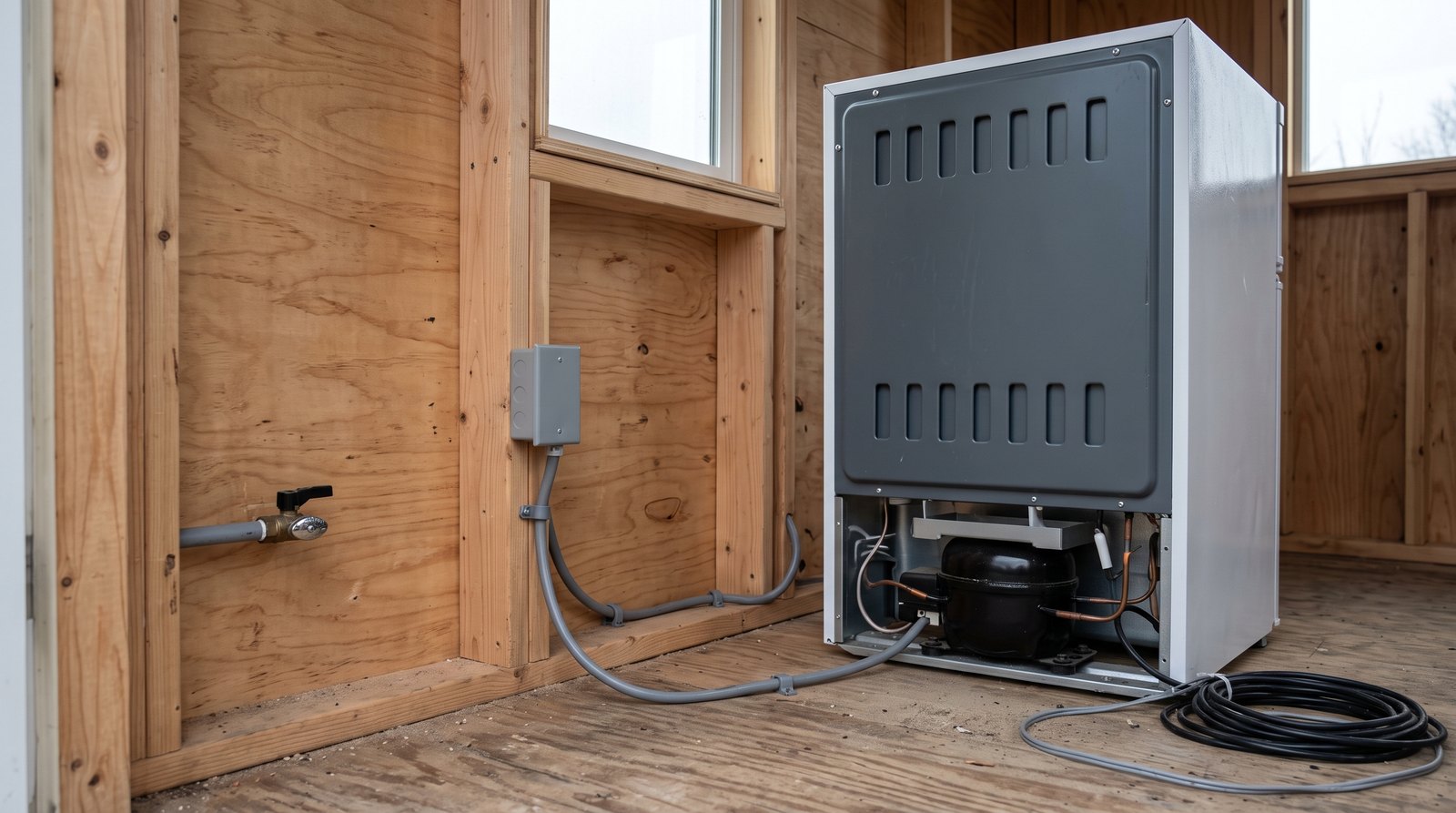
Install every refrigerator exactly as its listing and manual require. Compressor models need clearance for condenser heat and service access. Absorption units need the specified lower intake, upper exhaust path, combustion separation, and gas connection. In a THOW, fasten the appliance to structure and secure the door before every move.
A mobile refrigerator should have a positive travel latch, not just a magnetic gasket. Secure shelves and loose containers before towing. Dometic specifically recommends a refrigerator designed for mobile use because it is built for shock and vibration and includes door-security features. If you use a residential model in a THOW, the additional restraint system is your responsibility.
Propane work carries higher consequences. Have the gas piping, regulator, shutoff, combustion enclosure, and exterior vents installed and checked by a qualified technician under the rules that apply where the house is built and placed. The U.S. Fire Administration recommends checking propane lines for damage, testing fittings with a leak-detection device, and keeping working smoke and carbon monoxide alarms.
Rules for running LP appliances during travel differ by equipment, carrier, tunnel, ferry, and jurisdiction. Follow the refrigerator manual, tow-vehicle instructions, and route restrictions. If any source conflicts, shut the propane off and use an approved electrical mode or a prechilled cooler until safely parked.
Food Safety and Hot or Cold Weather Performance
Keep the refrigerator at 40 degrees Fahrenheit or below and the freezer at 0 degrees or below. Use an appliance thermometer because control-dial numbers are not temperatures. Ambient heat, blocked vents, low battery voltage, an unlevel absorption unit, or a cold unconditioned room can all change performance even when the refrigerator appears to run.
The USDA says an unopened refrigerator generally keeps food safely cold for about four hours during a power outage. Perishable food held above 40 degrees for more than two hours should be discarded. A battery monitor cannot answer that food-safety question, so keep a simple thermometer inside and avoid opening the door during an outage.
In hot weather, shade exterior refrigerator vents without blocking airflow and keep indoor heat under control. Load prechilled food when possible and leave space for air to circulate. Absorption refrigerators are especially dependent on correct chimney airflow and installation geometry, while compressor models may simply run longer and draw more energy as temperatures rise.
Realistic Refrigerator Costs in 2026
Expect the appliance price to range from roughly $330 for a basic small 120-volt top-freezer model to $2,000 or more for specialized mobile or absorption equipment. Installation can add wiring, cabinetry, ventilation, gas work, trim frames, and travel restraints. Compare total installed cost, expected energy use, warranty access, and replacement fit.
Current listings show many 7 cubic foot residential refrigerators around $330 to $650, with premium counter-depth models approaching $1,000. That makes 120-volt equipment the value choice when utility power is reliable. Confirm delivery clearance and service availability before choosing a bargain model that cannot be repaired locally.
Purpose-built 12-volt compressor refrigerators commonly begin around $700 to $900 for compact 44 to 75 liter units. Larger 8 to 10 cubic foot mobile models can run about $1,350 to $1,850. You may also need a mounting frame, heavier direct-current cable, circuit protection, and more battery or solar capacity.
Propane absorption refrigerators are often around $1,600 to $2,000 for common 3 to 8 cubic foot RV sizes, before installation. Their economic advantage is not a cheap appliance. It is the ability to use stored fuel when a remote site’s electrical system cannot reliably cover refrigeration through poor solar weather.
Budget for ownership, not just purchase. Door gaskets, control boards, cooling fans, burner cleaning, and mobile service calls can change the long-term result. If the tiny house moves regularly, review your tiny house insurance terms before installing a nonstandard fuel system or residential appliance.
Maintenance and Replacement Planning
A refrigerator lasts longer when heat can escape, doors seal, and electrical or gas connections stay sound. Clean accessible condenser areas, inspect gaskets, defrost when required, and verify temperature with a thermometer. For propane units, schedule qualified burner and vent service. Plan a replacement path before cabinetry makes the appliance permanent.
Check the door gasket with a strip of paper. If it slides out easily around part of the perimeter, clean the gasket and cabinet surface, then inspect for damage or misalignment. Vacuum only the condenser areas the manual identifies as owner-serviceable. Disconnect power first and avoid bending refrigerant tubing.
For a THOW, inspect the mounting fasteners, latch, cable strain relief, vent covers, and surrounding cabinet after every long trip. Movement that seems harmless can loosen a connection over time. This kind of routine systems care also affects how long a tiny house lasts.
When comparing replacements, favor a model that fits the existing opening without eliminating required clearances. Confirm the hinge side, door swing, voltage, circuit, ventilation path, and service access. If you are deciding whether the home should operate more like a residence or a recreational vehicle, our tiny house versus RV guide explains the broader tradeoffs.
Frequently Asked Questions
Can I use a regular refrigerator in a tiny house?
Yes. A regular 120-volt refrigerator is usually the best value in a stationary tiny house with reliable grid power. Provide the clearances, dedicated electrical supply, and ventilation required by its manual. In a THOW, also consider vibration, fastening, door restraint, inverter capacity, and whether the appliance can safely tolerate repeated travel.
Is a 12V refrigerator better for solar power?
Usually, especially when the house already uses a 12 or 24-volt battery system. A direct-current compressor refrigerator avoids running an inverter solely for cooling and often includes low-voltage protection. Compare tested daily energy use, cable requirements, battery reserve, climate rating, and price with an efficient 120-volt model before deciding.
How many solar panels do I need for a tiny-house refrigerator?
There is no reliable panel count without the refrigerator’s daily consumption, local sun hours, system losses, battery capacity, and every other household load. Start with measured or published watt-hours per day, model the worst practical season, then size panels and storage with reserve. A qualified designer can verify critical off-grid systems.
Does a propane refrigerator need electricity?
Many propane absorption refrigerators still need a small 12-volt supply for controls, ignition, or fans, even while LP gas provides the cooling heat. Requirements vary by model. Read the data plate and manual, and do not assume a dead house battery leaves the refrigerator operational merely because the propane cylinder is full.
What temperature should a tiny-house refrigerator maintain?
Keep the fresh-food compartment at 40 degrees Fahrenheit or below and the freezer at 0 degrees or below. Place an appliance thermometer where it is easy to read, especially in an off-grid or mobile house. Investigate temperature drift promptly, including battery voltage, ventilation, leveling, seals, controls, and unusually hot or cold surroundings.