The best tiny house washer-dryer is usually a ventless all-in-one for limited space, a compact pair for faster back-to-back loads, or a portable washer plus air drying for the lowest cost. Choose only after checking electrical capacity, water supply, drainage, floor strength, ventilation, service clearances, and travel needs.
Table of Contents
Which Tiny House Laundry Option Fits Your Situation?
Choose an all-in-one combo when floor space and venting are the main constraints. Choose a compact pair when you wash frequently and want one load drying while another washes. A portable washer or laundromat is often smarter when hookups, payload, budget, or winterization make permanent equipment impractical.
There is no universal winner because a foundation tiny house and a tiny house on wheels solve different problems. A fixed home can support permanent plumbing, a dedicated circuit, and a carefully vented dryer. A THOW must also account for axle capacity, road vibration, freezing lines, and the need to disconnect before travel.
Quick answer by situation
- One or two people, limited space: A 24-inch ventless all-in-one is the simplest permanent setup.
- Several loads each week: A compact stacked pair saves time because washing and drying can overlap.
- Off-grid or small electrical service: A high-efficiency washer plus line drying usually demands less power than any electric dryer.
- Occasional use or tight budget: A portable washer can work if you provide safe filling and controlled drainage.
- Frequent travel: A laundromat avoids appliance weight, leak risk, and winterization work.
Why an All-in-One Combo Works in a Tiny House
A ventless all-in-one saves the most physical space because one cabinet handles washing and drying without an exterior dryer duct. Current heat-pump models can use a standard 120-volt connection, but specifications vary. The tradeoffs are purchase price, longer occupied-machine time, maintenance, and having no backup when the single unit needs repair.
The best newer combos use heat-pump drying rather than a simple resistance heater. ENERGY STAR describes heat-pump drying as a closed loop that removes moisture and reuses warm air. Current certified all-in-one models can finish a normal wash-and-dry load in roughly 1.5 to 2 hours under test conditions, although bulky items, cold rooms, and overloaded drums can take longer.
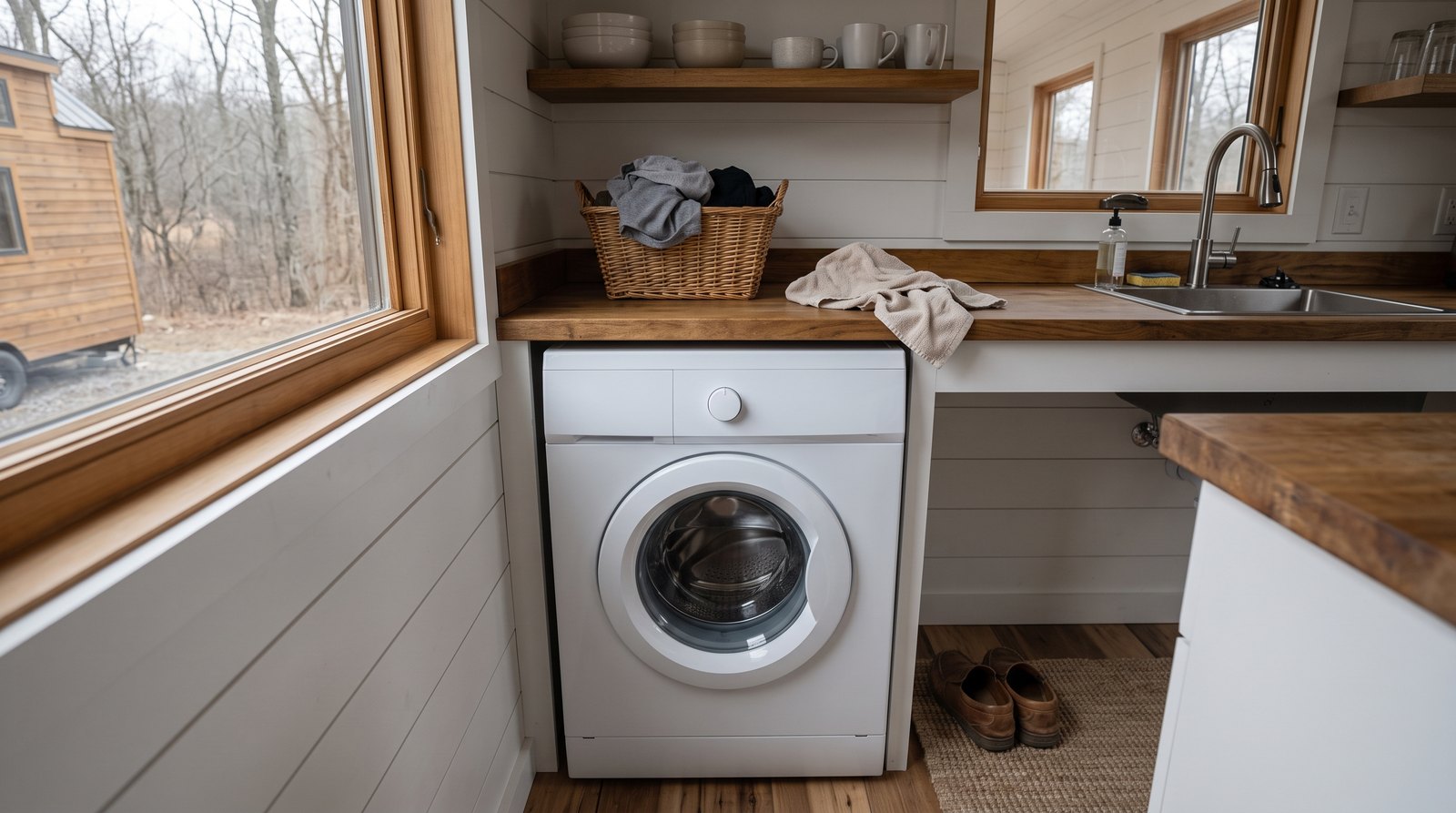
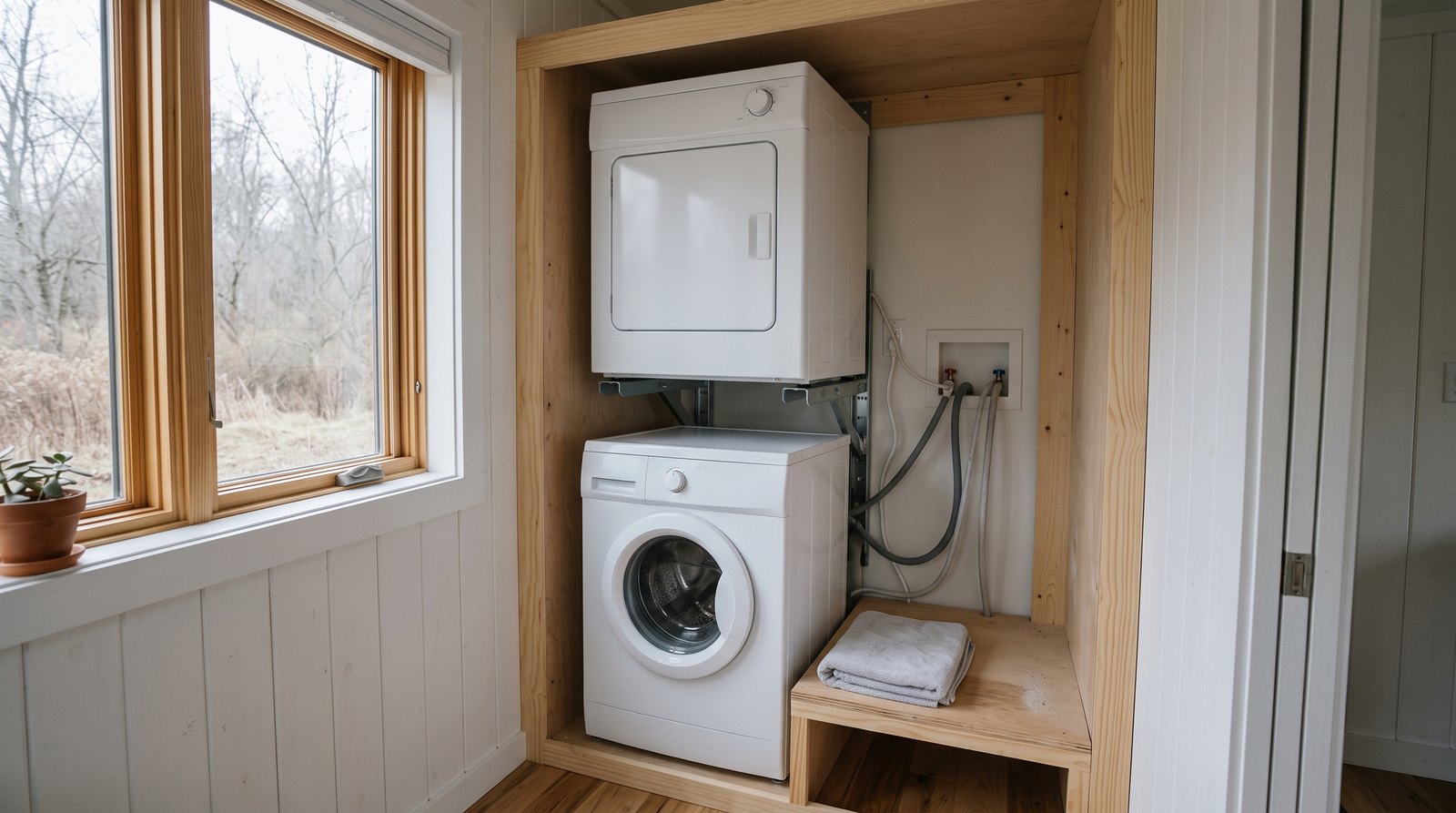
A combo is especially useful beneath a counter, but verify the entire installation drawing. Leave the required side, rear, top, and door clearances. Keep the drain filter, water shutoffs, plug, and service panels reachable. A machine that technically fits but cannot be pulled out for repair is not a workable tiny house installation.
When a Compact Washer and Dryer Pair Is Better
A compact pair is better for regular family laundry, towels, bedding, or any routine that produces consecutive loads. Separate machines let the dryer run while the washer starts again, and a failed appliance does not disable the whole laundry setup. Expect more space, more weight, and possibly a 240-volt circuit.
Most compact residential pairs are about 24 inches wide, but depth and door swing vary more than people expect. Add the manufacturer-required gap behind the machines for hoses, cords, a drain, and any duct. If the pair stacks, use the exact approved stacking kit. A shelf or improvised bracket is not a substitute for tested hardware.
Ventless heat-pump dryers suit small homes because they do not need an exterior exhaust. ENERGY STAR says certified heat-pump dryers can use around 70 percent less energy than conventional dryers, and lower drying temperatures are gentler on fabrics. Some drain automatically into the washer standpipe, while others use a tank that must be emptied.
Do not assume compact means low-power. A washer may use 120 volts while its matching dryer needs 240 volts. Other heat-pump dryers operate on 120 volts. Confirm voltage, amperage, plug type, and circuit requirements for the exact model numbers before buying either machine. Have a licensed electrician evaluate an undersized panel or shore-power system.
Portable Washer or Laundromat: The Lower-Cost Choices
A portable washer makes sense when you need basic laundry at home but cannot justify a permanent cabinet, while a laundromat is usually best when every pound and cubic foot matters. Neither is automatically simple. Portable machines still need safe water, drainage, storage, and power, and laundromats add travel time and recurring costs.
Current portable washers commonly sell for about $150 to $500, with larger premium models costing more. Faucet adapters are convenient, but a temporary connection can leak or pull loose. Never leave it unattended, and do not discharge onto the floor, outside near a foundation, or into a drain that cannot accept the pump flow.
For a laundromat comparison, calculate your real yearly cost. Three weekly loads at $8 each for washing and drying equal about $1,248 per year before detergent, mileage, and time. That can still beat buying equipment if you move often, lack legal hookups, or would need an expensive electrical and plumbing retrofit.
Plan Electrical Power, Water, and Drainage First
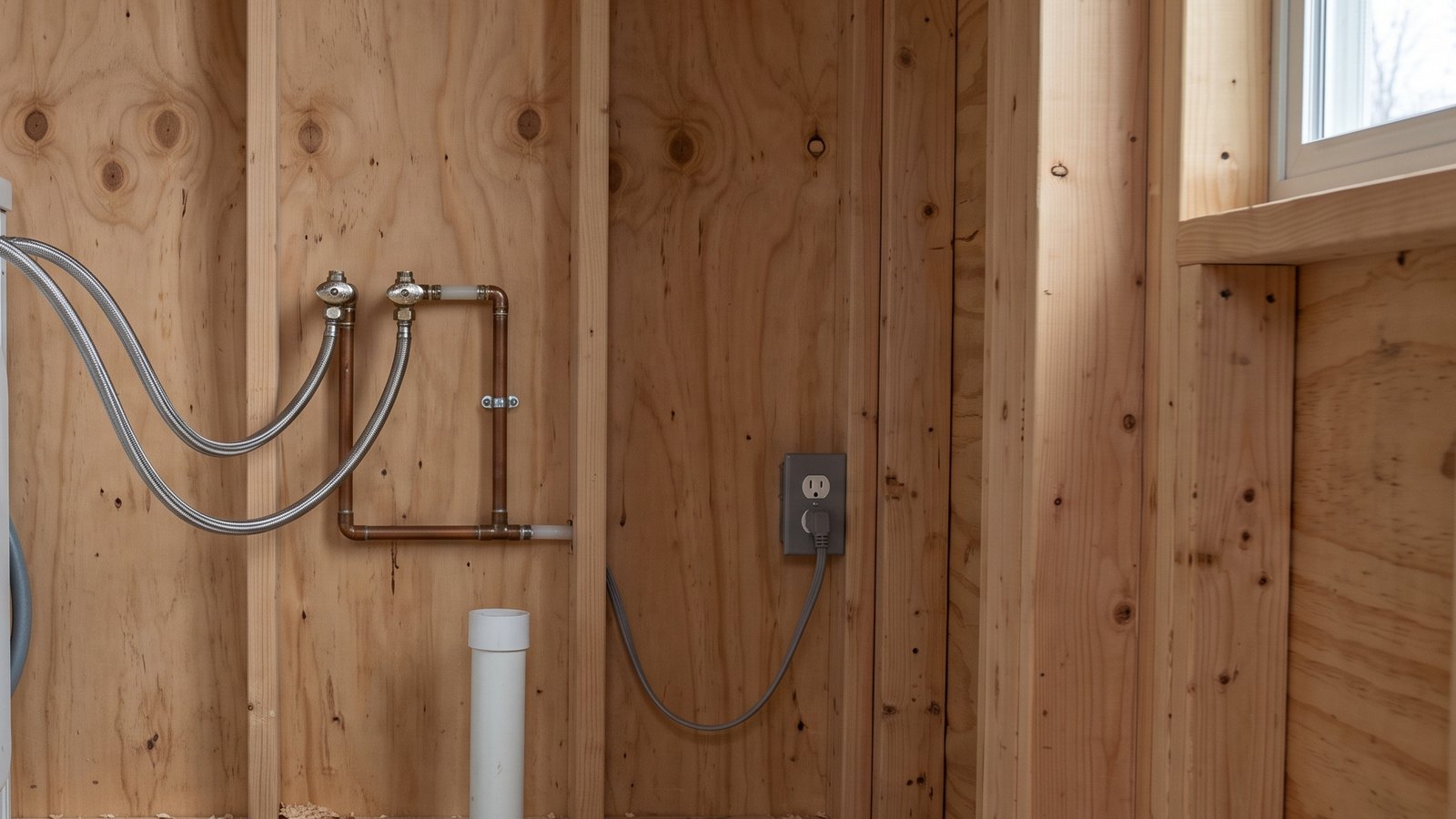
The safest order is to select a model, obtain its installation manual, and then design the utilities around its exact requirements. Do not buy from a width measurement alone. Voltage, circuit size, hot-water demand, hose routing, drain height, pump limits, shutoff access, and service clearances can decide whether the appliance truly fits.
Some modern heat-pump combos use a 120-volt receptacle, while many traditional electric dryers require a dedicated 240-volt circuit. Portable washers also use 120 volts, but that does not make a shared kitchen or bathroom circuit appropriate. Avoid extension cords and plug adapters. Local electrical rules and the manufacturer instructions control the final installation.
Use accessible hot and cold shutoff valves, quality supply hoses, and a drain arrangement approved for the machine. A drain pan with a safe outlet can limit damage from a slow leak, especially when the appliance sits over finished flooring. If a leak would threaten the home, review how appliance water damage is treated in your tiny house insurance policy.
Efficient washers also help tanks and septic systems. ENERGY STAR reports that a certified full-size washer uses about 14 gallons per load, compared with about 20 gallons for a standard machine. Actual use varies by model and cycle, so compare the EnergyGuide label and the listed Integrated Water Factor before sizing fresh-water and gray-water capacity.
Control Venting, Heat, and Moisture
Choose ventless equipment when a proper exterior duct is difficult, but do not confuse ventless with ventilation-free. The machine still releases heat and needs the clearances and room airflow stated in its manual. A vented dryer needs a correctly sized exterior duct, an operating damper, and regular lint removal.
Never discharge a dryer into the tiny house, wall cavity, attic, crawlspace, or undercarriage. That sends moisture and lint where they can cause damage or a fire. Use the dryer manufacturer’s approved duct material and route, and let local code determine length and termination details. Check that the outside flap opens freely during operation.
Cabinet doors can trap heat around a ventless unit. Louvered doors or planned openings may help, but only if they satisfy the manufacturer’s required free area. Watch the first several cycles. If the cabinet becomes unusually hot, clothing stays damp, or condensation appears on nearby windows, stop and correct the installation.
Prevent Vibration, Noise, and Floor Damage
A rigid, level base matters more than soft pads. A front-load washer spins at high speed, and a flexible tiny house floor can amplify vibration through the walls and trailer frame. Support the loaded appliance, lock all leveling feet, keep the cabinet square, and correct an unbalanced machine before it loosens plumbing.
Estimate the installed load, not just shipping weight. Include the machine, wet laundry, water retained during operation, stacking hardware, counter, and any storage above. For a THOW, compare the added weight with actual scale tickets, gross vehicle weight rating, axle ratings, and tongue weight. Convenient placement is not worth overloading one side.
Do not stack appliances unless the manufacturer permits that exact combination. Anchor cabinets and nearby shelves so they cannot rub or strike the machines. Maintain the specified gaps around hoses and cords. Check supply connections after the first few cycles and again after travel, seasonal temperature changes, or any noticeable increase in vibration.
Good maintenance also protects the house itself. Wipe the door gasket, leave a front-loader ajar after use when safe, clean filters, and inspect for drips. These habits help control mold and hidden water damage, two issues that also affect how long a tiny house lasts.
Laundry Equipment in a Tiny House on Wheels
A washer or dryer can travel in a THOW, but it must be treated as secured cargo and rechecked at every setup. Drain the appliance, close and disconnect water lines, cap or secure loose hoses, protect doors, and follow the manufacturer instructions for transport hardware. Never operate laundry equipment while the house is moving.
Keep the original shipping bolts if the manual says they are required for moving. Do not reinstall them by guesswork, and never run the washer with shipping bolts installed. Some machines use different transport procedures, so keep the manual and accessories with the unit. After arrival, level the house before leveling the appliance.
Freezing is a separate risk. Water can remain in pumps, filters, valves, and low hose loops even after the drum looks empty. Follow the manufacturer’s winterization procedure and protect supply and drain lines. If moving the home means hiring transport, include appliance preparation in the planning and compare it with the broader cost to move a tiny house.
Realistic Tiny House Laundry Costs in 2026
For equipment alone, plan roughly $900 to $2,500 for an all-in-one, $2,100 to $4,500 for a quality compact pair, and $150 to $500 for a portable washer. Sale prices change quickly. Plumbing, electrical work, cabinetry, stacking hardware, drain pans, delivery, and haul-away can add hundreds or several thousand dollars.
A cheaper appliance can become the expensive choice if it requires a new 240-volt circuit, panel upgrade, long dryer duct, or structural work. Conversely, a higher-priced 120-volt heat-pump combo may avoid some construction. Price the complete installed system, including tax, required accessories, professional labor, and any site-specific permit or inspection.
Buying and Installation Checklist
Measure the route into the house as carefully as the final alcove. Confirm doors, stairs, loft rails, counters, and turns before delivery. Then match the model to the available utilities, floor capacity, service access, travel plan, climate, and laundry volume. Keep the installation manual, receipts, and transport parts.
- Record the appliance width, depth, height, door swing, and every required clearance.
- Verify voltage, amperage, plug type, dedicated-circuit requirements, and shore-power limits.
- Confirm hot and cold water needs, drain height, pump limits, and freeze protection.
- Choose vented or ventless drying before framing the cabinet or cutting an exterior opening.
- Provide accessible shutoffs, a reachable filter, and a way to pull the unit out for service.
- Use an approved stacking kit and include the full wet operating weight in floor and trailer calculations.
- Check warranty coverage and qualified service availability in the area where the home will stay.
Frequently Asked Questions
What is the best washer-dryer for a tiny house?
For most one- or two-person tiny homes with permanent hookups, a ventless all-in-one offers the best balance of space and convenience. A compact pair is better for frequent loads, while a portable washer or laundromat makes more sense when budget, electrical capacity, trailer weight, or winterization is the priority.
Can a tiny house washer-dryer run on 120 volts?
Yes, some current ventless combos and compact heat-pump dryers operate on 120 volts, but not all do. Check the exact model’s voltage, amperage, and circuit instructions. A standard receptacle does not guarantee spare capacity, especially in a THOW with air conditioning, cooking appliances, and a limited shore-power connection.
How much water does a compact washer use?
Water use varies by capacity and cycle, so the EnergyGuide label and Integrated Water Factor are the best model-specific references. As a broad benchmark, ENERGY STAR says certified full-size washers average about 14 gallons per load, compared with about 20 gallons for a standard washer. Compact models are not automatically more efficient.
Do ventless dryers make a tiny house humid?
A properly installed heat-pump or condenser dryer captures moisture as liquid instead of exhausting it into the room, so it should not behave like an indoor vented dryer. It still releases heat and needs airflow and maintenance. Persistent condensation, damp clothing, or excessive cabinet heat signals a drainage, clearance, filter, or equipment problem.
Can I leave a washer installed while towing a THOW?
You can transport a properly secured washer, but disconnect and drain it first. Close valves, secure hoses and doors, follow the model’s transport instructions, and use shipping hardware only when directed. Recheck weight distribution, hookups, level, and leaks after arrival. Never operate the washer or dryer while the tiny house is moving.