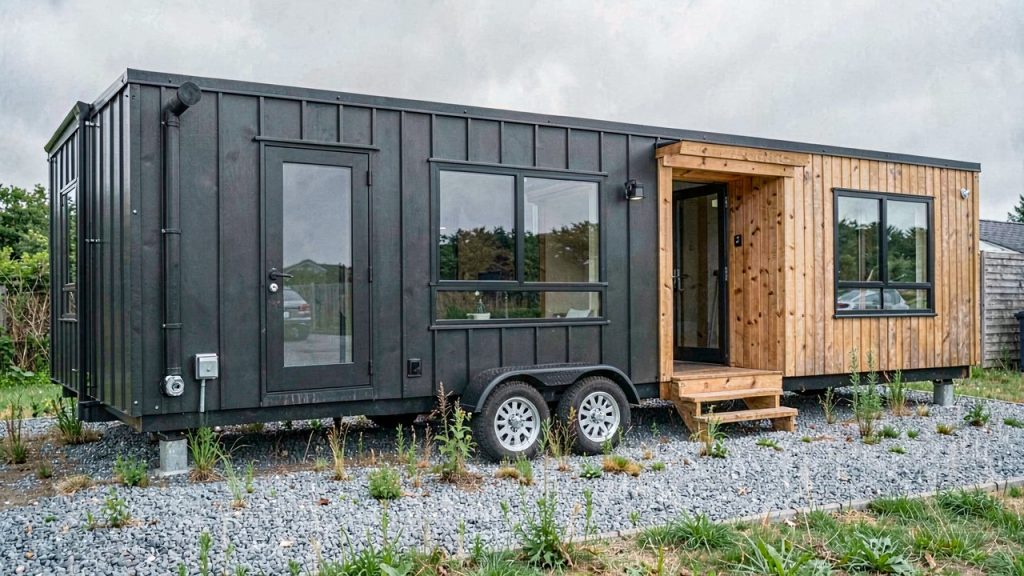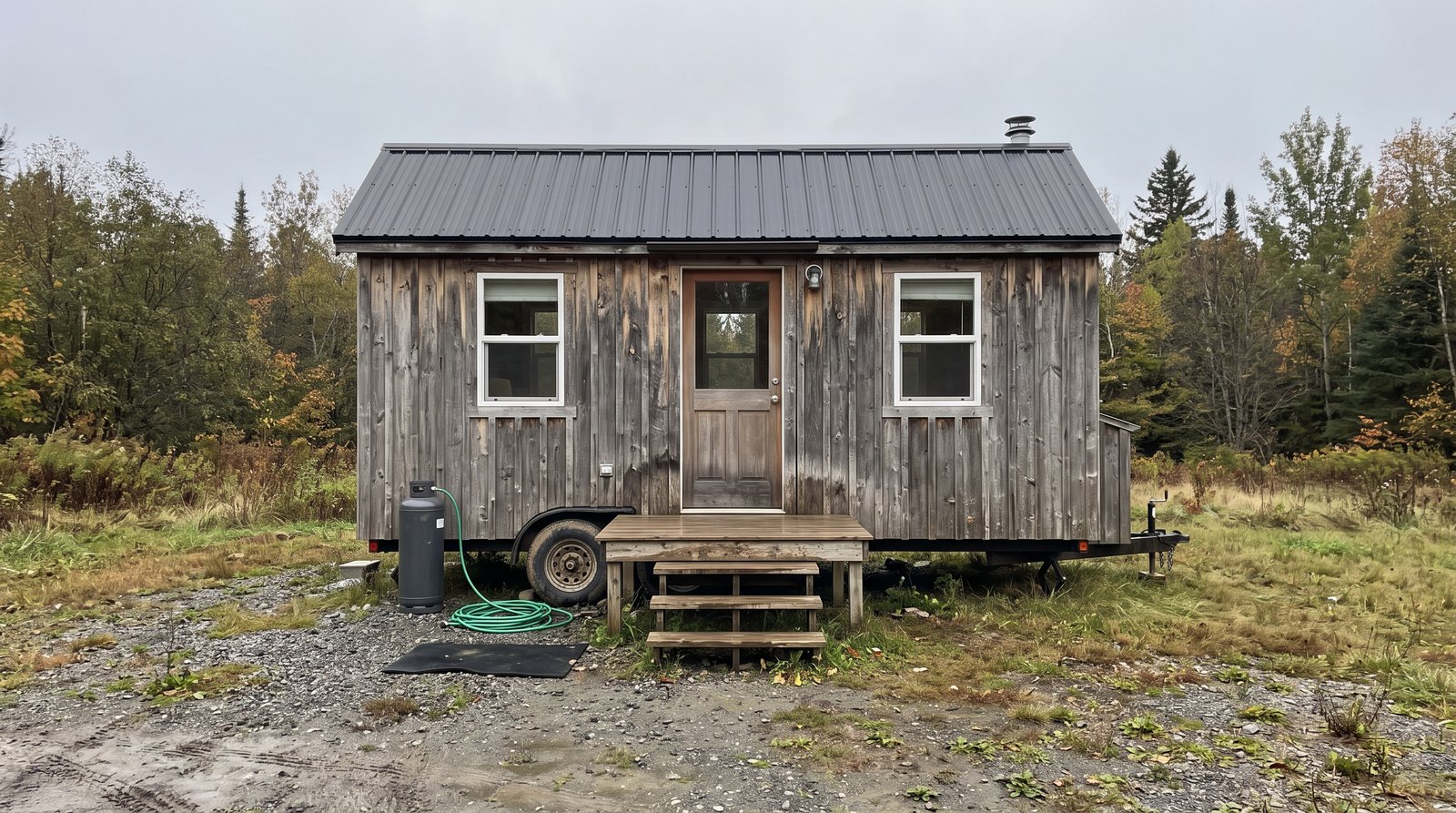
Before you pay for a used tiny house, inspect four things in this order: the trailer and tires, the roof and window seals, the subfloor for soft spots and high moisture readings, and the paperwork. Water intrusion and a failing trailer are the two problems that turn a bargain into a loss, and both are cheap to check.
Table of Contents
Quick Answer by Situation
The right level of caution depends on who built the house and how it has been stored. A certified build that lived under cover is a very different risk from a half finished DIY project that sat in a field for six winters. Match your inspection depth to the situation in front of you.
- Certified build, one owner, stored under cover: verify the certification label and the title, then do a normal moisture and trailer check. Lowest risk on this list.
- Professional build, parked outdoors for years: assume the sealant has aged out. Budget for resealing the roof and windows, and check the subfloor hard.
- Owner built, no certification: expect insurance and financing trouble. Inspect the electrical and propane work closely, and price the house accordingly.
- Unfinished shell: only worth buying if the trailer and the framing are sound. You are really buying a trailer and a weather envelope.
- Seller cannot produce a title or a VIN: walk away, or make the sale conditional on the seller titling it first.
- Flood or leak history disclosed: hire a professional inspection or skip the house. Hidden rot is the most expensive item on this page.
Start With the Trailer, Not the Interior
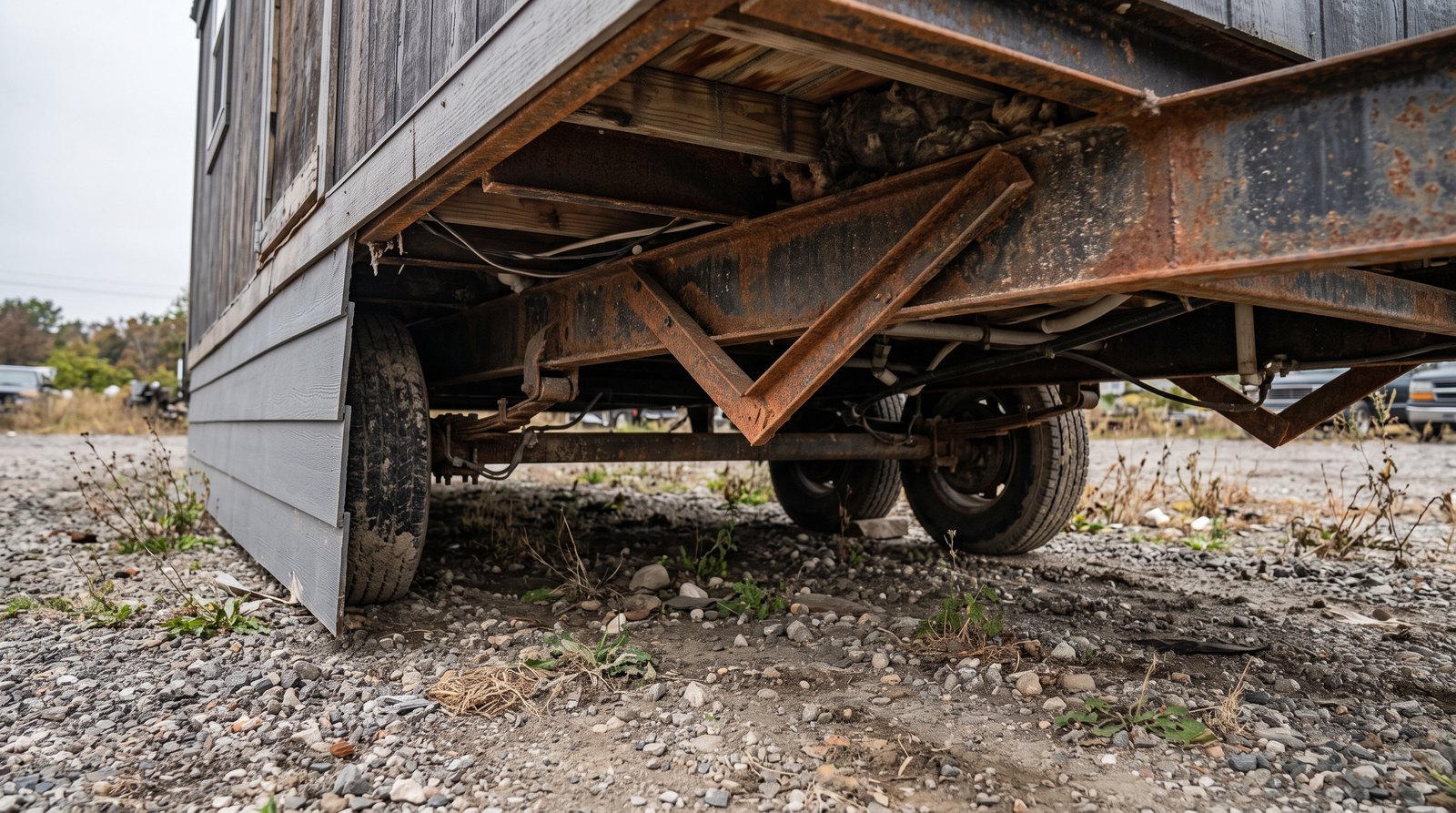
On a tiny house on wheels the trailer is the foundation, and it is the one component you cannot easily replace. Get low with a flashlight and look at the steel before you look at the countertops. Surface rust is normal and expected. Flaking, scaling, or rust that has eaten into a weld or a frame member is not.
Work along the main rails and the cross members. Tap suspect areas with a screwdriver handle and listen for a dull thud instead of a ring. Check the welds at the tongue and at every cross member joint, because those carry the load when the house moves. Look for any sag or twist in the frame, which usually means the house was overloaded or the trailer was undersized for the build it is carrying.
Then check the running gear. Look at the springs, the shackles, the axles, and the brake wiring. Ask when the wheel bearings were last packed. If the seller cannot answer, assume they were not.
Tires are the easiest failure to spot and the most commonly ignored. Every tire made since 2000 carries a DOT code on the sidewall, and the last four digits are the manufacture date in week and year format. A code ending in 2419 means week 24 of 2019. Trailer tires age out before they wear out, because they sit parked in sun and heat while the rubber degrades from the inside. The Rubber Manufacturers Association recommends replacement at six years regardless of remaining tread, and many trailer specialists suggest five years for tires that live outdoors year round. Check every tire individually, including the spare, because sets are often mismatched.
Finally, find the VIN plate on the trailer tongue or the frame rail. A missing VIN is a serious complication, not a detail to sort out later.
Roof, Flashing, and Window Seals
Almost every expensive tiny house problem starts as a small leak at a penetration. Check the roof seams, the vent and skylight curbs, the flue collar if there is a stove, and the flashing above every window and door. Cracked, brittle, or peeling sealant is the warning sign you are looking for.
Understand the difference between caulk and flashing. Caulk is a surface sealant that fills a visible gap and fails over time. Flashing is a layered system built into the wall or roof assembly to shed water. A house that relies on caulk alone at its windows will leak eventually, no matter how neatly the bead was tooled. Galvanized steel flashing typically lasts fifteen to twenty years before it needs attention.
From the ground, look for rust streaks running down from a flashing edge, lifted metal, exposed fastener heads, and peeling paint on the overhangs. Inside, look at the ceiling around every roof penetration. A small brown ring above a vent fan is telling you exactly where to dig.
Open and close every window. Look for fogging between the panes, which means the seal has failed, and press the trim below each window for softness. Windows are the most common leak point on a house that gets towed, because road vibration works fasteners loose over time. Our guide on how long tiny houses last covers why sealant maintenance decides the lifespan of the whole structure.
How to Find Water Damage and Subfloor Rot
Water damage is the reason most used tiny houses are worth less than they look. In a house of two hundred square feet, a leak that a normal home would absorb becomes a structural problem quickly, because the same small amount of framing carries all of the load. Look for it deliberately rather than hoping it is not there.
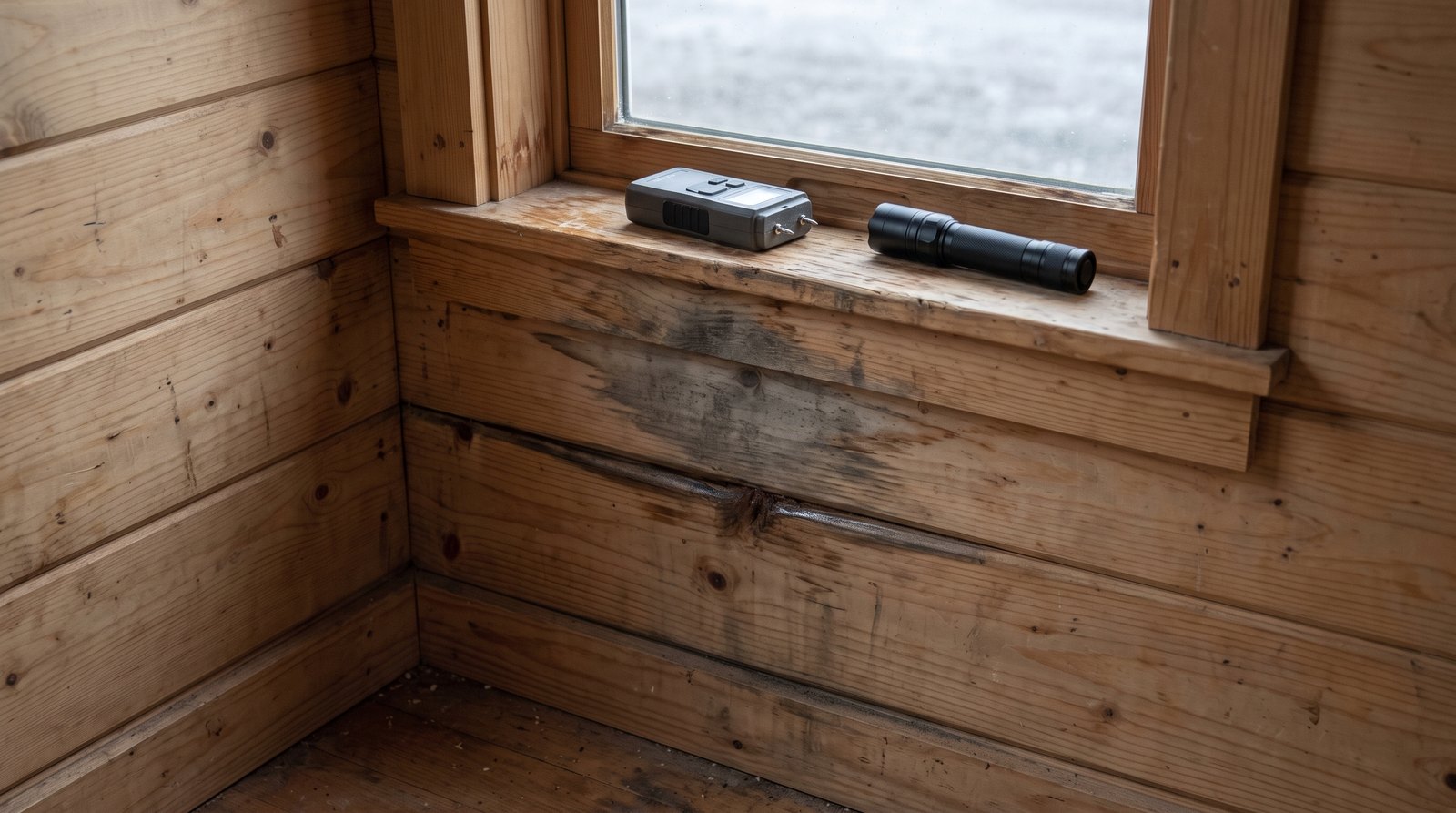
Start with your feet. Walk the whole floor slowly and press down at the entry door, in front of the shower, under the sink, along the wall bases, and anywhere the finish flooring looks discolored. Soft or spongy floor is subfloor rot until proven otherwise. Then press the wall panels low, where water collects, and look for swollen seams and dark staining.
Bring a moisture meter. A basic pin type meter costs less than a tank of fuel and it removes the guesswork. Readings around six to twelve percent are normal for interior wood, and up to roughly fifteen percent is unremarkable in an exterior wall. A reading above eighteen percent means the wood is at risk of rot, and twenty percent or more indicates active moisture and possible structural damage. Wood begins to decay once it reaches roughly thirty five percent. Take readings at the base of every wall, around the windows, and in the bathroom, and compare them against a known dry interior wall as your baseline.
Smell matters too. A persistent musty odor in a closed up tiny house usually means moisture somewhere in the assembly, even when nothing is visible. Open the loft hatch and the utility bay and smell those spaces separately.
If you find rot that has reached the floor framing or the trailer deck, understand what you are taking on. Repairs at that level commonly run into the thousands, because reaching the damage means pulling finished surfaces, cabinets, and sometimes part of the wall assembly. Labor rates and access vary a great deal by region, so get a written quote before you commit rather than after.
Systems: Electrical, Plumbing, Propane, and Heat
Systems in a used tiny house range from professionally installed to genuinely dangerous, and the difference is not always visible. Ask who did the work and whether any of it was inspected. On an owner built house, treat the electrical and propane work as unverified until you have looked at it yourself or paid someone else to.
On the electrical side, open the panel cover and look at the workmanship. You want proper breakers, wire gauges that match those breakers, cable secured and protected where it passes through framing, and no household extension cord doing duty as permanent wiring. Test every outlet and confirm that the ones near water are GFCI protected. Check the shore power inlet and cord for heat damage at the plug.
On plumbing, run every fixture and watch under the sink and behind the shower while the water runs. Look at the water heater, the pump, and any exposed lines for signs of a past freeze, which usually shows up as a split fitting or a repair clamp. Ask how the house was winterized and whether it has ever frozen.
For propane, look for a proper regulator, secured tanks, and hard lines rather than long runs of flexible hose. Confirm that there is a working propane detector and a carbon monoxide alarm. If the house has a wood stove, check the clearances to combustibles and the condition of the flue, because undersized clearances are common in small builds and they matter a great deal to insurers.
Paperwork: Title, VIN, Liens, and Certification
The paperwork decides whether you can insure, finance, register, and eventually park the house you are buying. Sort it out before money changes hands, because a house you cannot title is a house you cannot easily move legally or resell.
A tiny house on wheels is titled through its trailer. Confirm that the seller holds the title, that the name on it matches the person you are paying, and that the VIN on the paperwork matches the plate on the frame. Run the VIN through the National Motor Vehicle Title Information System, and consider a vehicle history report as well, to surface title brands and liens reported across states. A lien that survives the sale becomes your problem, not the seller’s.
Then ask about certification. RVIA and NOAH are the two third party certifications you are most likely to encounter, and both make a tiny house easier to insure, easier to finance, and more likely to be accepted at an established RV park or tiny house community. NOAH in particular certifies owner built houses through a documented remote inspection process. An uncertified DIY build is not automatically a bad house, but it is often difficult or impossible to insure, and many lenders decline it outright. If certification matters to you, find the label and verify it rather than taking a seller’s word for it.
If you plan to borrow, read our breakdown of tiny house financing options first, because the certification status of the house you are inspecting will shape which lenders will talk to you at all. Insurance follows the same logic, and our tiny house insurance cost guide explains what carriers ask for.
What a Used Tiny House Is Actually Worth
Used tiny houses on wheels depreciate more like recreational vehicles than like real estate. A commonly cited pattern is a fifteen to twenty five percent drop in the first year, continued decline after that, and a value somewhere around forty to sixty percent of the original price after five years. Condition and certification move that number more than age alone does.
In practical terms the used market is wide. Unfinished shells and rough owner built houses trade in the low thousands. Well kept professional builds with certification hold much more of their value, and premium custom houses still change hands near six figures. Buying used commonly saves somewhere in the range of fifteen to thirty percent against ordering the same house new.
Price the house against what you actually found. Deduct the real cost of the work sitting in front of you: new tires, resealing the roof and windows, replacing a rotted section of subfloor, correcting the electrical. A seller who has priced the house as though it were new is telling you they have not accounted for the trailer underneath it. Remember also that the pool of buyers is small, so a house that is hard for you to finance will be equally hard for you to sell later.
Frequently Asked Questions
Should I hire a professional inspector for a used tiny house?
For anything above roughly twenty thousand dollars, yes. A certified RV inspector understands trailers, propane, and twelve volt systems far better than a residential home inspector does. Expect to pay a few hundred dollars, which is small against the cost of undiscovered subfloor rot or a corroded frame.
Can I get a loan for a used tiny house?
Sometimes. RVIA or NOAH certified houses can qualify for RV style loans through specialty lenders, because the lender can place a lien and the unit can be titled cleanly. Uncertified and owner built houses usually fall back on personal loans, which carry shorter terms and higher interest rates.
What is the most expensive problem to fix on a used tiny house?
Structural water damage that has reached the floor framing or the trailer deck. Repairs require removing finished surfaces and often cabinetry to reach the damage, so labor dominates the cost. A corroded trailer frame is worse still, because replacing it effectively means rebuilding the house on a new one.
How old is too old for a used tiny house?
Age matters less than maintenance and storage. A well built, well sealed house kept under cover can be sound at fifteen years, while a neglected five year old house parked in the open can already have rot in the walls. Judge the sealant history and the trailer, not the model year.
Do I need the seller present during the inspection?
Yes, and use the opportunity. Ask when the roof was last resealed, whether the house has ever frozen or leaked, who did the electrical and propane work, and where it has been parked. Vague or inconsistent answers to those four questions tell you more than most of what you will see.