Raising kids in a tiny house can work when each child has a suitable bed, dependable routines, personal storage, and space to retreat. Start with safe sleeping and a lawful place to live, then test ordinary school days. A clever floor plan cannot compensate for poor sleep, constant crowding, or an insecure parking arrangement.
Table of Contents
Quick answer by situation
The right family layout depends more on ages and daily schedules than on how many mattresses fit. Plan around the youngest child now and the oldest child several years ahead. A home that handles bedtime, breakfast, homework, and a rainy afternoon is more useful than one that merely sleeps everyone.
- Baby or toddler: Reserve accessible main-floor space for an appropriate sleep product and hands-on care.
- School-age siblings: Consider separate beds, individual storage, and a study surface that remains usable during meal preparation.
- Children with different bedtimes: Separate sleeping from the kitchen and evening seating area as much as possible.
- Teenager: Prioritize changing privacy, confidential conversations, and a place for friends.
- Parent working from home: Test overlapping calls, schoolwork, and play before committing to one open room.
- Uncertain long-term parking: Resolve the site arrangement before ordering a larger family-sized house.
Write down the activities that must happen simultaneously. If dinner preparation blocks the only study desk, or unfolding a bed closes the bathroom route, revise the layout before buying furniture.
Choose sleeping arrangements by age
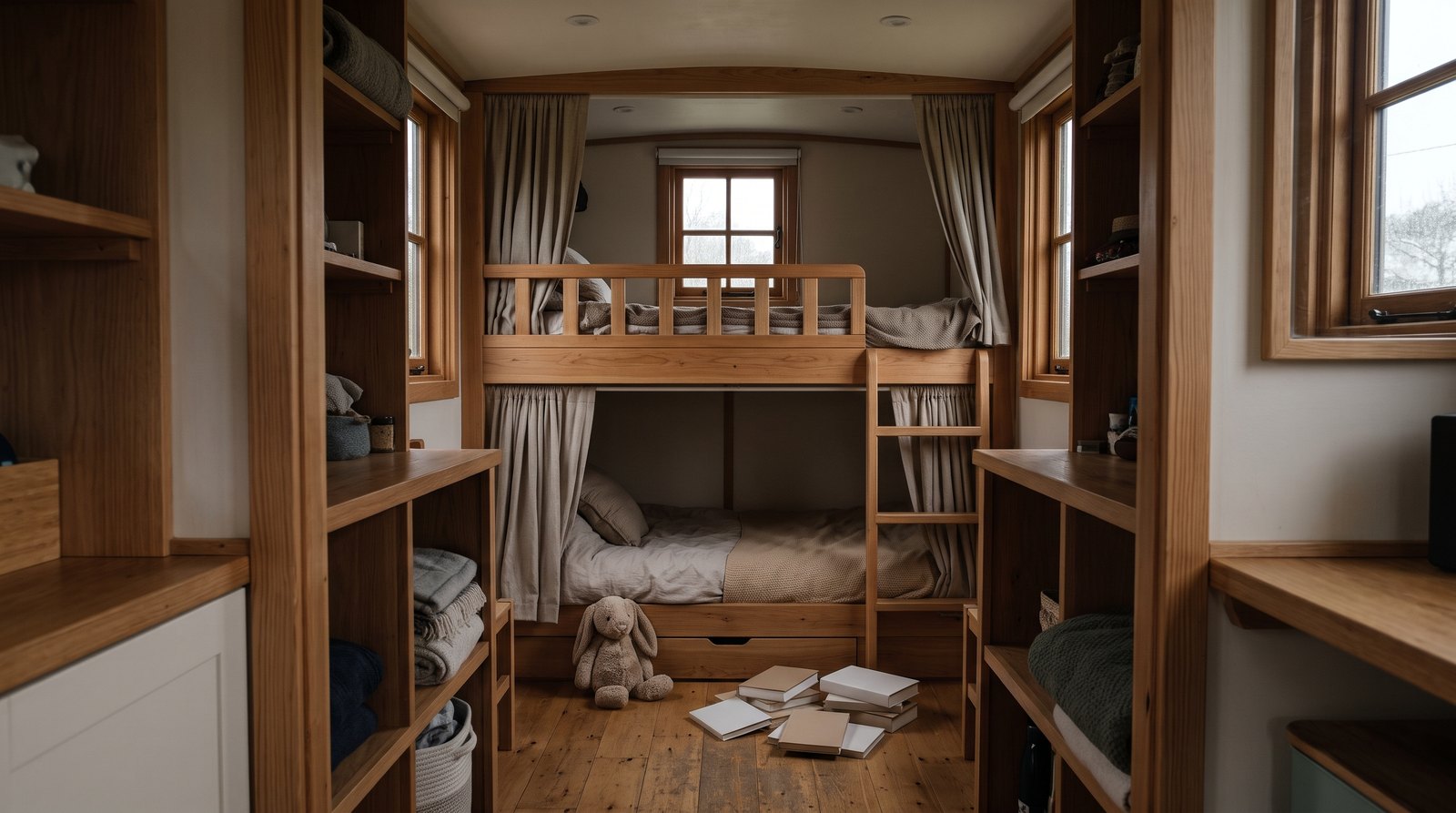
Give every child a dependable sleeping place that suits their age, size, and ability to use it safely. Main-floor beds simplify supervision and nighttime help. Bunks can save floor space for older children, but mattress thickness, guardrails, access, and the surrounding room all matter more than the number of advertised sleeping positions.
For an infant, leave room for a separate, compliant crib, bassinet, or play yard. Follow CDC safe-sleep guidance: place babies on their backs on a firm, flat sleep surface with a fitted sheet, without soft bedding or toys. A sofa cushion or improvised drawer is not a space-saving substitute.
The American Academy of Pediatrics advises against upper-bunk use for children younger than six. That threshold does not automatically make every older child ready for a high bed. Consider nighttime bathroom trips, mobility, and whether a caregiver can reach the child.
Measure the actual mattress and usable headroom. Ask the builder to demonstrate changing the bedding and helping a sick child, not just climbing up once in a showroom.
Treat bunks, lofts, and escape routes separately
A bunk bed, a sleeping loft, and an emergency exit solve different problems and need separate checks. A rail that looks substantial in a photograph does not establish safety. Have the builder explain applicable bed requirements, local loft rules, and emergency escape provisions for the specific house and the children using it.
CPSC bunk-bed guidance requires guardrails at least five inches above the mattress and addresses entrapment separately. That measurement is not a complete design checklist or a substitute for building-code requirements at a loft edge. Use the specified mattress and follow the bed manufacturer’s instructions.
Keep the route from each sleeping place to the exit clear even when beds and tables are unfolded. Ask the local building official or fire department to review difficult access arrangements. Plan how an adult will assist a child who cannot escape independently.
The U.S. Fire Administration recommends smoke alarms in every bedroom, outside sleeping areas, and on every level. Follow installation instructions and local requirements, and test monthly. Practice the household escape plan and choose an outdoor meeting place.
Count outdoor space only when it is usable
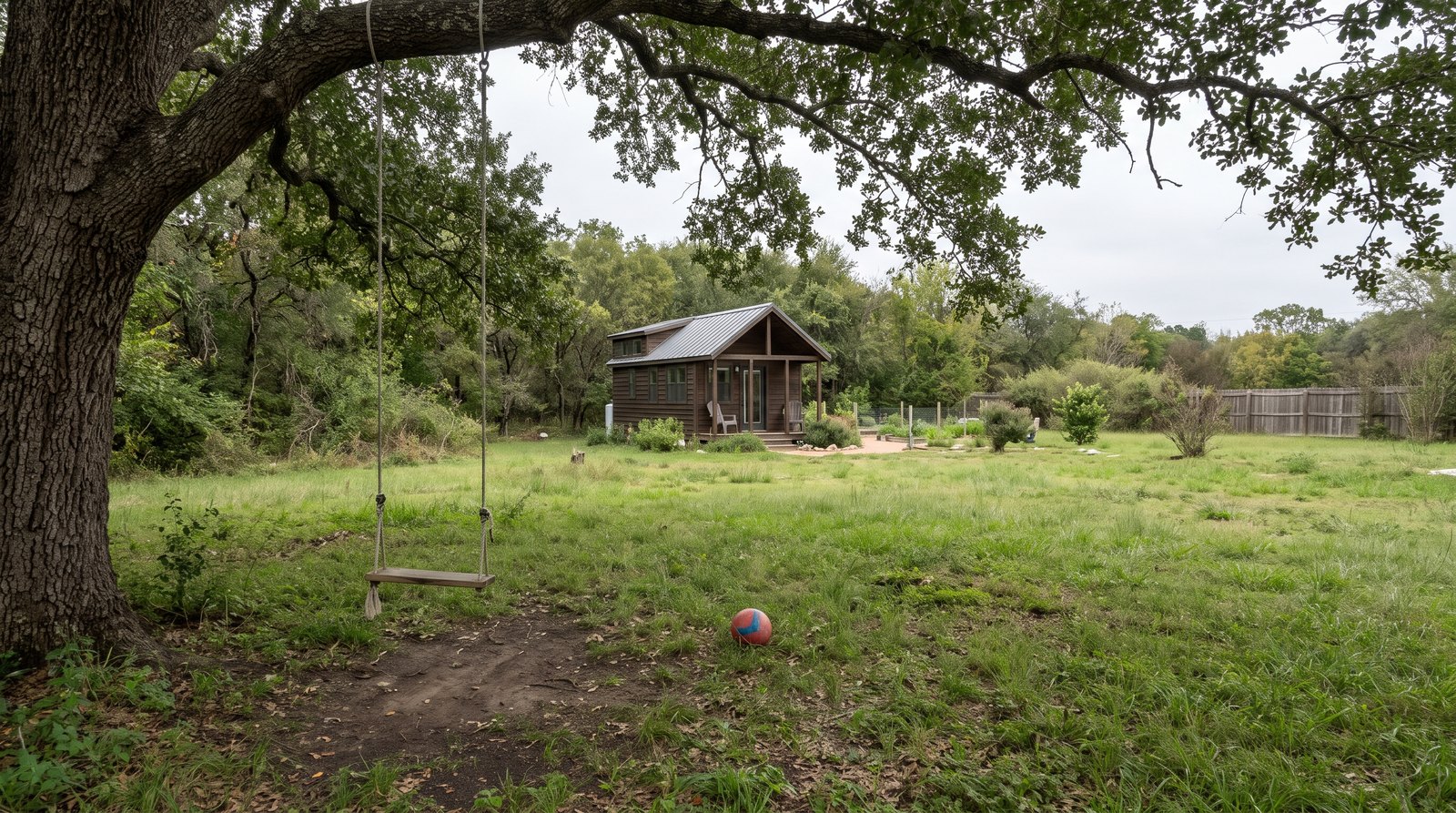
A yard, nearby playground, or shared community space can make a small home easier for a family, but it cannot replace the indoor space needed during bad weather. Evaluate the site during the season you actually expect to live there. Safe access and permission to use the space matter as much as acreage.
Walk the route to the play area. Consider traffic, water, animals, visibility from the house, and where adult supervision will happen. Ask a landlord whether play equipment, bicycles, storage boxes, or a fence are allowed. A listing photograph does not grant permission to use adjoining land.
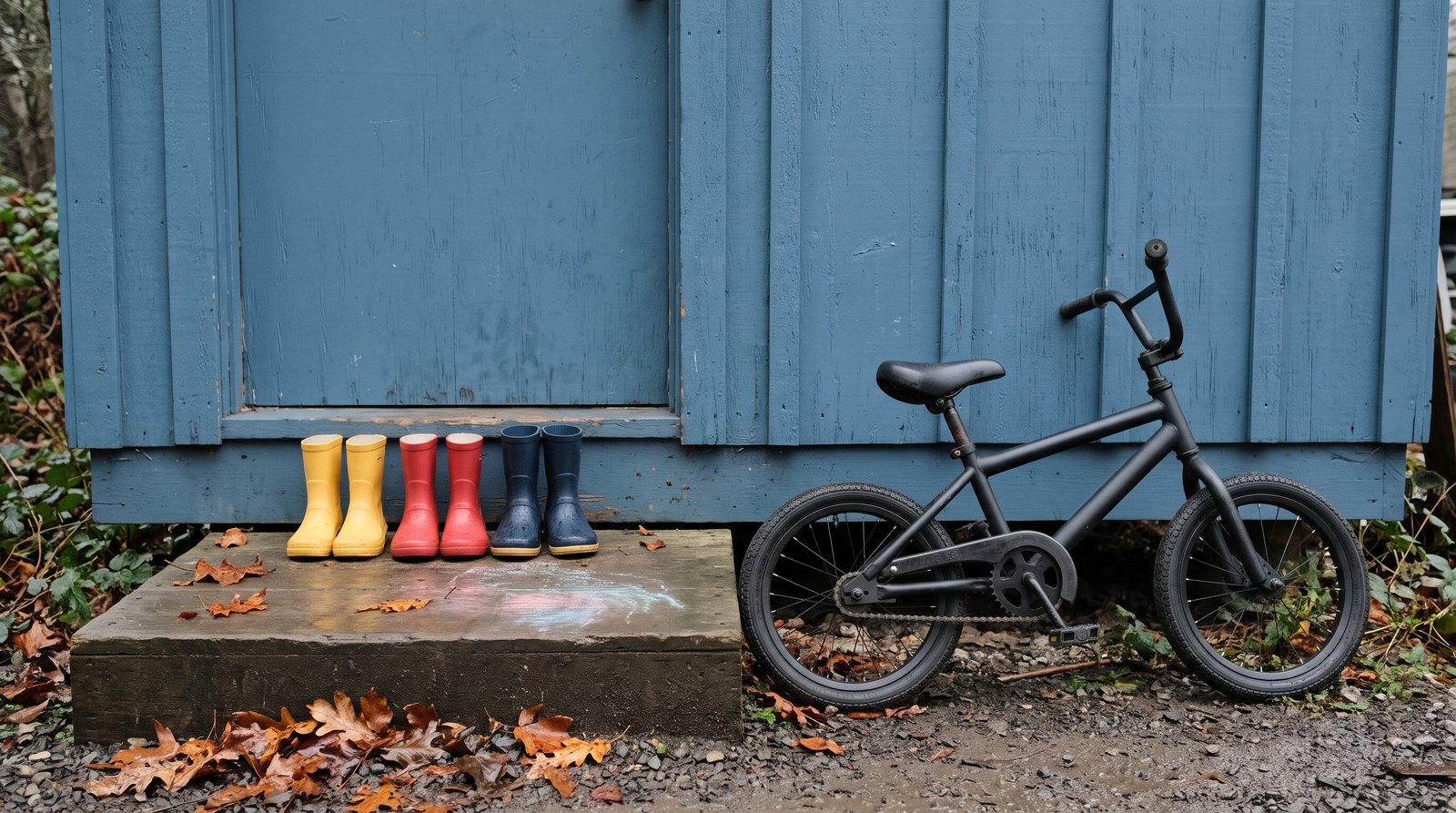
Try a rainy-day floor plan with shoes, coats, school bags, and laundry indoors. Give wet gear a drying location that does not block a heater or doorway. If outdoor storage is essential, include its price and site approval in the plan.
Look beyond the lot. A nearby library, reliable transportation, and friends within reach may be more valuable than a remote property with a larger lawn.
Build privacy into the daily routine
Children need some control over their belongings, conversations, and bodies even when bedrooms are shared. Provide a private changing arrangement, a place to keep personal items, and predictable time alone. Curtains can reduce visual exposure, but they provide little sound separation and should never interfere with ventilation, access, or escape.
Agree on simple boundaries: ask before entering another person’s bed space, leave private drawers alone, and allow uninterrupted time for calls. Apply those rules to adults too. Privacy is difficult to protect if the only quiet corner is always claimed by a parent’s laptop.
Consider what happens when one child wants silence and another wants music. Headphones and scheduled quiet periods may help, but persistent conflict can signal that the layout needs a separate room. Fabric dividers will not perform like a properly designed wall and door.
Keep window treatments appropriate for children. CPSC identifies cordless window coverings as the safest option where young children are present. Avoid creating dangling loops near beds when adding privacy curtains.
Make homework and meals coexist
A family tiny house needs a practical place for schoolwork that does not disappear whenever someone cooks. A shared table can work if supplies move easily and schedules rarely conflict. When schoolwork overlaps with dinner or remote employment, a second compact work surface may be worth more than additional decorative storage.
Test the chair, writing surface, lighting, and charging location with the child who will use them. Measure with the chair pulled out, not tucked under the table. Keep chargers and cords away from walkways, cooking surfaces, and younger children.
Give ongoing projects a tray or shallow bin so clearing the table does not mean dismantling the work. Store school supplies close to the study spot. A fold-down surface should have suitable supports and enough clearance to open without trapping someone behind it.
Check internet service at the actual site before depending on it for school or work. Ask about outages and data limits, and identify a realistic backup location. A strong signal in a seller’s video is not evidence of coverage on your lot.
Use storage that children can manage
Good family storage keeps daily items easy to reach and gives each child a clearly defined share of space. Start with ordinary belongings, including coats, shoes, school bags, bedding, and sports equipment. Use toy rotation to control what is out at once, while protecting a child’s favorite possessions and unfinished projects.
Choose a few accessible bins rather than packing everything into deep compartments under heavy furniture. Test whether a child can put things away without adult help. A storage system that requires moving the dining table twice a day will quickly become a pile on the floor.
Keep medicine, cleaning products, and other hazardous items secured rather than merely high up. Have furniture and built-ins secured appropriately, and avoid turning open shelves into a climbing route. Check the latches and hardware on frequently used compartments.
Agree on what happens when a bin is full. Rotation, donating outgrown items, and borrowing occasional-use equipment can help. Do not make children repeatedly discard meaningful belongings simply because an adult underestimated the storage requirement.
Confirm the address and occupancy arrangement
Before moving children into a tiny house, confirm that the specific dwelling and site can support the intended household and year-round use. Local rules vary, and a seller’s description of sleeping capacity is not an occupancy approval. Contact the relevant planning, building, and school offices with the actual address and house details.
Ask about the dwelling classification, approved use, required inspections, sleeping areas, and any occupancy conditions. For a rental lot, get the permitted use and lease terms in writing. Include water, wastewater, trash service, and access for emergency responders in the conversation.
Ask the school district what it needs to establish residency, which school serves the site, and whether transportation is available. As one state-specific example, the Texas Education Agency explains that districts determine acceptable residency documentation. Do not assume that example describes every state’s process.
A mailing address alone does not answer every enrollment question. If housing is unstable, contact the district’s student-support or homeless-education liaison for guidance about the family’s circumstances.
Budget for the household, not just the house
A tiny house only reduces family housing costs if the complete arrangement fits the budget. Include the site, utilities, transportation, insurance, storage, maintenance, and any financing alongside the purchase price. A cheaper house far from school and childcare may create expenses and time demands that erase the expected advantage.
Build a monthly comparison using your own bills and written quotes. Include seasonal costs and an emergency reserve. Do not count a hoped-for campsite rate or informal parking promise as a stable long-term expense. Price the arrangement you can actually secure.
Financing depends on the house and its classification. Review tiny house mortgage and financing options before assuming a conventional mortgage applies. If frequent travel is central to the plan, compare a tiny house with an RV for full-time living.
Also consider how long the arrangement must work. Our guide to how long tiny houses last explains why maintenance and construction quality remain important in a smaller building.
Test the routine and set an exit point
A realistic trial should include school preparation, laundry, meals, bedtime, and time indoors together. Invite children to describe what feels difficult without treating criticism as disloyalty to the plan. Decide in advance which problems can be adjusted and which mean the family needs a different home or a larger footprint.
Rent a comparable layout if possible, or mark the proposed rooms and furniture on the floor at home. Practice with doors, drawers, beds, and chairs in use. Record repeated bottlenecks instead of relying on the excitement of a short tour.
Review the arrangement as children grow. Ongoing sleep disruption, lack of changing privacy, unsafe access, or schoolwork constantly displaced by daily chores are reasons to reconsider. Moving to a larger home can be the sensible next step, even when the tiny house worked well for an earlier stage.
Frequently asked questions
Family suitability depends on the actual house, the site, and each child’s needs. These answers address common planning questions, but they do not establish local approval or certify a bed design. Use them to prepare questions for your builder, local officials, school district, and any professionals advising your family.
Can a family of four live in a tiny house?
Yes, some layouts can accommodate two adults and two children, but four sleeping positions do not establish comfort or legal occupancy. Check the approved use, beds, bathroom access, storage, and everyday schedules. Test the arrangement with everyone present before deciding that a particular floor area is enough.
Should young children sleep in a tiny house loft?
Main-floor sleeping is generally easier to supervise and reach for nighttime care. Upper bunks are not for children younger than six, and a loft needs its own assessment of access, guards, and escape. Do not assume a ladder and a decorative railing make a high sleeping platform suitable.
Do children need separate bedrooms?
A separate bedroom is one way to provide privacy, but the practical requirement depends on ages, individual needs, and applicable local rules. Shared rooms still need personal storage, changing privacy, and workable sleep schedules. Ask local officials about the specific occupancy arrangement rather than assuming one nationwide rule applies.
How do you manage toys in a tiny house?
Keep a manageable selection within reach and rotate other items from a defined storage space. Give each child a personal bin and somewhere to preserve unfinished projects. Agree on donation decisions together. If essential belongings consistently overflow, reconsider the storage plan instead of making every cleanup a forced purge.
When does a family outgrow a tiny house?
A family may outgrow the house when sleep, privacy, schoolwork, or safe movement remain difficult despite reasonable changes. Growing children can need different beds and more separation. Review the arrangement regularly and keep a realistic moving budget, so choosing more space remains an option rather than a crisis.