Tiny house shower storage works best when every item drains, dries, and stays secure without damaging the waterproof wall system. A recessed niche is the cleanest permanent option, while removable baskets, tension caddies, and hanging organizers suit finished bathrooms. Any drilled mounting must reach solid backing and follow the waterproofing manufacturer’s instructions.
Table of Contents
Which tiny house shower storage option is best?
The best choice depends on whether the shower is still being built, how the walls are waterproofed, and whether the house travels. Use a framed recessed niche during construction, a properly supported shelf when backing is available, or a removable caddy when you cannot confirm what is behind the finished wall.
Corner shelves use otherwise awkward space. They can be tiled in, bonded to tile, or fastened to blocking, depending on the product and wall system. Keep the lowest shelf high enough that knees and shoulders do not hit it, but low enough that bottles are reachable without stretching across a wet floor.
Portable caddies are usually the safest retrofit. A tension pole, showerhead caddy, over-door organizer, or lift-out basket adds storage without opening the wall. They are also easy to remove for cleaning or travel. The downside is less capacity, more visual clutter, and occasional movement if the caddy is poorly fitted.
Quick answer by situation:
- New build: Frame and waterproof a recessed niche, with blocking for any additional shelves.
- Finished tile shower: Choose a removable tension caddy or a bonded shelf approved for that surface.
- Fiberglass surround: Avoid random screws. Use a compatible removable organizer unless the surround maker approves another method.
- Wet bath: Favor open baskets, rounded edges, and materials that tolerate constant spray.
- House that moves: Use a caddy that can be emptied, latched, or removed before towing.
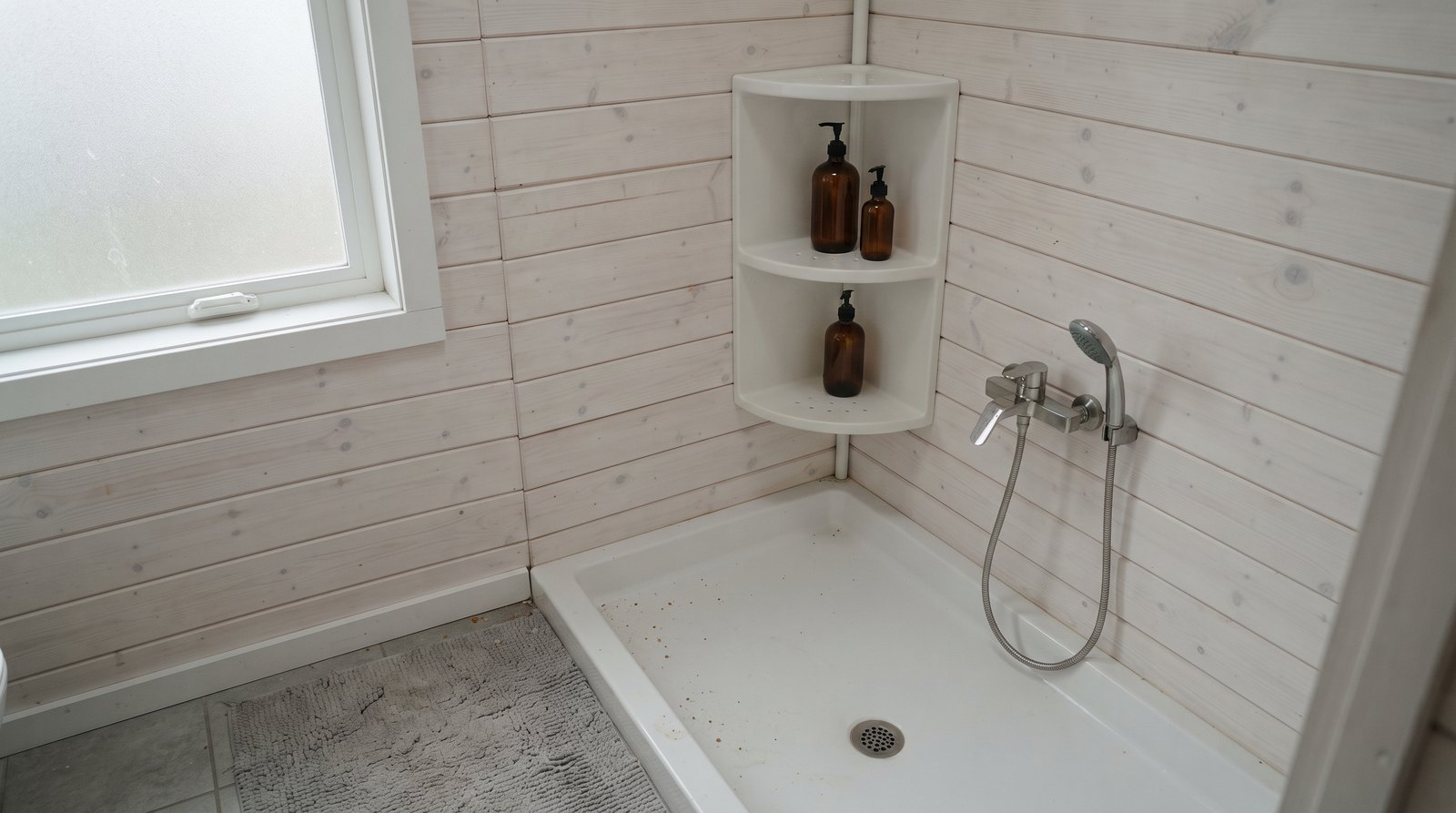
Check the wall before drilling or cutting
Do not drill a tiny house shower wall until you know the wall layers, waterproofing system, framing, and utility locations. A stud finder alone cannot reliably identify every pipe or wire. Review build photos or plans, inspect from the opposite side when possible, and confirm the approved penetration detail for the exact wall system.
A compact bathroom often packs a mixing valve, supply lines, drain vent, electrical cable, and structural framing into a small area. The apparent empty spot between two grout lines may not be empty behind the tile. A mistaken hole can create a slow leak inside the wall or puncture a pipe that is expensive to reach.
Waterproofing is a complete assembly, not just tile and grout. Cement board, foam board, sheet membrane, liquid membrane, and molded surrounds have different attachment rules. Some systems allow a fastener penetration when it is treated with a compatible seal or band. Others require a specific flange, adhesive, or factory accessory. Ordinary caulk is not a universal substitute.
Heavy shelves and grab points need structural support. Waterproof foam board makers generally require solid blocking or framing behind heavy wall-mounted objects. Even a small shelf becomes heavy when it holds several full bottles and someone grabs it while slipping. If the wall lacks backing, use a light removable option instead of treating tile as structure.
How to plan a recessed shower niche
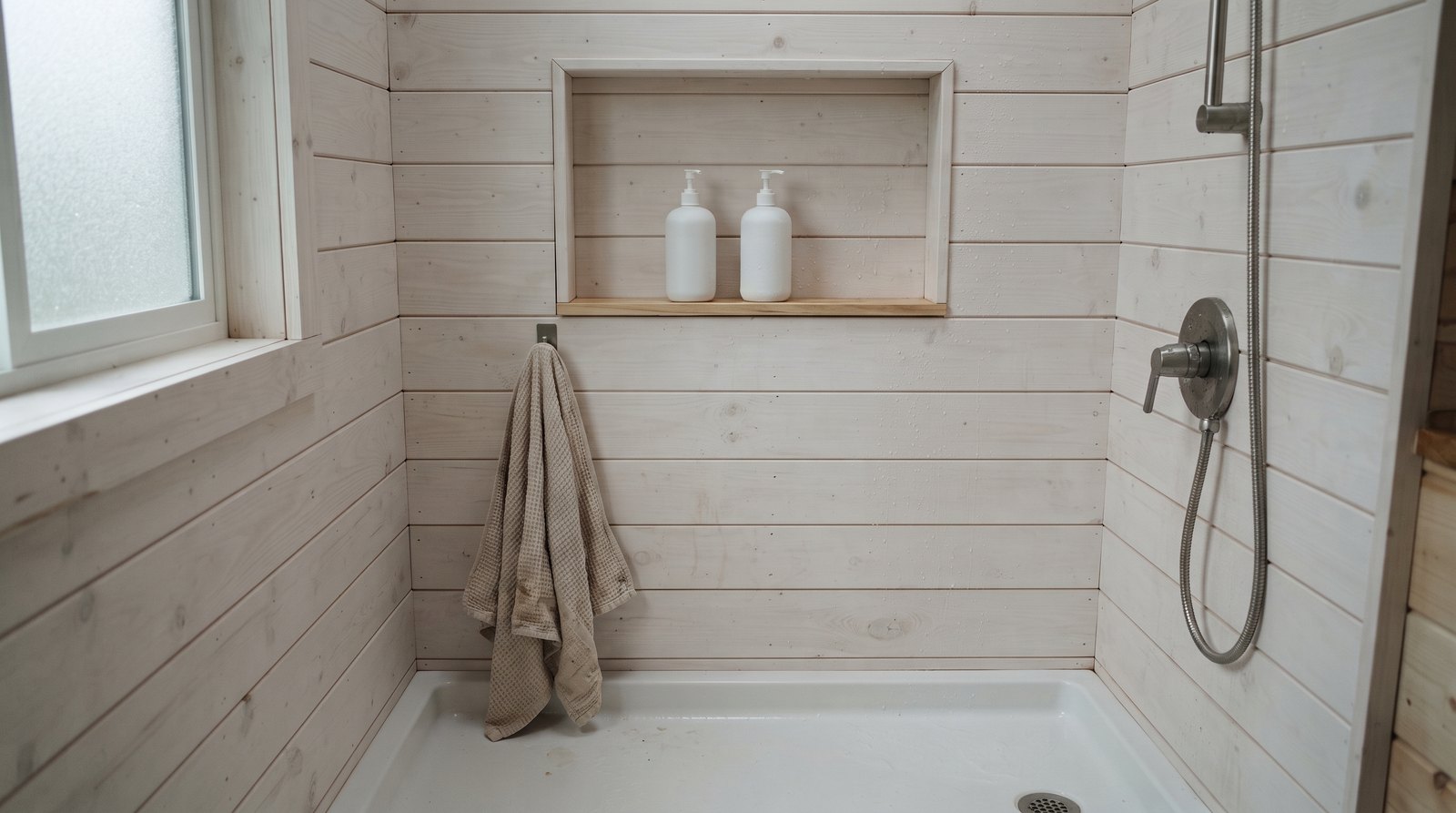
A recessed niche is the most space-efficient permanent solution, but it should be designed before the wall is closed. Size it around real containers, place it outside the strongest spray when practical, support all required edges, and integrate its flange or membrane into the approved waterproofing system before tile is installed.
Start with bottle dimensions, not a catalog photo. Tall pump bottles often need more clear height than expected, and a shelf can divide a large opening more effectively than two tiny niches. Allow room to lift a bottle past its pump. A niche that is too shallow or short encourages residents to balance products on the floor.
Locate the niche only after confirming stud spacing and utilities. Moving a nonstructural stud may be possible during a build, but changes to bearing walls, headers, shear panels, or engineered framing need qualified review. Never notch a pipe, vent, or structural member just to make a storage box fit.
The bottom must shed water toward the shower rather than trap it against the back. Maintain the slope through the substrate, waterproofing, setting material, and finish surface. Corners and seams must be sealed exactly as the system specifies. Prefabricated niches simplify these transitions, but they still need support and proper connection to the surrounding waterproof layer.
Current retail examples put many basic prefabricated niche shells around $85 to $165 before mortar, membrane accessories, tile, trim, and labor. Custom framing can use inexpensive lumber, but the total installed price may be higher because layout, waterproofing, tile cuts, and edge finishing take time. Treat the shell price as only one part of the job.
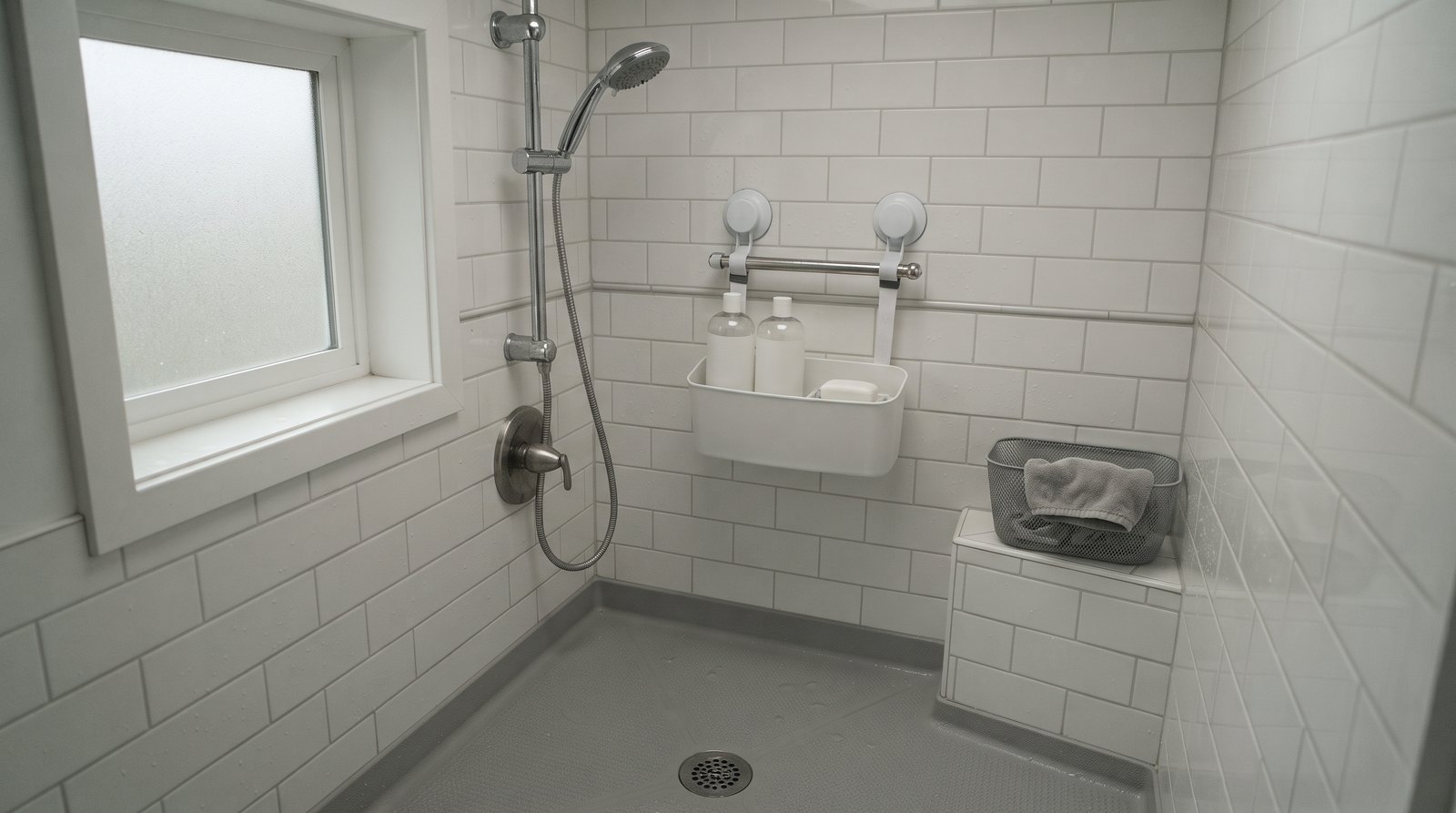
Corner shelves, adhesive mounts, and suction cups
Surface-mounted storage can work well when its attachment method matches the wall and the expected load. Bonded shelves need a clean, compatible surface and full cure time. Suction cups need smooth nonporous tile or glass. Mechanically fastened shelves need backing and an approved waterproof penetration detail, not screws placed wherever convenient.
A tiled-in corner shelf is best installed as part of the tile work. Stone, solid-surface, metal, and purpose-made profiles can all work, but the support method and edge treatment matter. Keep a drainage gap or slope so water does not sit behind bottles. Avoid sharp projecting corners in a shower that is only a few feet wide.
Adhesive shelves vary widely. Follow the listed surface preparation, temperature, cure time, and weight rating. Soap film, hard-water scale, grout texture, and flexible wall panels can weaken the bond. Do not load the shelf early, and do not assume a high laboratory rating applies to an uneven shower wall.
For hardware, plastic, anodized aluminum, and good stainless steel usually tolerate wet service better than painted mild steel. “Rust resistant” does not mean rustproof. Cut edges, welds, fasteners, and chipped coatings often corrode first. Rinse away product residue and replace any organizer that develops sharp rust, loose joints, or swelling.
Tension caddies and hanging organizers
Tension caddies and hanging organizers are the most practical no-drill choices for many completed tiny houses. Measure the full installation range, choose ventilated shelves, and limit the load to the maker’s rating. In a mobile house, remove bottles and restrain or remove the organizer before travel, even if it feels stable when parked.
A corner tension pole keeps products off the floor and avoids wall penetrations. Current retail examples range from about $35 for a basic four-tier pole to roughly $95 for larger or upgraded models. Measure floor-to-ceiling height at the exact corner, since a sloped ceiling, shower pan radius, or trim ledge can prevent secure contact.
For travel, think beyond the organizer itself. A full shampoo bottle becomes a moving weight during a hard stop. Empty every open shelf, close bottle pumps, place containers in a latched bin, and secure the caddy so it cannot strike tile, glass, or fixtures. This is one reason a tiny house and an RV differ in daily routines, even when their bathrooms look similar.
Wet bath versus dry bath storage
A wet bath needs faster drainage, fewer hidden crevices, and storage materials that can be sprayed from every direction. A dry bath gives you more freedom outside the shower enclosure, but items inside the wet zone still need ventilation. In either layout, keep toiletries clear of the floor drain and the user’s standing area.
In a wet bath, toilet paper, towels, medicines, and electrical grooming tools need sealed or genuinely dry storage outside the spray path. A wall cabinet with a positive latch may be more useful than adding another shower shelf. Keep the shower floor open so it can be squeegeed and so the drain remains visible.
Ventilation protects both layouts. Run the bath fan during bathing and long enough afterward to clear moisture, following the fan maker’s guidance. Wipe pooled water from shelves and niche corners. Persistent dampness can shorten the life of finishes and hidden materials, which is one reason moisture control matters when considering how long a tiny house lasts.
Realistic costs and a safe installation plan
Budget about $15 to $50 for a basic removable basket or hanging caddy, $35 to $95 for many tension poles, and roughly $85 to $165 for a basic niche shell. Permanent installation costs rise with blocking, waterproofing accessories, tile, trim, and labor. Prices vary by size, finish, seller, and location.
Begin by listing every bottle, bar, razor, and washcloth that needs a home. Remove duplicates and bulk containers. Then measure wall width, ceiling height, niche depth, door swing, showerhead clearance, and the user’s reach. Tape a cardboard outline to the wall to test placement before buying or cutting anything.
For a permanent installation, document the wall before it is closed. Photograph framing, blocking, pipes, wires, membrane seams, and the final fastener locations. Keep product instructions and receipts with the house records. This documentation can help future repairs and may be useful when discussing water-damage coverage with a tiny house insurance provider.
After waterproofing is complete, perform any required inspection or water test before installing finish materials. One major bonded-membrane manufacturer recommends a water test before tile and notes that local officials may require it. Follow the cure time and test procedure for your exact system instead of copying a generic schedule.
Cleaning and maintenance
Good shower storage should be easy to empty, rinse, and inspect. Once a week, remove bottles, clear hair and residue from drainage openings, and wipe the wall behind the organizer. Monthly, check fasteners, adhesive pads, suction cups, pole tension, sealant, grout, and metal joints for movement, staining, or corrosion.
Do not seal over a mystery crack or loose fitting without finding the cause. A moving shelf may indicate failed adhesive, missing backing, a loose fastener, or damaged substrate. Brown streaks can come from a corroding screw hidden under a coating. Soft wall material, recurring mildew, or dampness outside the shower deserves prompt investigation.
Before towing, empty every shower shelf and verify that removable parts are restrained. After arrival, check the organizer and nearby plumbing before reloading it. Small movements during travel can loosen a tension pole, caddy collar, or fastener even when nothing looks damaged at first glance.
Frequently asked questions
The safest storage choice protects the waterproofing, keeps the shower floor clear, and matches whether the house moves. These answers cover the most common retrofit, travel, cost, and moisture questions, but the approved plans, local requirements, wall-system instructions, and product load limits still control each installation.
Can I screw a shower caddy through tile?
Only when you know what is behind the tile and the waterproofing manufacturer provides an approved penetration detail. The fastener normally needs solid framing or blocking, and the hole must be sealed with compatible materials. Random screws through tile, grout, or a molded surround can create hidden leaks and weak attachment.
Are suction cup shelves safe in a tiny house shower?
They are reasonable for light, unbreakable items on smooth, clean, nonporous surfaces. They are unreliable across grout joints, textured tile, and many matte finishes. Check the cups often, keep heavy bottles low, and never treat a suction shelf as a grab point or leave it loaded during towing.
What is the best shower storage for a tiny house on wheels?
A removable, drainable basket or a caddy that can be emptied and positively restrained is usually best. Permanent niches also travel well because they have no moving frame, but every bottle must still be removed or secured. Do not rely on tension, suction, or bottle weight to hold items during travel.
How much does a recessed shower niche cost?
Many basic prefabricated niche shells currently cost about $85 to $165, but the installed total also includes framing, waterproofing accessories, mortar, tile, edge trim, and labor. A niche added during construction is usually simpler than one retrofitted into a finished wall because utilities and membrane transitions are visible.
How do I keep tiny house shower storage from getting moldy?
Choose open shelves and baskets, keep drainage holes clear, run the bath fan, and remove pooled water after use. Reduce the number of containers so air can circulate. Clean behind the organizer weekly, wash removable pieces, and investigate recurring dampness rather than covering it with fragrance, paint, or extra sealant.