Tiny house water leak detectors are worth installing because a small plumbing leak can soak a compact floor or cabinet quickly. Use simple sensors at likely leak points, then add a compatible automatic main shutoff when the house is unattended, hard to inspect, or insured on that condition. Test every device before relying on it.
Table of Contents
How Tiny House Leak Protection Works
Leak protection comes in three practical layers: point sensors that detect water on a surface, connected sensors that send remote alerts, and flow monitors or motorized valves that can stop the supply. The best setup often combines inexpensive sensors at fixtures with one accessible manual or automatic whole-house shutoff.
A standalone sensor is a battery-powered puck, strip, or rope that sounds an alarm when its contacts get wet. It is cheap and easy to place, but the alarm only helps if someone can hear it. A connected sensor adds app, text, email, or hub notifications. Some connected systems can command a compatible valve when a sensor trips.
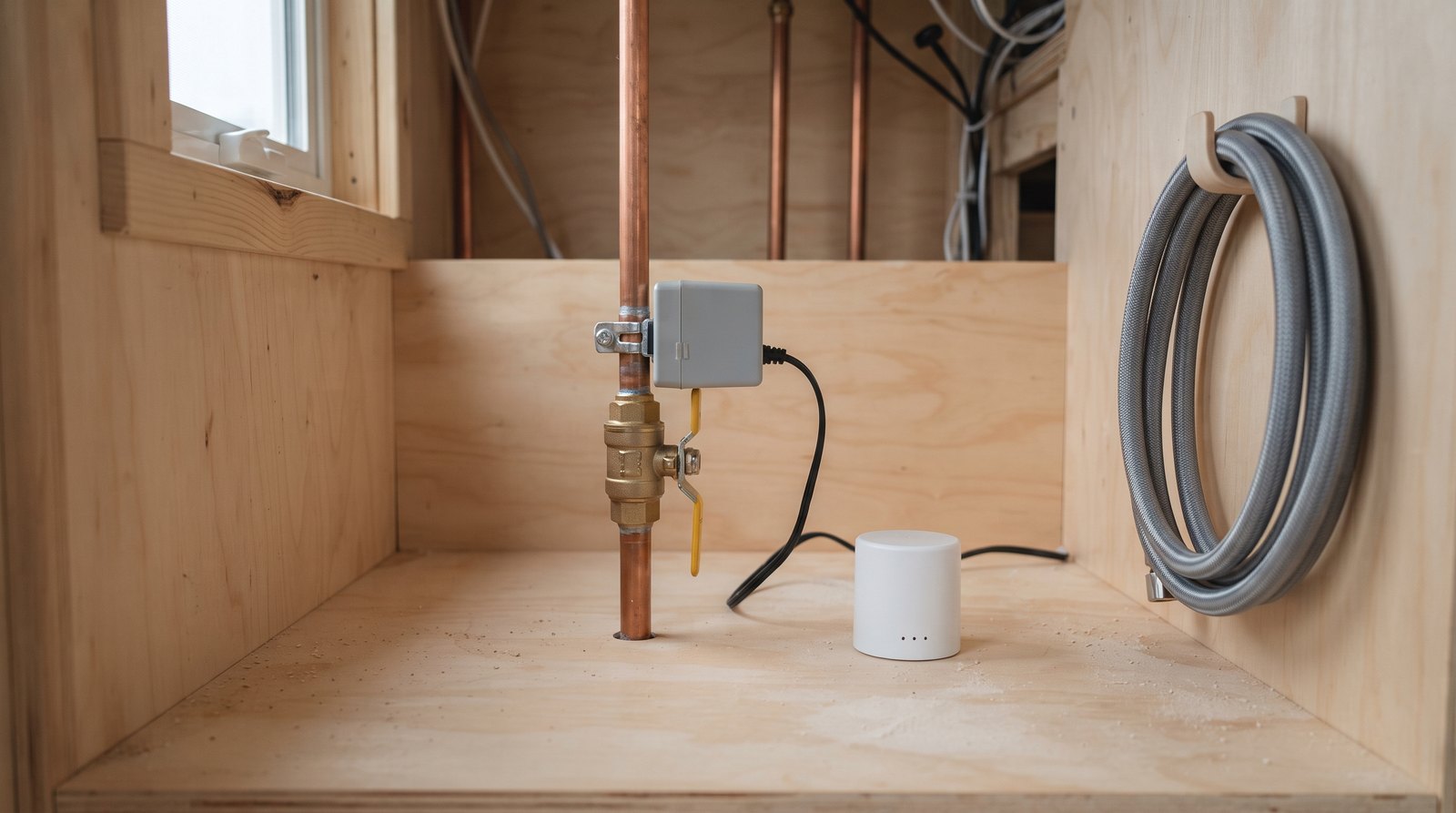
A flow monitor watches water movement, pressure patterns, or both. It may notice a running toilet, slow leak, or sudden burst even when no floor sensor gets wet. An in-line automatic shutoff is installed in the supply pipe and physically closes the water. A clamp-on actuator turns an existing compatible quarter-turn valve without cutting the pipe, but its fit and torque limits matter.
Quick Answer by Situation
Choose protection according to how the tiny house is used, not by the longest feature list. A full-time occupied home may need good local alarms, while a rental, seasonal cabin, or frequently vacant house benefits more from remote notifications and automatic shutoff. A THOW also needs travel and freeze planning.
- Full-time foundation tiny house: Put audible or connected sensors under sinks, beside the toilet, near the water heater, and by any washer or dishwasher.
- Home left empty for days: Add a remotely controlled or automatic main-line shutoff, plus alerts that reach more than one trusted person.
- Short-term rental: Use tamper-resistant sensor placement, clear reset instructions, and a valve that still has an obvious manual override.
- THOW that travels: Close the supply and depressurize as appropriate before towing. Secure sensors and confirm that vibration has not shifted them after arrival.
- Freezing climate: Keep the valve, monitor, and vulnerable pipe inside conditioned or properly protected space. A temperature alert is a warning, not freeze protection.
- Weak internet service: Favor a loud local alarm and a system whose sensor-to-valve action works locally, then treat cloud alerts as a useful extra.
If the budget is limited, start with several correctly placed sensors and a clearly labeled manual main valve. That catches common drips and makes a fast response possible. Upgrade to automatic shutoff when absence, property value, insurance terms, or slow emergency access makes delayed action especially costly.
Realistic Costs in 2026
A basic tiny house system can cost under $100, while automatic whole-house protection commonly costs several hundred dollars before labor. Current manufacturer pricing puts individual connected sensors near $17 to $50, multi-sensor hub kits around $60 to $110, valve-operator kits near $270 to $430, and premium in-line shutoffs near $580.
Those figures are shopping ranges, not quotes. Sales, extra sensors, rope cables, batteries, adapters, shipping, and subscription terms can change the total. Some products need a hub, some connect directly to Wi-Fi, and some reserve advanced monitoring or extended history for a paid service. Confirm what still works if a subscription ends.
Professional installation can move the total for an in-line valve to roughly $900 to $1,800 when the job needs a plumbing loop, pipe changes, a nearby receptacle, or difficult access. A straightforward clamp-on operator may be a do-it-yourself project if the manufacturer approves the existing valve, but a stuck, corroded, or poorly supported valve should be corrected first.
Ask your insurer whether a listed or professionally installed automatic shutoff earns a credit. The EPA notes that some insurers offer discounts, but eligibility varies. Do not buy a system based only on an advertised discount. Get the requirement in writing and compare it with the broader issues covered in our guide to tiny house insurance costs.
Where to Put Water Sensors
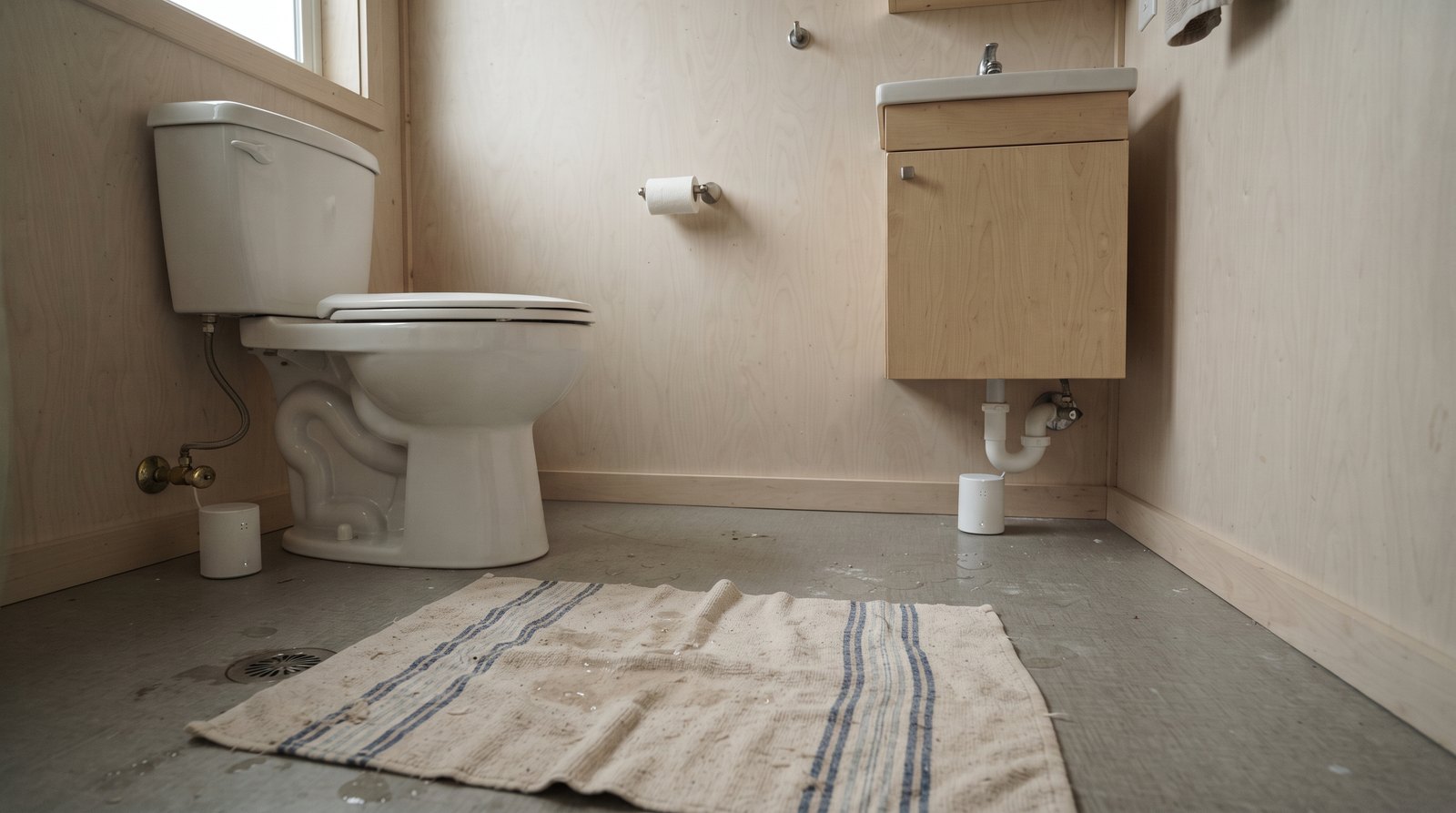
Place each sensor where the first escaping water is likely to collect, while keeping it reachable for testing and battery changes. In a tiny house, a few inches matter. A puck on a high cabinet shelf cannot detect water on the floor, and one trapped under stored supplies may be impossible to inspect.
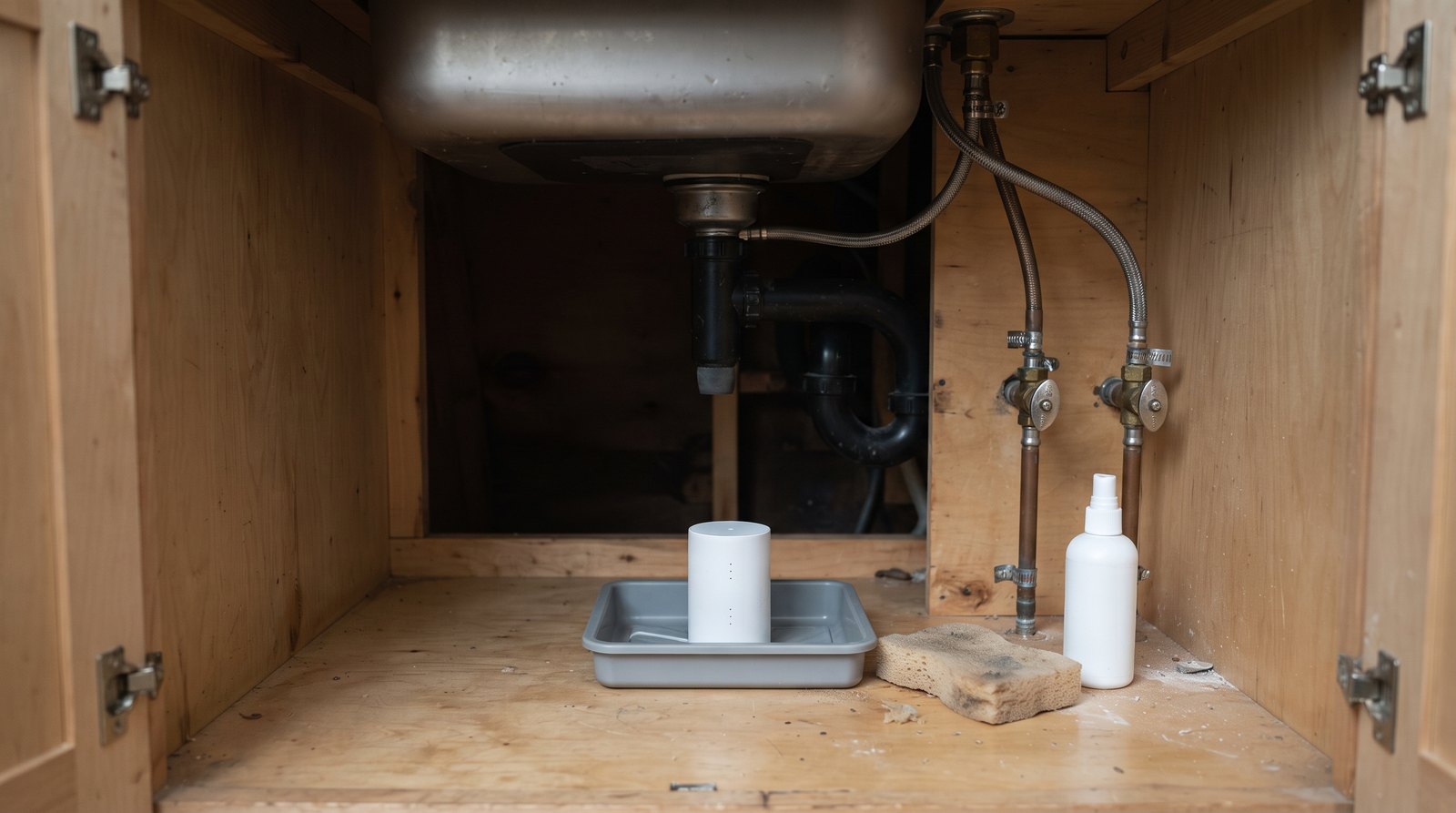
Start beneath the kitchen sink, under or beside the bathroom vanity, next to the toilet supply connection, below the water heater relief and drain area, and near a washer or dishwasher. Add coverage at a filter housing, pump, accumulator tank, refrigerator supply, exterior hose connection, or composting-toilet water line if the house has one.
Do not set electrical hardware in a place that routinely gets splashed unless the instructions specifically allow it. Use a rope or cable sensor when water could emerge along a wider edge. Keep the sensing contacts against the lowest likely path, but avoid a low spot that collects harmless shower spray or condensation every day.
Before final placement, pour a small amount of clean water at the suspected leak source and watch where it actually travels. Cabinet lips, floor slope, pipe penetrations, and wheel-well boxes can redirect it. Dry the area completely, place the sensor at the true collection point, then perform the maker’s wet-contact test.
Installing an Automatic Shutoff Safely
Install the shutoff where it can control the intended supply, remain accessible, and stay within its temperature, pressure, pipe-size, orientation, and power limits. Follow the exact product instructions. In-line work may require a plumber, a permit, approved potable-water materials, electrical protection, and inspection under the codes adopted locally.
Usually, a whole-house device belongs downstream of the existing manual main shutoff and any component position specified by the manufacturer, such as a pressure-reducing valve. Do not bury the manual shutoff behind the new actuator. You still need a way to isolate the system for service and a way to operate the valve during a power, network, or motor failure.
Check the pipe size and connection type instead of measuring only the outside diameter. Verify flow direction if the body has one. Support the pipe so the device weight and motor torque do not strain a joint. Plan for a nearby approved power source without an extension cord crossing wet space unless the instructions expressly permit that arrangement.
After installation, restore water slowly and inspect every disturbed joint. Command a full close and open cycle while watching the physical valve position. Then wet a paired sensor and confirm the valve closes. Finally, test the manual override. A green light or app status is not enough if the valve itself did not move.
Special Considerations for a THOW
A tiny house on wheels adds vibration, changing hookups, limited power, and possible freezing to the normal leak risks. Treat departure and arrival as inspection events. Secure every sensor, cable, hub, and actuator, then verify their positions after towing. Shut off the water before travel rather than trusting automation on a moving house.
For storage, decide whether the plumbing will stay pressurized, be drained, or be fully winterized. Follow the house system and appliance instructions. A leak detector does not prevent frozen pipes, and an automatic valve that sits in an unheated utility box can freeze or fail. Temperature alerts buy reaction time only when someone can act.
If shore power can drop, check whether the valve remains open, closes, or simply stays in its last position. Learn whether local sensor-to-valve automation continues without internet. Keep the manual override reachable. Travel-related utility preparation also belongs on the checklist when calculating the cost to move a tiny house.
Avoiding False Alarms and Missed Leaks
False alarms usually come from poor placement, condensation, cleaning water, weak batteries, lost connectivity, or an overly sensitive flow profile. Missed leaks come from sensors being too high, too far away, blocked by storage, or offline. Good commissioning means creating controlled tests instead of assuming a connected app equals protection.
Assign meaningful device names such as Bathroom Toilet Floor or Water Heater Pan. Send alerts to at least two people if the house is a rental or seasonal property. Test local sound, remote notification, and automatic closing separately. Also confirm what the system reports when Wi-Fi, the hub, external power, or the cloud service is unavailable.
Small leaks can contribute to rot, corrosion, mold, insulation damage, and finish failure long before a flood is obvious. Leak protection supports durability, but it does not replace drying and repair. Our guide to how long tiny houses last explains why water management and prompt maintenance matter so much.
Testing and Maintenance
Test every sensor after installation, after towing, after a battery change, and on a regular schedule. EPA guidance recommends checking leak detection or flow-monitoring systems at least annually. For a small home, quarterly sensor checks and a monthly glance at status, batteries, cords, and valve access are a practical routine.
Use the manufacturer’s test method. Some sensors have a button, while others require wetting the contacts or cable with clean water. Confirm the local alarm first, then the app alert, shared-user alert, and valve response. Dry the contacts fully and verify that the system returns to its normal state.
Exercise the automatic valve on the schedule in its manual so it does not seize. One major manufacturer’s maintenance cycle is designed to close and reopen the valve and recommends running it at least every two months. Your product may specify a different interval. Watch the valve during the cycle and investigate grinding, hesitation, leaks, or an incorrect position report.
What to Check Before Buying
Buy only after confirming valve compatibility, pipe material and size, operating temperature, power, connectivity, manual override, alert method, and local automation behavior. Also check whether the device is approved for potable-water use where applicable. The right product is the one that still protects the house during its most likely failure.
For an in-line device, send the manual and photos of the main entry piping to the installer. Ask for a written scope covering fittings, pipe support, electrical work, permits, testing, and cleanup. For a THOW, state clearly that the house moves and may be winterized. Device instructions, plumbing materials, adopted plumbing and electrical codes, and insurer requirements control the final installation.
A sensible tiny house package is often four to six point sensors, one loud or connected hub, an accessible manual main valve, and an automatic shutoff only when the risk justifies it. That layered approach catches local drips, supports remote response, and still leaves a simple physical control when software or power is unavailable.
Frequently Asked Questions
Are water leak detectors worth it in a tiny house?
Yes. A tiny floor area means escaping water can reach cabinets, insulation, wiring routes, and finished surfaces quickly. Even inexpensive alarms can shorten the time to discovery. They provide the most value when they are placed at real collection points, tested regularly, and backed by an accessible shutoff and a response plan.
How many leak sensors does a tiny house need?
Most tiny houses need four to six sensors, but plumbing layout matters more than square footage. Cover the kitchen sink, bathroom vanity, toilet, water heater, and any washer or dishwasher first. Add sensors near pumps, filters, refrigerator lines, or other connections. One sensor cannot reliably cover water that drains into separate low spots.
Will an automatic shutoff work without Wi-Fi?
Some systems can close locally when a paired sensor detects water, while others need a hub, Wi-Fi, internet access, or a cloud service for part of the response. The valve may also need continuous power. Read the outage behavior in the manual and test it by safely disconnecting one dependency at a time.
Can I install a water shutoff valve myself?
A compatible clamp-on operator may be suitable for careful do-it-yourself installation. Cutting an in-line valve into potable-water piping is different and often calls for a plumber, approved materials, a permit, or inspection. Follow the manufacturer and local rules. Never motorize a stiff or damaged valve and assume the actuator will overcome it.
Should I turn off water when leaving a tiny house?
Usually, closing the water is the safest choice for travel or a long absence if the plumbing and appliances allow it. Follow water-heater, pump, filter, winterization, and utility instructions before depressurizing or draining anything. Automatic shutoff is useful backup, but it should not replace a deliberate departure checklist and an accessible manual valve.